Endangered
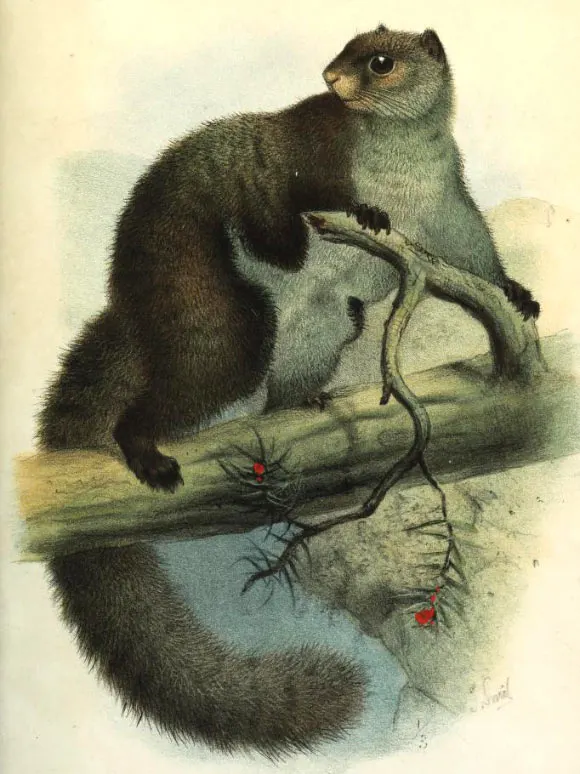
Woolly flying squirrel
Eupetaurus cinereus
The western woolly flying squirrel (Eupetaurus cinereus) is one of the largest gliding mammals alive, a heavy, thick-furred squirrel of high Himalayan forests and cliffs in northern Pakistan and northwestern India. The IUCN Red List assessed it as Endangered in 2021 and puts the population at roughly 1,000 to 3,000 animals.
How to recognise it
This is a very big squirrel. The head and body measure 42 to 60 cm, the tail 43 to 54.5 cm, and adults weigh 1.4 to 2.5 kg. A 2021 science-news report puts the largest animals at about 1.1 m overall. The fur is long, thick and grizzled, which gives the woolly look behind its name.
Despite its bulk it glides well, like smaller flying squirrels. The 2021 revision of the genus found that it has the tallest-crowned cheek teeth of any flying squirrel.
Where it lives
Oldfield Thomas described the species in 1888 from two skins and a skull from northern Pakistan. Its core known range is in the Diamer and Gilgit districts of Gilgit-Baltistan, and it has also been recorded in Azad Jammu and Kashmir. The IUCN lists Pakistan and India, and puts the extent of occurrence at roughly 100,000 square kilometres.
It lives at 2,400 to 4,800 m, in temperate and boreal forest and on steep, rocky slopes with cliffs and caves. In the Jutial and Kargah valleys near Gilgit, it has been associated with cliffs and forest patches of pine, spruce, fir, juniper, ash and birch.
Pins are Wikidata “endemic to” fields. Orange dots, when present, are GBIF occurrence tiles — survey bias included.
A species that split in 2021
For more than a century this was the only known woolly flying squirrel. In 2021, researchers from Australia and China measured and photographed museum specimens, reviewed published records, and combined shape with genetic evidence. They described two more species, the Tibetan woolly flying squirrel and the Yunnan woolly flying squirrel. The squirrel in this account keeps the name Eupetaurus cinereus and is the form found along the western end of the Himalayas, in northern Pakistan and northwestern India.
How it lives
It eats pine needles. A squirrel caught in Gilgit city in 2014 ate needles in captivity, and droppings analysis reported in a 2015 Journal of Threatened Taxa note points to them as its main food. It rests in rocky crevices and reportedly uses caves. Salajit, a dark substance sold as a traditional medicine, collects in cliff crevices where the squirrel is found, and some local people believe the squirrel produces it.
The IUCN gives a generation length of about 5.5 years.
Why it is in trouble
Scientists treated the species as extinct from 1924 to 1994, when it was rediscovered in the Sai Valley in northern Pakistan. Before that, knowledge rested on 11 museum specimens. The IUCN records a continuing decline.
The Red List lists small-holder farming, small-holder plantations and housing as threats. The 2015 note names deforestation, overgrazing and salajit collection, and the Rufford project page adds habitat fragmentation and unsustainable use of alpine pastures. The 2015 note gave 1,000 to 3,000 as an older estimate for Pakistan, from 1997, and said deforestation had reportedly eased in Gilgit-Baltistan through community conservation and more rangers.
What is being done
The IUCN says the squirrel is not known from any protected area, though it has been the subject of education and awareness work. A 2011 project listed by the Rufford Foundation aimed to survey the squirrel and run awareness programmes with schoolchildren and wildlife staff in the Upper Neelum Valley in Azad Jammu and Kashmir. The Red List lists site and area protection and management among needed actions. The 2015 note recommended systematic occupancy surveys.
Sources
Written for this catalog in our own words from the sources below, checked against them on 12 November 2026. Population figures are estimates and carry the year they were made. Status and assessment year: IUCN. 2026. The IUCN Red List of Threatened Species. Version 2026-1. iucnredlist.org.
- IUCN Red List assessment
- Wikipedia, Western woolly flying squirrel
- Wikipedia, Eupetaurus
- Sci.News, Two new species of woolly flying squirrels discovered
- Din et al. 2015, Journal of Threatened Taxa 7(9), note on the giant woolly gliding squirrel in northern Pakistan
- Rufford Foundation project listing, Upper Neelum Valley (2011)




