Critically Endangered
Wilkins's Finch
Nesospiza wilkinsi
Wilkins's finch (Nesospiza wilkinsi), also called the grosbeak bunting, is a heavy-billed songbird found only on Nightingale Island in the Tristan da Cunha group, South Atlantic. The IUCN Red List rated it Critically Endangered in 2021. Estimates of its population range from under 50 to about 200 birds.
How to recognise it
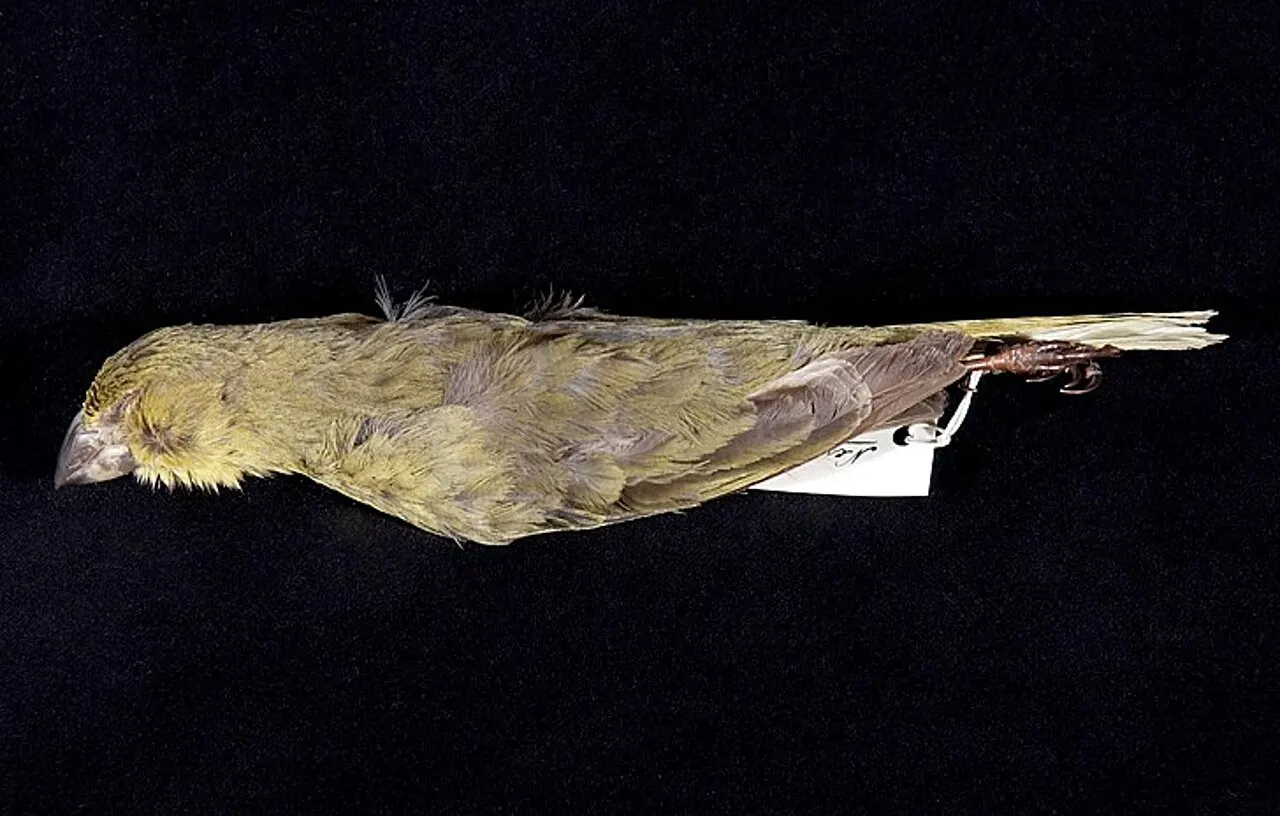
This is the largest bird in its genus, about 20 to 22 cm long and roughly 41 to 53 g. Males are olive-green, with a brighter yellow throat, chin and upper breast. Females are a little smaller and duller, with more streaking, and young birds look like females but buffier and more heavily streaked.
The bill is the giveaway. It is almost twice as deep as that of the Nightingale Island finch (Nesospiza questi), the smaller relative sharing the island, and it is specialised for cracking open woody fruit.
Where it lives
Nightingale is a small, remote island in the Tristan da Cunha archipelago, a British overseas territory. Wilkins's finch is tied to patches of island tree (Phylica arborea), and also forages in the tussock grass nearby. It is commonest around the Ponds area, where the woodland is thickest.
Some accounts also place birds on Inaccessible Island (dunnei) in this species. A UK Overseas Territories Conservation Forum fact sheet instead treats dunnei as a subspecies of the Inaccessible Island finch, which leaves Nightingale as the only home of Wilkins's finch.
Pins are Wikidata “endemic to” fields. Orange dots, when present, are GBIF occurrence tiles — survey bias included.
How it lives
Phylica fruit is the staple. The bird clambers through the canopy and crushes the woody fruits to reach the large seeds inside. It also picks invertebrates from tussock grass, the ground and the undergrowth, and young birds forage mostly in fern-bush.
Adults hold territories from about September to March, and breeding runs from November to January. The female builds a cup nest low down, 25 to 110 cm off the ground, at the base of a tussock or in a fern clump, and lays one or two pale blue eggs with dark brown markings. The male feeds her near the nest. Both parents chase off the Tristan thrush, which eats eggs and chicks.
Why it is in trouble
Numbers are small and estimates differ. One source gave about 100 pairs in 2009, a UK Overseas Territories Conservation Forum fact sheet gives 50 pairs, and the 2021 Red List assessment records a population size in the band of 1 to 49. The assessment rates the trend as decreasing.
With everything on one small island, a single event can do damage. The 2021 assessment lists storms and flooding as an ongoing threat, plus scale insects and a fungus (Seiridium phylicae) that affect the Phylica trees the bird depends on. Introduced New Zealand flax is listed as a past threat that could return. Rats and cats are listed as future threats, and the accidental introduction of predators is a standing worry.
What is being done
Conservation here is mostly prevention. The assessment calls for strict controls on visits to the island, awareness of the dangers of moving soil, plants and animals between islands, and removal of the flax. It also suggests considering a translocation of some birds to Tristan da Cunha (an RSPB suggestion dating from 2021), which would give the species a second site.
As of 2021, the assessment recorded no species recovery plan and no systematic monitoring scheme, and it recommended regular surveys to follow the population.
Sources
Written for this catalog in our own words from the sources below, checked against them on 12 November 2026. Population figures are estimates and carry the year they were made. Status and assessment year: IUCN. 2026. The IUCN Red List of Threatened Species. Version 2026-1. iucnredlist.org.




