Critically Endangered
Wicker ancylid
Rhodacmea filosa
The wicker ancylid (Rhodacmea filosa) is a tiny freshwater limpet from rivers and creeks of Alabama, in the southeastern United States. Listed as extinct for years, it was found alive in 2011. The IUCN Red List rated it Critically Endangered in 2012, from a single known location.
How to recognise it
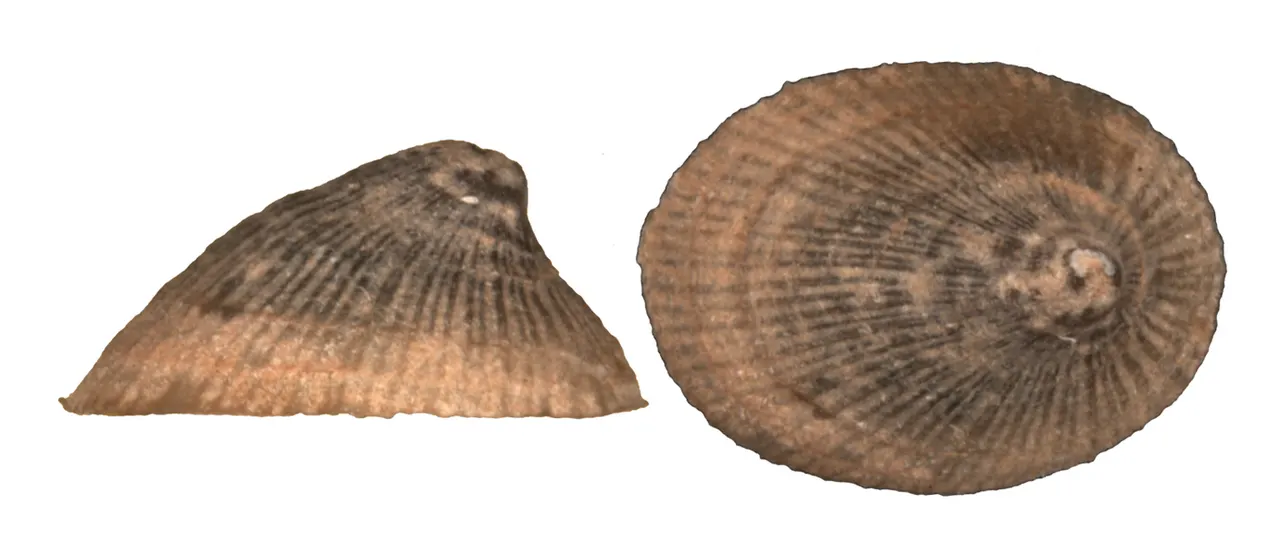
Despite the name, this is not a marine limpet. It is a freshwater snail whose shell is a low cone rather than a coil. The shell is fairly elevated, with strong ribs radiating from the tip to the edge, and one early naturalist described the apex as pink, striated and oddly indented. Timothy Conrad first named the species in 1834.
Shell sizes are rarely given in the sources. In the 2011 rediscovery study, the Choccolocco Creek limpets were much smaller than related limpets from the Green River in Kentucky and the Cahaba River in Alabama, but the paper gives no figures in its text.
Where it lives
The IUCN assessment records it only from Alabama, in permanent rivers and streams, and counts a single location with an extent of occurrence of about 90 square kilometres. Historically it ranged through the Mobile River Basin, and the type locality is the Black Warrior River south of Blount Springs. The 2011 rediscovery came from Choccolocco Creek, a 91 km tributary of the Coosa River.
There the limpets sat on cobble and boulders in shallow, flowing water about 20 cm deep, in the lower part of the watershed. Older accounts of the genus place limpets under large rocks, roughly one to two feet below the summer low-water line, where they graze on algae films, especially diatoms.
Pins are Wikidata “endemic to” fields. Orange dots, when present, are GBIF occurrence tiles — survey bias included.
A species thought lost
Surveys over about 20 years, covering hundreds of sites in the Coosa, Cahaba and Black Warrior drainages, turned up no wicker ancylids, and the IUCN had listed it as extinct. In 2011 a team including Diarmaid O Foighil, writing in PLoS ONE, reported living animals in Choccolocco Creek. They checked them against old reference specimens using shell measurements and DNA.
The same study found related limpets in the Cahaba River and in the Green River at Munfordville, Kentucky. Whether these are one species or several is disputed. The 2011 authors suggested names for the Green and Cahaba populations, while another account describes the paper as proposing to unite all populations under filosa. That is why accounts of where the species lives differ.
Why it is in trouble
The Mobile River Basin has 36 major dams and locks, and 47 of its 139 endemic mollusc species have gone extinct. Choccolocco Creek has three substantial dams and a history of severe industrial pollution, and it is still listed as impaired for PCB and mercury contamination.
The IUCN assessment lists nutrient loads, soil erosion and sediment, and herbicides and pesticides as ongoing threats across the whole range, and notes a continuing decline in the area the species occupies. It found too little information to give a population trend.
What is being done
The assessment lists no conservation actions in place. The 2011 research team urged a proactive, targeted program, which could include captive propagation and reintroduction. They also credited improved water management and anti-pollution policy over the previous three decades for helping some surviving Mobile Basin molluscs recover. NatureServe ranks the species as critically imperiled.
Sources
Written for this catalog in our own words from the sources below, checked against them on 12 November 2026. Population figures are estimates and carry the year they were made. Status and assessment year: IUCN. 2026. The IUCN Red List of Threatened Species. Version 2026-1. iucnredlist.org.




