Endangered
White steenbras
Lithognathus lithognathus
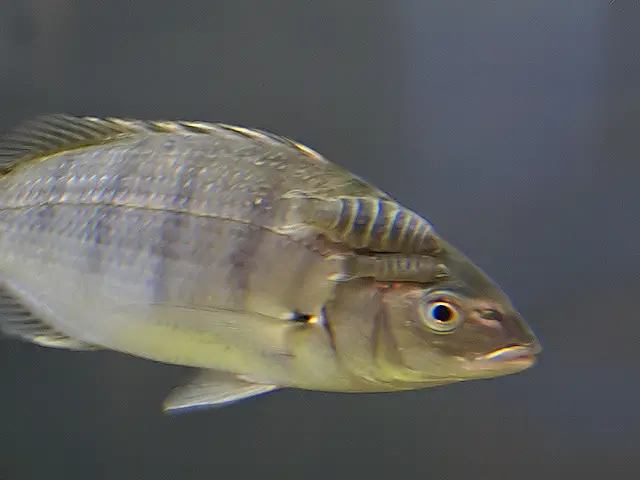
The white steenbras (Lithognathus lithognathus) is a large, silvery sea bream found only along the coast of South Africa. Young fish grow up in estuaries, and adults are a popular catch for anglers. The IUCN Red List rated it Endangered in 2025 after a long population decline.
How to recognise it
A big, silvery fish with a pointed snout, often with a mother-of-pearl sheen. The jaws carry small teeth at the front and larger molars toward the back, which suit hard-bodied prey.
Size figures vary. The Two Oceans Aquarium gives up to about a metre and 30 kg. FishBase lists a common length of 65 cm and a maximum of 200 cm, a figure far above the other source.
Where it lives
The species is endemic to South Africa, known from the Orange River mouth to Natal. The IUCN gives a depth range of 0 to 30 m and lists its habitats as estuaries, sandy and rocky shores, rocky reefs and gravel bottoms.
Estuaries are the nursery. Adults spawn at sea, and young fish move into estuaries to grow.
Pins are Wikidata “endemic to” fields. Orange dots, when present, are GBIF occurrence tiles — survey bias included.
How it lives
It eats bottom-living invertebrates such as worms, crabs and shrimp. It matures at around 54 cm according to FishBase, or at about five years old according to the Two Oceans Aquarium. It is fairly solitary, but at certain times of year large groups gather and run along the coast, for example up the east coast.
A study of seven juveniles, 154 to 184 mm long, fitted with acoustic tags in the Great Fish Estuary found they stayed mostly 5 to 7 km upstream. Each had a home range of about 97,000 square metres and stayed loyal to its capture site.
The IUCN puts a generation at about 13 years. A slow-growing fish that matures late takes a long time to replace what is caught.
Why it is in trouble
The 2025 assessment records a decline, including an estimated past population reduction of about 70 percent. It lists small-scale and large-scale fishing as threats, along with habitat change, temperature extremes and storms. Seine netting in False Bay has reportedly removed breeding shoals.
A 2024 review in the African Journal of Marine Science compared two estuaries. In the Swartkops, adults that were common in 1915 have been lost and the population had collapsed by the late 1900s. The spotted grunter now seems to fill its niche. Knysna held a healthy juvenile population in the 1970s and 1980s, but pressure from anglers and small-scale fishers there is growing and fishing rules are not being followed.
What is being done
The IUCN reports a harvest management plan and occurrence in at least one protected area. The 2024 review says no-take marine reserves appear to have helped adults recover in some parts of the range. It calls for enforcing existing regulations and declaring estuarine protected areas in key juvenile nurseries.
The Two Oceans Aquarium reports that the WWF SASSI seafood guide rates it Red, meaning consumers should not buy it.
Sources
Written for this catalog in our own words from the sources below, checked against them on 12 November 2026. Population figures are estimates and carry the year they were made. Status and assessment year: IUCN. 2026. The IUCN Red List of Threatened Species. Version 2026-1. iucnredlist.org.
- IUCN Red List assessment, Lithognathus lithognathus (2025)
- White steenbras, encyclopedia entry
- Lithognathus lithognathus, FishBase
- White steenbras, Two Oceans Aquarium
- Future of the IUCN Endangered white steenbras: a tale of two estuaries, African Journal of Marine Science (2024)
- First assessment of estuarine space use and home range of juvenile white steenbras, abstract