Endangered
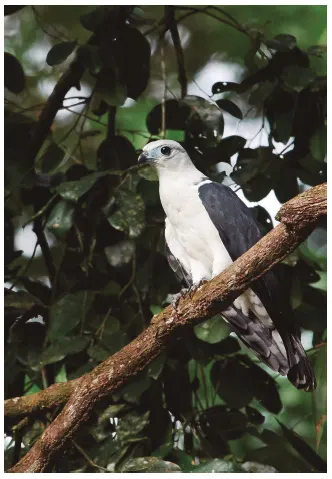
White-collared Kite
Leptodon forbesi
The white-collared kite (Leptodon forbesi) is a rare hawk found only in the Atlantic Forest of north-eastern Brazil, in scattered fragments among sugarcane fields. The IUCN Red List rated it Endangered in 2018, after Critically Endangered ratings from 2000 to 2016. Fewer than 1,000 mature birds are thought to remain.
How to recognise it
A medium-large raptor about 50 cm long, weighing around 550 to 580 g. Adults are white below and blackish above, with white tips on many wing feathers. The head is white, though the crown and sides can be pearl grey. In flight the white leading edge and underwing coverts are very noticeable. The tail is ashy white with a black band and a whitish tip.
The grey-headed kite, a more widespread relative, looks similar but lacks the white head, the white leading edge to the wing and the white underwing coverts. Until the early 2000s the white-collared kite was known from so few records that some experts doubted it was a real species. A flight call is a series of short kua notes.
Where it lives
It is endemic to north-eastern Brazil, with records in Rio Grande do Norte, Paraiba, Pernambuco and Alagoas, and a handful in Sergipe and northern Bahia. Most records come from Pernambuco and Alagoas, in open rainforest and seasonal semi-deciduous forest, often close to streams. It lives from sea level to about 600 m, and has reportedly been seen over mangroves.
A 2019 study in Papeis Avulsos de Zoologia compiled 41 records and modelled the species' range at about 20,300 square kilometres. Only about 1,640 square kilometres of that is forest fragments big enough to count as occupied area, and just 241 square kilometres is legally protected.
Pins are Wikidata “endemic to” fields. Orange dots, when present, are GBIF occurrence tiles — survey bias included.
How it lives
Remarkably little is known. The IUCN does not class it as a migrant, and it has been seen crossing sugarcane fields between forest patches. A single documented hunt involved a swoop from a perch, probably at an insect, and a return to the same perch. What it eats is essentially unrecorded.
Fluttering display flights have reportedly been seen between October and January, and an active nest was found in April. Most other details of its breeding are unknown.
Why it is in trouble
Most of the original forest along this coast has been cleared, mainly for sugarcane and other farming, and small-scale logging continues in some remnants. The IUCN puts the population at 250 to 999 mature individuals in about seven locations. That is a precautionary band: Brazil's 2014 national assessment suggested no more than 2,500. The IUCN records a continuing decline and a severely fragmented population.
Most of the forest patches it uses are on private land inside cane plantations, and the 2019 study found only 15% of the patches are legally protected. The kite has been recorded in urban forests near Joao Pessoa and Maceio, but with no sign of breeding there.
What is being done
The kite is on CITES Appendix II. Some records come from private reserves, and the IUCN notes that conservation sites have been identified across its range, although no species recovery plan or monitoring scheme was in place at the time of the 2018 assessment.
The 2019 study recommends new protected areas, including private ones, forest restoration to link the best fragments, and captive breeding. It names the Murici Ecological Station and the Frei Caneca private reserve among the priority sites.
Sources
Written for this catalog in our own words from the sources below, checked against them on 12 November 2026. Population figures are estimates and carry the year they were made. Status and assessment year: IUCN. 2026. The IUCN Red List of Threatened Species. Version 2026-1. iucnredlist.org.




