Critically Endangered
Werneria bambutensis
Werneria bambutensis
The Bambouto torrent toad, also called the Bamboutos smalltongue toad, is a small stream toad found only in the mountains of western Cameroon. The IUCN lists it as Critically Endangered (assessed 2018, population decreasing). Surveys on Mount Bamboutos have not found it for well over a decade.
How to recognise it
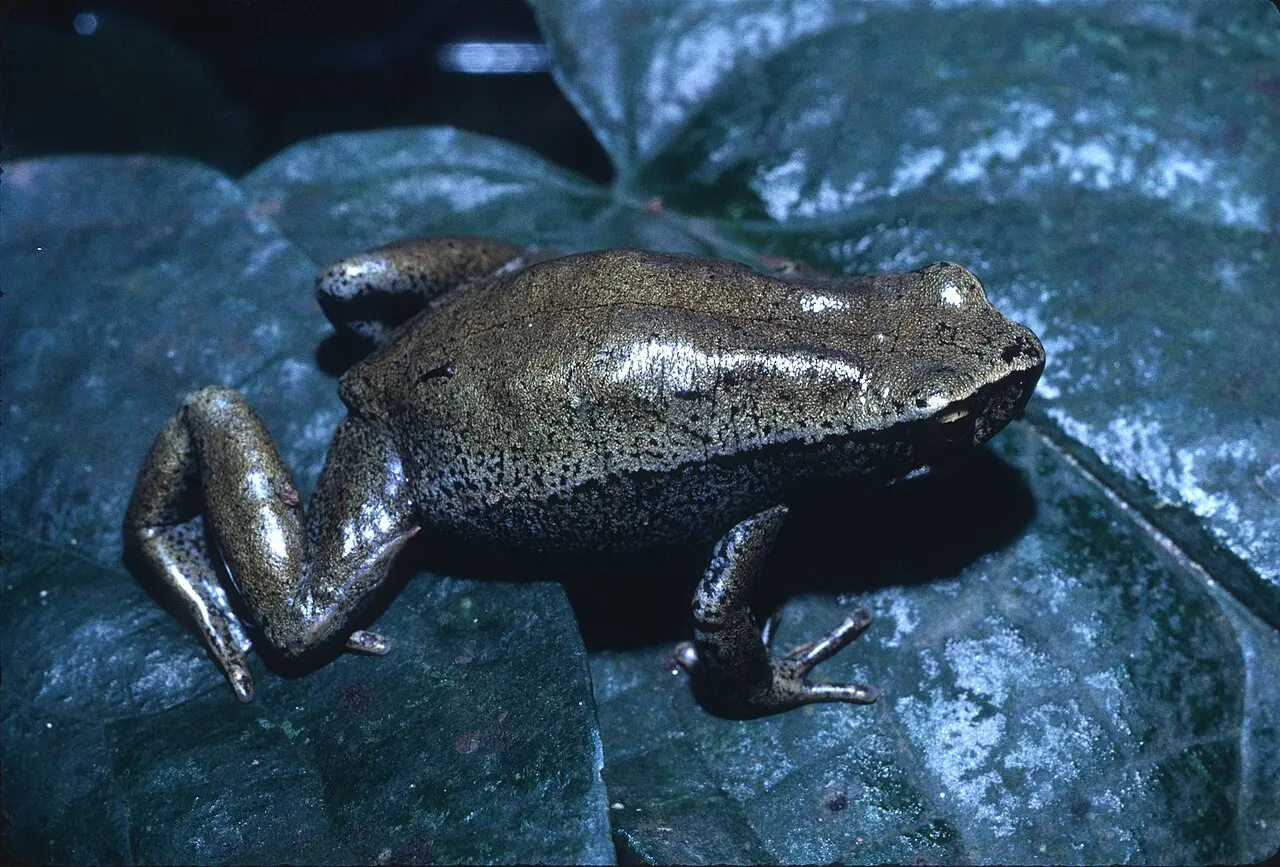
This is a compact toad with short, thick legs and a short, rounded snout. Males reach about 33 millimetres from snout to vent and females about 38. There is no visible eardrum, and the toes are fully webbed, a useful trait in fast water.
The back and flanks range from dark greenish olive to clear bronze, with a gold shimmer or blackish speckles. The underside is grey to white with grey spots.
Where it lives
It is endemic to western Cameroon, in highlands between Mount Manengouba and Mount Oku that include the Bamboutos Mountains, which gave the species its name. The IUCN gives an elevation range of 1,750 to 2,600 metres and counts two locations.
Its home is fast-flowing streams, mostly within patches of montane forest. Outside the breeding season adults move away from the water into nearby forest, bamboo glades and high grassland. In the dry season they may shelter under stones in the streams.
Pins are Wikidata “endemic to” fields. Orange dots, when present, are GBIF occurrence tiles — survey bias included.
Why it is in trouble
The toad is rare, and the IUCN records a decreasing population. Much of the mountain forest has been converted to crop fields, pasture and Eucalyptus plantations. The IUCN lists small-holder farming, grazing, housing, pesticides and increased fire as pressures. Amphibian declines on the neighbouring Mount Oku and Mount Manengouba have been linked to the chytrid fungus, and researchers suspect it could be involved on Bamboutos too, though that is not settled.
A survey on Mount Bamboutos from 2014 to 2016, published in the journal Oryx, found 10 amphibian species but no Bambouto torrent toads. It was among six species with earlier records that went unseen, and its last sighting on the mountain dated to 2006. A later project funded by the Rufford Foundation searched eight forest patches, took 80 water samples for environmental DNA and again found no individuals. Cattle disturbing breeding streams, bush fires and farm chemicals are among the suspected causes.
What is being done
None of the natural habitat on Mount Bamboutos has official protection, and the IUCN records it as unknown whether the toad occurs in any protected area. Actions called for include site and habitat protection and captive breeding.
The Rufford project worked with local communities, and farmers gave up one hectare of degraded land along breeding streams for replanting. Its report raises the possibility that the toad has gone from the mountain, or from the wild altogether, and recommends monitoring the whole mountain rather than only the old collecting sites.
Sources
Written for this catalog in our own words from the sources below, checked against them on 12 November 2026. Population figures are estimates and carry the year they were made. Status and assessment year: IUCN. 2026. The IUCN Red List of Threatened Species. Version 2026-1. iucnredlist.org.




