Critically Endangered
Wattle-necked softshell turtle
Palea steindachneri
The wattle-necked softshell turtle (Palea steindachneri) is a large freshwater turtle from southern China, northern and central Vietnam and Laos. The IUCN Red List rated it Critically Endangered in 2021 because wild numbers have fallen steeply under hunting for food, even though thousands are bred on farms.
How to recognise it
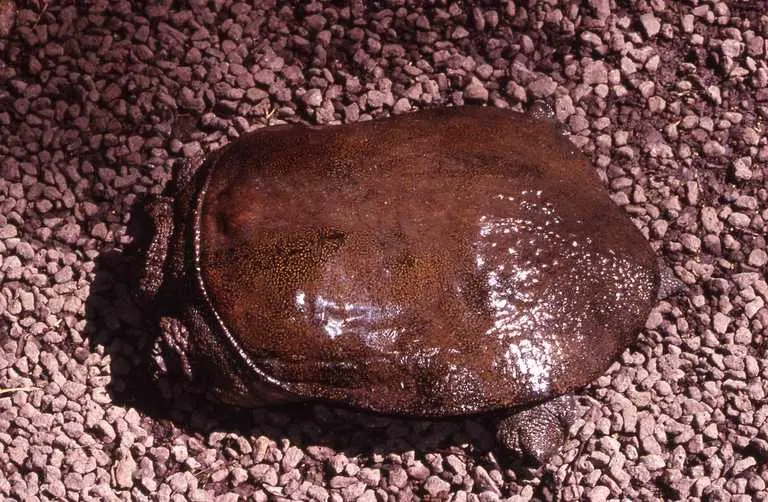
Like other softshells, it has a flat, leathery shell rather than a hard carapace. Males and females differ in size. Females reach a straight shell length of up to about 44.5 cm and males up to about 36 cm, and males have longer tails.
It is the only species in its genus, Palea. It also goes by the name Steindachner's softshell turtle.
Where it lives
The native range takes in Guangdong, Guangxi, Guizhou, Hainan and Yunnan in southern China, plus Vietnam and Laos. The Red List also records introduced animals in Hong Kong, Hawaii and Mauritius.
The assessment names permanent rivers and streams, permanent freshwater lakes and moist lowland forest as habitat, from sea level to about 436 m. In Vietnam, a 2024 report in the Herpetological Journal gave the first direct field observations of the species in its native range, made in Pu Mat National Park, where turtles were found in slow water in a sandy stream. Earlier knowledge had come mostly from interviews with local people.
Pins are Wikidata “endemic to” fields. Orange dots, when present, are GBIF occurrence tiles — survey bias included.
How it lives
Life in the wild is poorly documented, although the species is common on farms and in the turtle trade. The Red List gives a generation length of 15 to 20 years, and lists life history and ecology among the research still needed.
Why it is in trouble
Harvest for food is the main problem. The Red List scores subsistence and small-scale harvest, both intentional and incidental, as high impact with very rapid declines across most or all of the range. Its use as human food is recorded at national and international level. Small and large dams and renewable energy projects are also listed, with unknown severity.
The assessment records an estimated 80 percent population reduction, linked to exploitation and to loss of range and habitat quality, and says the decline is continuing.
Farming has not saved wild populations. Several thousand turtles are reportedly hatched on farms in China and Vietnam each year for food and traditional medicine. A report published in 2000 described a farm at Tunchang on Hainan, set up in 1983, which started with about 10 turtles taken from the wild and held about 500 by then.
What is being done
The species is covered by international trade controls (CITES Appendix II) and occurs in at least one protected area. The assessment lists site protection, harvest and trade management, national and local regulation, livelihood alternatives and site management among its conservation actions. No population estimate is recorded.
Sources
Written for this catalog in our own words from the sources below, checked against them on 12 November 2026. Population figures are estimates and carry the year they were made. Status and assessment year: IUCN. 2026. The IUCN Red List of Threatened Species. Version 2026-1. iucnredlist.org.




