Endangered
Waigeo Brush-turkey
Aepypodius bruijnii
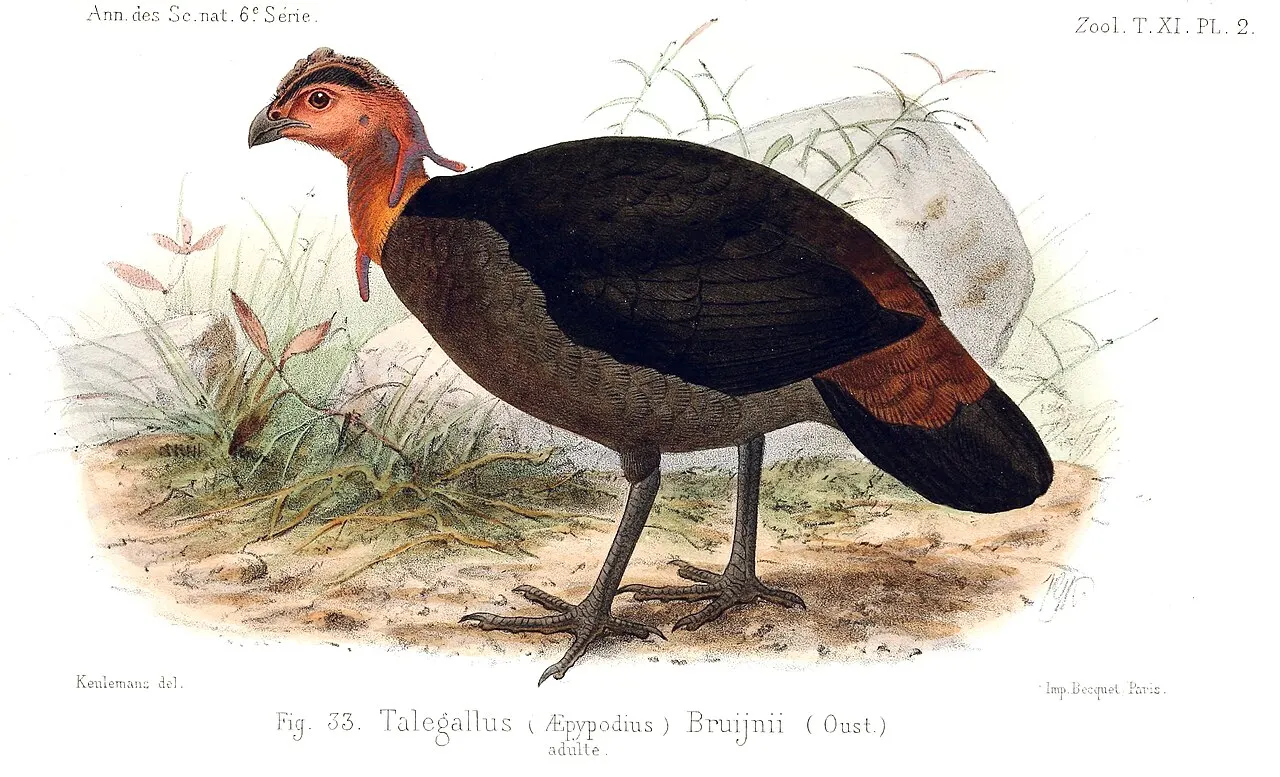
The Waigeo brush-turkey is a large, dark ground bird with a red face and wattles, found only in the mountain forests of Waigeo, an island off the western tip of New Guinea in Indonesia. The IUCN Red List assessed it as Endangered in 2021, with a small, declining population of roughly 977 mature birds.
How to recognise it
It's a megapode, one of the mound-building birds, and it's big for a forest bird at about 43 cm long. The plumage is dark brown to blackish, with chestnut underparts and a maroon rump. The bare facial skin carries a small red comb and red wattles. The sexes look alike, though the female has a smaller comb and lacks the head wattles.
The French zoologist Émile Oustalet described the species in 1880. The name Bruijn's brush-turkey, used in some books, honours the Dutch merchant Anton August Bruijn.
Where it lives
Waigeo is part of the Raja Ampat group in West Papua, and the bird is found nowhere else. A field study by Iwein Mauro, published in 2006, found it nesting only on the island's highest summits, above about 620 m. The IUCN assessment gives an elevation range of roughly 620 to 970 m.
The habitat there is stunted, wind-shorn cloud forest growing on poor soils. Mauro estimated that suitable forest covers only about 60 square kilometres across six locations, with 98 percent of the birds in three eastern ones.
Pins are Wikidata “endemic to” fields. Orange dots, when present, are GBIF occurrence tiles — survey bias included.
A species lost, then found again
For a long time almost nothing was known of this bird. Fewer than 25 specimens existed, and the last records from the late 1870s were followed by decades of silence. A 1938 sighting was reported in 1940, but the first observation in the wild by a modern researcher came only in 2002, when Mauro saw it. A first photograph of a wild bird was reported in 2007.
Mauro's 2006 study confirmed breeding at only two locations. Like other megapodes, males tend incubation mounds, heaps of earth and plant matter in which eggs are buried and warmed by the heat of decay.
Why it is in trouble
Mauro's 2006 estimate was 349 mound-owning males, or about 977 mature birds in total. Only 47 mound-owning males (84 mature birds) were actually recorded. He argued that the species had been rated too lightly, and in 2008 the IUCN moved it from Vulnerable to Endangered. The 2021 assessment lists the population trend as decreasing and keeps the 977 figure.
The assessment lists small-scale hunting, loss and alteration of forest, drought and more frequent fires as threats. Mauro named wildfire and a recent surge in logging as the main drivers of habitat loss. BirdLife's species page also lists introduced pigs and dogs, and mining, among the pressures.
What is being done
The IUCN assessment records that the species occurs in a protected area, with 91 to 100 percent of the population inside protected land. It also records that no recovery plan or systematic monitoring scheme exists, and that none are held in captivity. Protection on paper has not yet been matched by systematic counts, so how the population is really changing remains hard to judge.
Sources
Written for this catalog in our own words from the sources below, checked against them on 12 November 2026. Population figures are estimates and carry the year they were made. Status and assessment year: IUCN. 2026. The IUCN Red List of Threatened Species. Version 2026-1. iucnredlist.org.




