Endangered
Volcano rabbit
Romerolagus diazi
The volcano rabbit (Romerolagus diazi) is one of the smallest rabbits on Earth, living only on the high, grassy slopes of a few volcanoes near Mexico City. The IUCN Red List has it as Endangered (assessed 2019), with about 7,000 animals left and a declining trend.
How to recognise it
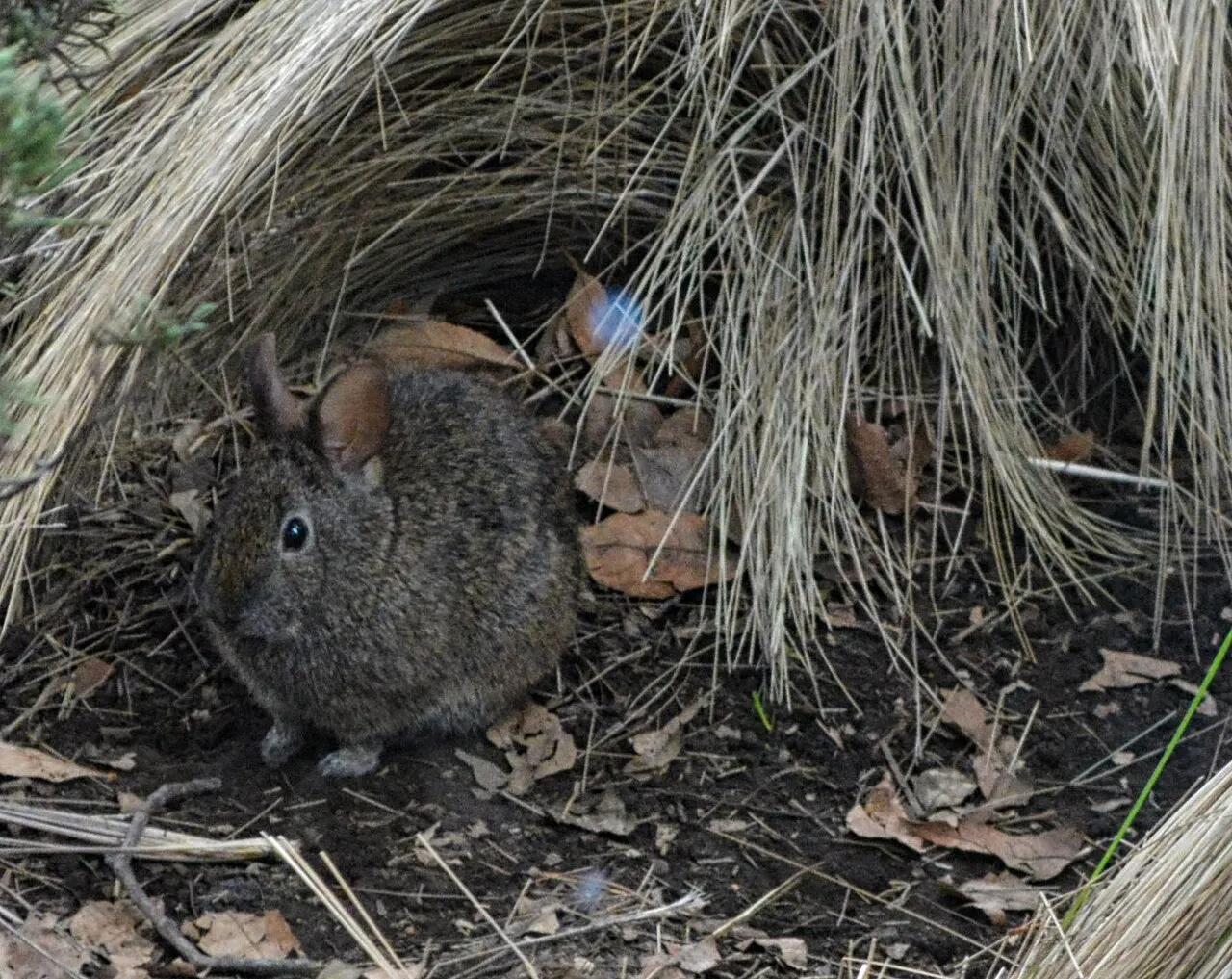
It's a small, compact rabbit. Adults weigh roughly 390 to 600 grams and measure about 23 to 31 centimetres. The ears are short, under 4 centimetres, and the tail is so reduced that it only shows in young animals.
The fur is dense and short, yellowish brown with darker bases and tips. When something alarming appears, the rabbit gives a high-pitched call, a habit that's unusual among rabbits and one it shares with pikas.
Local names include teporingo, zacatuche and conejo de los volcanes. Zacatuche comes from Nahuatl words for grass and rabbit. The origin of teporingo is less clear.
Where it lives
The species is found nowhere else but Mexico. The IUCN lists it as present in Mexico City, the State of Mexico, Morelos, Puebla and Tlaxcala. It lives in temperate forest and grassland on volcanic mountains southeast of Mexico City, including Mount Tláloc inside Iztaccíhuatl-Popocatépetl National Park, at roughly 2,900 to 4,250 metres.
Its range is small and broken up. The 2019 assessment puts the area it actually occupies at about 335 square kilometres, inside a wider extent of about 2,469. It counts 19 subpopulations and records the population as severely fragmented. Another estimate gives 386 square kilometres, so figures differ.
It once lived in more places. A survey of Nevado de Toluca, another volcano in the State of Mexico, sampled 1,807 units between April 2016 and November 2017. Dung that could belong to the species turned up in 41 of them, but camera traps never recorded a volcano rabbit. Mexico News Daily reported in 2018 that researchers had declared it locally extinct there, with a single sighting in August 2003 as the last.
Pins are Wikidata “endemic to” fields. Orange dots, when present, are GBIF occurrence tiles — survey bias included.
How it lives
Volcano rabbits dig burrows that can reach about 5 metres long and 40 centimetres deep. They eat grasses, and one study found the bunchgrass Muhlenbergia macroura in 89 percent of the droppings it examined. Grass alone doesn't meet their energy and protein needs, so they also take flowers, seeds, roots, leaves and bulbs.
They live in small groups of two to five. They're active mostly in the early morning and evening, though groups have occasionally been seen around midday. Bobcats and coyotes prey on them in Iztaccíhuatl-Popocatépetl National Park.
Pregnancy lasts about 39 days and litters hold up to three young. A female can have four or five litters a year, and young are weaned at about four weeks. Wild adults are thought to live less than a year.
Why it is in trouble
The main problem is the loss and breaking up of its habitat. The Red List threat entries include small-holder grazing and farming, shifting agriculture, roads, utility lines, housing, mining and recreation. At Nevado de Toluca, livestock grazing and deliberate burning were both linked to fewer droppings, and Mexico News Daily said forest cleared for potato farming and growing towns had removed much of the habitat.
Hunting is also a concern. The IUCN lists use of the species for human food, and hunting is reportedly illegal in Mexico but poorly enforced. Volcanoes themselves appear among the listed threats.
Visitors can add pressure. In 2020 Mexico News Daily reported that the national park authority said crowds on Mount Tláloc, more than 3,500 in one weekend at a site that copes with about 200 a day, were damaging the alpine grassland where the rabbit lives. Earlier population estimates ran from 11,000 to 25,000, while the 2019 figure is about 7,000. The methods differ, so it isn't a clean before-and-after.
What is being done
The species is on CITES Appendix I and is reportedly listed as Endangered by the Mexican government. The IUCN records that conservation sites have been identified across its whole range, that education programmes exist and that it is bred in captivity. It also lists genome resource banking and reintroduction among actions in place or needed. It records no recovery plan and no systematic monitoring scheme.
The best-known breeding group is at Chapultepec Zoo in Mexico City. A genetic comparison found it had lost variation relative to wild rabbits after about 20 generations. Gerald Durrell's attempt at Jersey Zoo in 1968 failed. In 2022 Pulse News Mexico reported that a Twitter user, using a public records request, alleged more than 1,000 teporingo deaths at Chapultepec since 2012, falling from 420 in 2012 to 40 in 2018. The report included no response from officials, so treat the figures as allegations.
Eruptions at Popocatépetl are said to have reduced human visits, which has helped some populations recover.
Sources
Written for this catalog in our own words from the sources below, checked against them on 11 November 2026. Population figures are estimates and carry the year they were made. Status and assessment year: IUCN. 2026. The IUCN Red List of Threatened Species. Version 2026-1. iucnredlist.org.
- IUCN Red List assessment, Romerolagus diazi (2019), via API structured fields
- Volcano rabbit, Wikipedia
- GBIF species match, Romerolagus diazi
- Monroy-Vilchis et al. 2020, Nevado de Toluca: habitat for Romerolagus diazi?, Animal Biodiversity and Conservation 43
- Mexico News Daily, Volcano rabbit declared extinct due to lost habitat (29 Sept 2018)
- Mexico News Daily, Endemic rabbit threatened by hordes of volcano gawkers (13 Feb 2020)
- Pulse News Mexico, Mexico City Government Collects Millions for Deaths of Endangered Rabbits (20 Sept 2022)




