Endangered
Vinodolia matjasici
Vinodolia matjasici
Anagastina matjasici, long catalogued as Vinodolia matjasici, is a tiny freshwater snail known from just four springs and caves around Lake Skadar in Montenegro and Albania. The IUCN Red List assessed it as Endangered in 2026, citing its small range and the abstraction of spring water.
How to recognise it
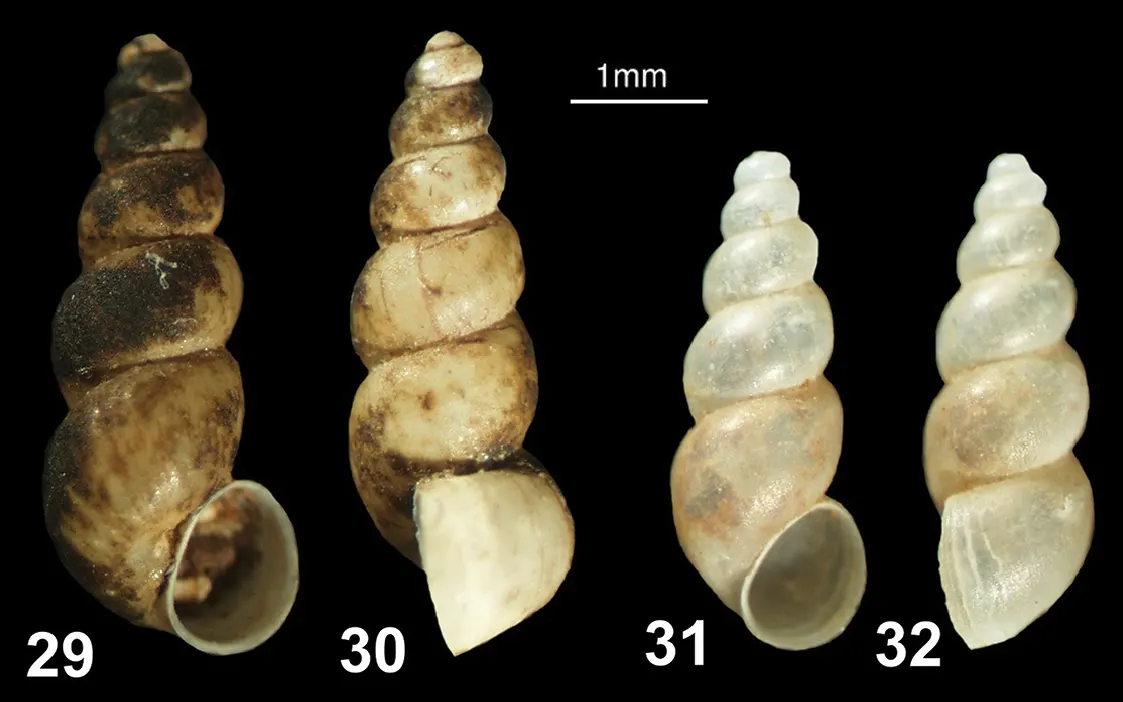
This is a slender, tower-shaped shell with a rounded opening, built of several smoothly swelling whorls. In the photographs published in 2017 the shells stand only a few millimetres tall (the photo scale bar is 1 mm). Some are pale and almost glassy, others honey-coloured with dark brown to blackish patches.
That paper notes that brown or black coatings are often seen on the shells of underground snails, and suggest they are iron and manganese oxides left by the microbes the snails feed on. The species belongs to the family Hydrobiidae, a large group of small freshwater snails.
Where it lives
The zoologist Bole described it in 1961 as Iglica matjasici, from a small spring near Rijeka Crnojevica in Montenegro. Later authors moved it through several genera, including Anagastina and Vinodolia, and databases still disagree on the name. The IUCN uses Anagastina matjasici.
Until 2016 it was known from three Montenegrin sites: Lipovik Spring near Rijeka Crnojevica, Vilina Cave near Virpazar, and Vitoja Spring. On 27 June 2016 a team collected it at Syri i Sheganit, a spring beside Lake Skadar at Bajze in northern Albania, only 10 m above sea level. A 2017 paper in Subterranean Biology reported that record, which confirmed the species in Albania. The IUCN counts four locations, an area of occupancy of 16 square kilometres and an extent of occurrence of 239 square kilometres.
The 2017 paper noted that shell size and shape differ a little between the populations. With so few specimens it treated all of them as one species for now.
Pins are Wikidata “endemic to” fields. Orange dots, when present, are GBIF occurrence tiles — survey bias included.
How it lives
Very little has been written about this particular snail. The IUCN lists its habitat as karst and other underground water systems, and the Albanian record comes from a spring.
For underground snails of this group, the 2017 paper presumes that food is mostly microbes living on iron and manganese compounds in groundwater, and that the absence of daylight and a steadier environment helped drive their move underground. Nothing specific to this species has been tested.
Why it is in trouble
The assessment applies criterion B1ab(iii)+2ab(iii), which covers small ranges with few locations and a continuing decline in habitat quality. The one threat recorded is the abstraction of surface water for domestic use. The overall population trend is recorded as unknown and no population size has been estimated.
The status has shifted over time. The IUCN rated the species Critically Endangered in 2010 and Endangered in 2026. Whether it occurs in a protected area is recorded as unknown, and no conservation actions are listed.
Sources
Written for this catalog in our own words from the sources below, checked against them on 12 November 2026. Population figures are estimates and carry the year they were made. Status and assessment year: IUCN. 2026. The IUCN Red List of Threatened Species. Version 2026-1. iucnredlist.org.




