Endangered
Victaphanta compacta
Victaphanta compacta
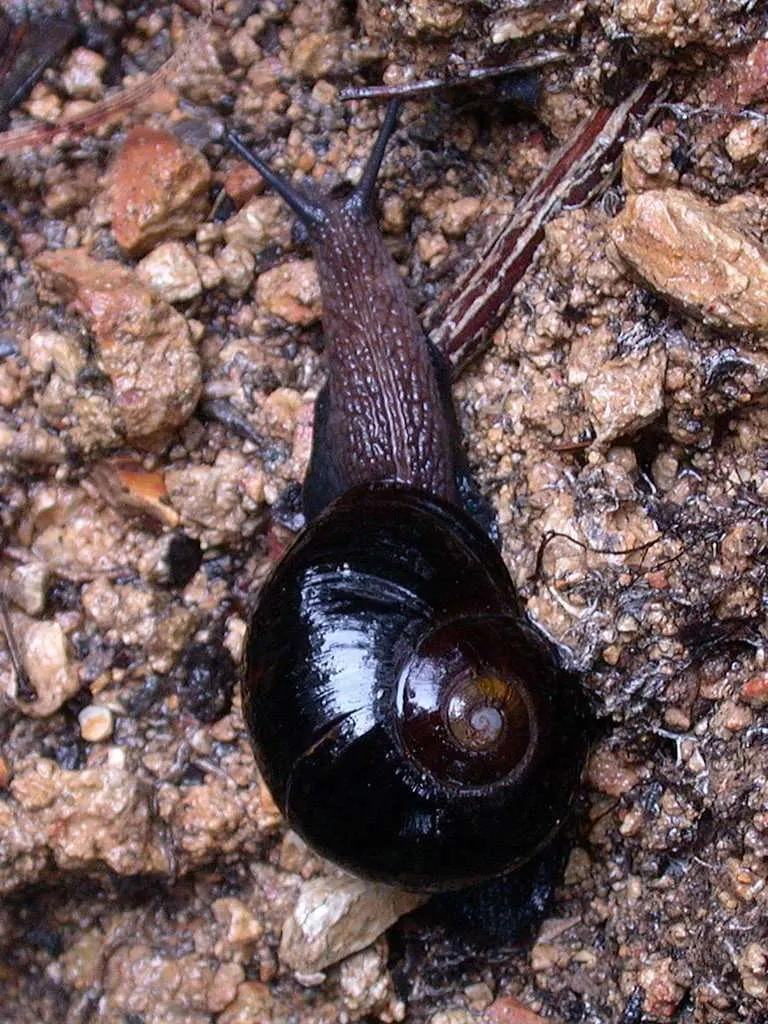
The Otway black snail (Victaphanta compacta) is a glossy, dark-shelled land snail that hunts other snails and worms. It lives only in the wet forests of the Otway Ranges in Victoria, Australia. The IUCN Red List assessed it as Endangered in 1996, and drought, fire and forest disease threaten its small, damp range.
How to recognise it
For a land snail it is large, with a rounded shell up to 28 mm across. The shell is thin, light and slightly flexible, shiny dark brown to black, with a yellow-brown tint around the spire. The body is grey-blue to black.
Its relatives in the genus Victaphanta have an orange frill along the foot and leave orange mucus. This species has neither. Four other meat-eating snails of its family (Rhytididae) also live in the Otways, but this is the only one found nowhere else, and the only one with a glossy dark shell.
Where it lives
The species is known only from the Otway Ranges. Its stronghold is an area of about 900 square kilometres running south between Lorne, Gellibrand and Lavers Hill.
It uses wet forest, cool temperate rainforest and the zone where the two meet. Wet forest here is mostly mountain ash over ferns, and the rainforest is myrtle beech over soft tree-ferns. The snail is most often found at the base of trees and tree-ferns and in deep leaf litter. It is less likely to turn up in rotting logs and is rarely found 2 m or more above the ground.
Pins are Wikidata “endemic to” fields. Orange dots, when present, are GBIF occurrence tiles — survey bias included.
How it lives
It is a predator and active partly at night, though it can be seen by day in cool, damp weather. Prey includes other snails, slugs, earthworms and soft-bodied insect larvae, but not its own kind.
It has no jaw. Rows of long, sharp, backward-pointing teeth on its tongue-like radula hold prey while it feeds. Females lay clutches of small white eggs, 2 to 3 mm across, with hard shells. Nobody has measured its lifespan. Related snails are thought to live about 2 to 8 years.
Why it is in trouble
The snail needs moisture and dries out easily. Two years of below-average rainfall in 2014 and 2015 added strain, and a long dry spell can shrink the forest it can use. Its small range also leaves it exposed to a single severe fire. The Christmas Day bushfire of 2015 burnt an area that included some of its habitat.
Habitat damage from myrtle wilt disease and from disturbance of the forest floor and canopy, such as logging and road building, is also listed as a threat. The 1996 IUCN assessment gave criterion A2c, which relates to a suspected decline in habitat area and quality.
How many snails remain is not known. No regular surveys track the population. Records suggest it is rare and may have contracted in the north of its range. Recent records are sparse: three in 2023 and one in May 2024, none of more than a single animal.
What is being done
Timber harvesting in the Otways was phased out by 2008. After a 2005 public land investigation, the Great Otway National Park and Otway Forest Park were created, which brought much more of its habitat into protected land. It is listed as Endangered under Victoria's Flora and Fauna Guarantee Act (2025 list) but is not listed under Australia's national environment law.
Sources
Written for this catalog in our own words from the sources below, checked against them on 12 November 2026. Population figures are estimates and carry the year they were made. Status and assessment year: IUCN. 2026. The IUCN Red List of Threatened Species. Version 2026-1. iucnredlist.org.




