Critically Endangered
Ventsia tricarinata
Ventsia tricarinata
Ventsia tricarinata is a tiny sea snail that lives around deep hydrothermal vents in the Lau Basin of the southwest Pacific, in waters off Tonga. The IUCN Red List assessed it in 2021 as Critically Endangered because it is known from a single location, where seabed mining is the threat.
How to recognise it
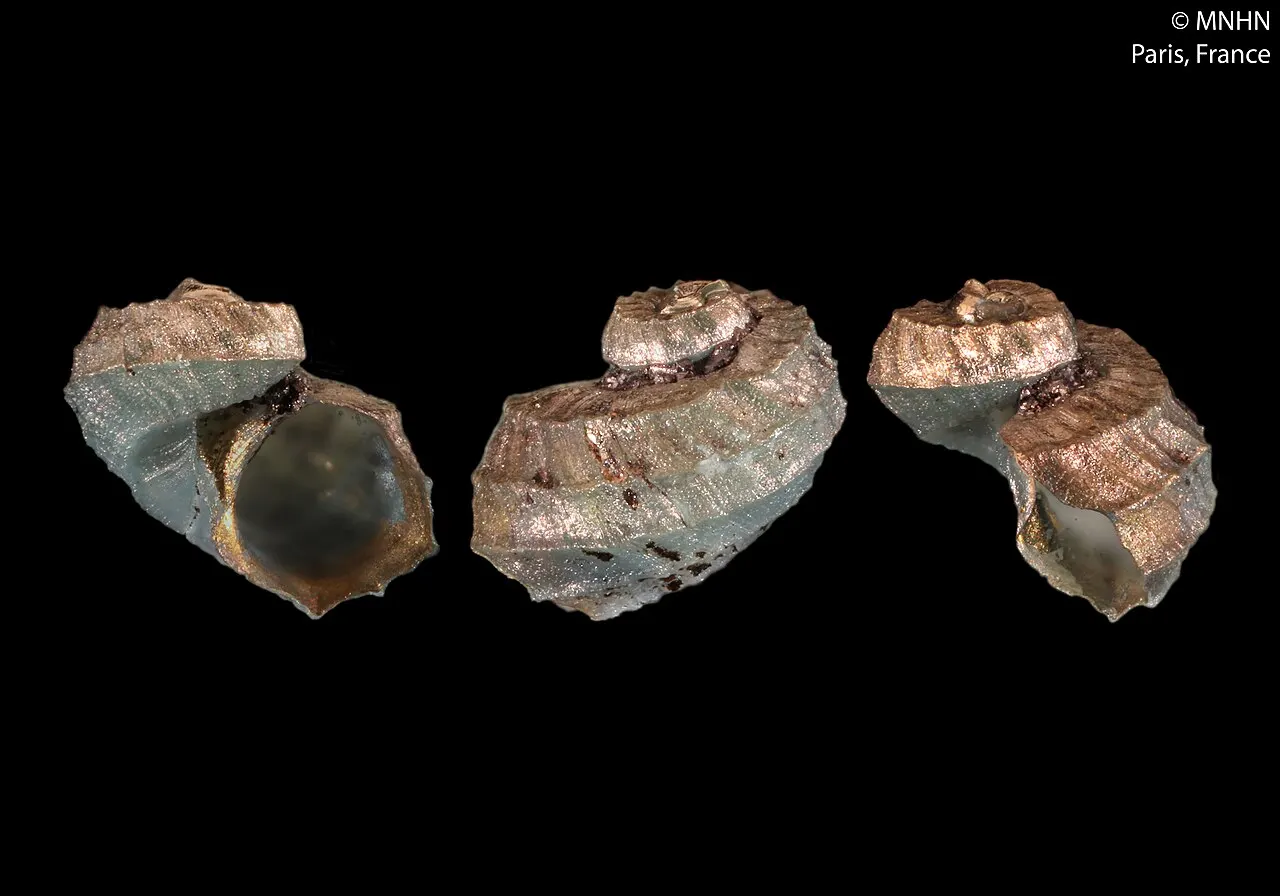
It is a small coiled snail of the kind zoologists call skeneimorph. Anders Warén and Philippe Bouchet described it in 1993. It was first placed in the family Skeneidae, but later molecular data suggested a basal position within the superfamily Seguenzioidea, and its family is still unassigned. No shell size is given in the sources available.
A 2016 study in the Journal of Molluscan Studies reconstructed its anatomy from thin tissue sections and 3D models, the fullest account yet for a snail of this group. It found two tentacles on the right side of the neck, separate sense organs on the epipodium, and a two-part seminal receptacle on the left side of the mantle roof. The male reproductive system could not be found in that material.
Where it lives
The IUCN assessment gives a depth range of 1,750 to 1,900 metres and names two vent fields in the Lau Basin, Vai Lili and Hine Hina, where it lives around active black smokers and areas of gentler venting. These fields lie in Tonga's national waters, and the snail is present over only a small area of them. It is also reportedly found off Fiji, which the Red List does not record.
The snails have been sampled only by remotely operated vehicles, so little is known about their numbers.
Pins are Wikidata “endemic to” fields. Orange dots, when present, are GBIF occurrence tiles — survey bias included.
Why it is in trouble
Under the Red List rules (criterion B), a species with a very small range, one location and a habitat expected to decline qualifies as Critically Endangered. This snail was listed under criteria B1ab(iii)+2ab(iii) in 2021 as part of a global assessment of vent molluscs. That study covered 184 species and found 114 of them, about 62 per cent, to be threatened, with 39 Critically Endangered. In the Southwest Pacific, about 96 per cent of vent species were in a threatened category.
The only threat listed for Ventsia tricarinata is mining and quarrying. Tonga has granted exploratory licences for the Lau Basin to two companies, and the assessment expects any mining to cause habitat degradation, disturbance and deaths of animals, including through sediment plumes that could smother neighbouring seabed. The population trend is unknown, and no population size has been estimated.
What is being done
The assessment says no conservation actions are currently in place at any vent field in Tonga's waters. It recommends specific national and international rules to protect deep-sea habitats, and more research on how mining would affect the populations and whether the snail lives at other vents. It says the listing would be reassessed if Tonga were to adopt a moratorium on deep-sea mining.
Sources
Written for this catalog in our own words from the sources below, checked against them on 12 November 2026. Population figures are estimates and carry the year they were made. Status and assessment year: IUCN. 2026. The IUCN Red List of Threatened Species. Version 2026-1. iucnredlist.org.




