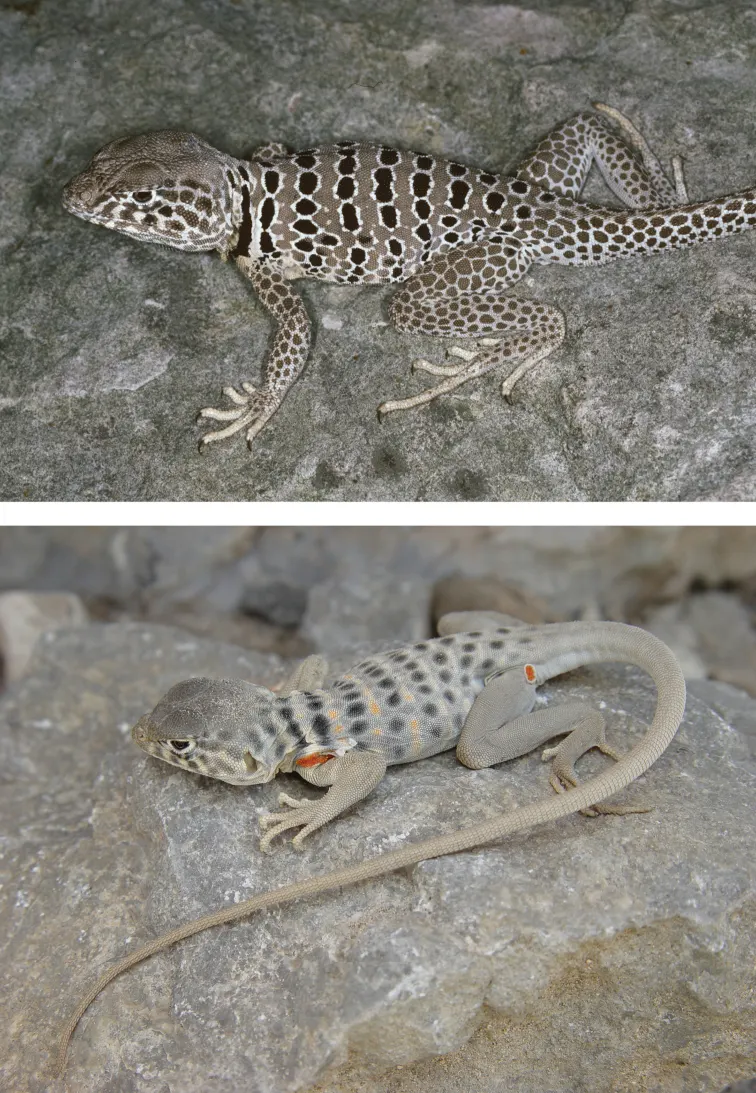
Endangered
Venerable collared lizard
Crotaphytus antiquus
The venerable collared lizard (Crotaphytus antiquus) is a collared lizard that lives only in the rocky hills of southwestern Coahuila, in northern Mexico. The IUCN Red List rates it Endangered (assessed 2007) with a decreasing population. Quarrying is the threat the assessment names, and the species has a very small range.
How to recognise it
This is one of the collared lizards, the family Crotaphytidae, and it was only described as a new species in 1995, by the herpetologists R. W. Axtell and R. G. Webb. Several features set it apart from its relatives. The lining of its mouth is black, and its tail is round in cross section rather than flattened from side to side, with no white stripe running down the middle of the back. Its skin carries a network of white lines enclosing dark pigment.
Females are more subdued in colour than males. Females carrying eggs show their breeding colour only on the front part of the belly, roughly the first 15 to 50 percent of its length.
Where it lives
The species is found only in Mexico, and within Mexico only in the southwest of Coahuila. A 2016 survey of the state's amphibians and reptiles lists it among six amphibians and reptiles found nowhere else in Coahuila. It is tied to the Sierra San Lorenzo, the Sierra Solis and the Sierra Texas, though published accounts differ on whether the last of these is listed separately. The original specimen came from the Sierra Texas near Vizcaya, at about 1,100 metres above sea level.
A 2012 modelling study in the Journal of Arid Environments describes it as restricted to small areas of rocky hills in the centre of the Chihuahuan Desert. The IUCN assessment records the habitat as dry subtropical or tropical shrubland and hot desert.
Pins are Wikidata “endemic to” fields. Orange dots, when present, are GBIF occurrence tiles — survey bias included.
How it lives
It lays eggs. Few details of its daily life have been published, but a laboratory study in Copeia in 2006 looked at how males settle disputes. Researchers staged contests between males of matching body size. The winners bit harder, while body measurements did not differ between winners and losers. Bite strength rather than size appeared to decide who dominated.
Why it is in trouble
The Red List assessment names mining and quarrying as the threat. Gravel extraction for building materials near towns and cities is reportedly the main form. The listing criteria, B1ab(iii)+2ab(iii), reflect a small range with habitat that is declining in quality.
The 2012 study found a high degree of human transformation of land within the lizard's range. Its model, run under one climate scenario, projected a significant reduction of the species' distribution by 2050, and its researchers recommended immediate conservation action.
What is being done
The Red List assessment lists site protection and site management as conservation actions. It gives no population estimate, recording only that numbers are decreasing, and the assessment dates from 2007, so the present situation may differ.
Sources
Written for this catalog in our own words from the sources below, checked against them on 12 November 2026. Population figures are estimates and carry the year they were made. Status and assessment year: IUCN. 2026. The IUCN Red List of Threatened Species. Version 2026-1. iucnredlist.org.
- IUCN Red List assessment, Crotaphytus antiquus (2007)
- Venerable collared lizard, encyclopedia entry
- The Reptile Database, Crotaphytus antiquus
- Effects of land-cover transformation and climate change on two endemic lizards, Journal of Arid Environments 2012 (abstract)
- Lemos-Espinal and Smith 2016, Amphibians and reptiles of Coahuila, ZooKeys
- Husak et al. 2006, Copeia 2006(2): 301-306 (abstract)




