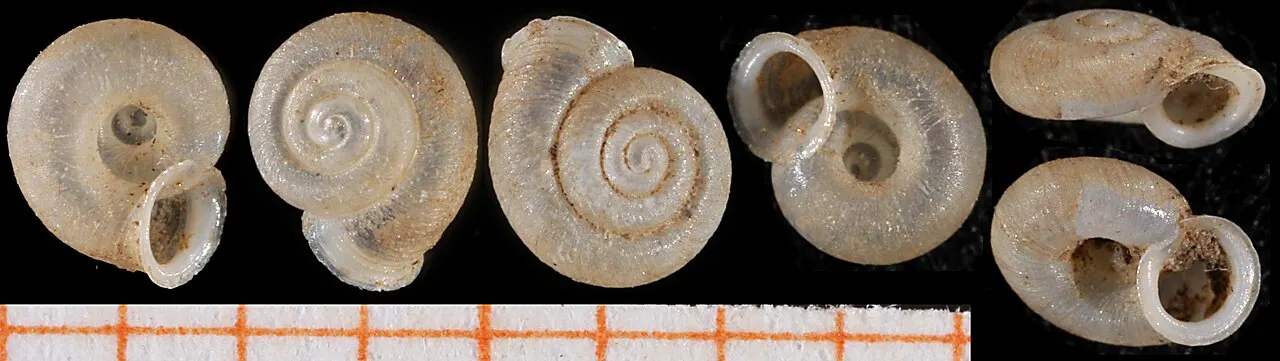
Endangered
Vallonia suevica
Vallonia suevica
Vallonia suevica is a small air-breathing land snail of central Europe, recorded mainly in Germany and Luxembourg. The IUCN Red List assessed it as Endangered in 2025. It is known from four locations in grassland and wet habitats, and intensive farming is still eating away at that habitat.
What it is
This is a terrestrial pulmonate snail in the family Valloniidae and the genus Vallonia. David Geyer described it in 1908. In the same year he described another Vallonia, alamannica, which is now treated as a junior synonym of it.
Its Red List history shows how little was once known about it. It was listed as Data Deficient in 1996, and a 2011 assessment is cited as Endangered. A fresh assessment in 2025 kept it Endangered under criterion B2ab(iii), which rests on a small occupied area, few locations and ongoing habitat decline.
Where it lives
The assessment names Germany, Luxembourg, Austria and Italy. Records for Germany and Luxembourg are reported as confirmed, while the species' presence in Austria and Italy is uncertain. The biodiversity database GBIF holds 48 occurrence records: 16 from Germany, 14 from Austria, 10 from Luxembourg, 5 from Czechia and 2 from Hungary. Such records are not always checked by a specialist.
The IUCN counts only four locations and puts the area the snail actually occupies at roughly 16 square kilometres. The habitats it lists are temperate grassland, the edges of rivers and streams, and bogs, marshes and fens.
Pins are Wikidata “endemic to” fields. Orange dots, when present, are GBIF occurrence tiles — survey bias included.
Why it is in trouble
The population is decreasing, and the assessment records continuing decline in the area the snail occupies. The threats listed are agro-industrial farming, agro-industrial grazing and ranching, and other changes to the ecosystem. All are ongoing and are rated as causing slow but significant declines.
The assessment also records that the species does not occur in any protected area, so none of its known sites has formal protection.
What is being done
No species-specific programme is recorded. The measures the assessment lists as needed are protection of its sites and habitat, and restoration of habitat and natural processes.
Sources
Written for this catalog in our own words from the sources below, checked against them on 12 November 2026. Population figures are estimates and carry the year they were made. Status and assessment year: IUCN. 2026. The IUCN Red List of Threatened Species. Version 2026-1. iucnredlist.org.




