Critically Endangered
Ursine colobus
Colobus vellerosus
The ursine colobus (Colobus vellerosus), also called the white-thighed colobus, is a black-and-white monkey of the lowland forests of West Africa. The IUCN Red List rated it Critically Endangered in 2020, after an inferred decline of more than 80 percent over three generations. Hunting and forest loss have emptied much of its range.
How to recognise it
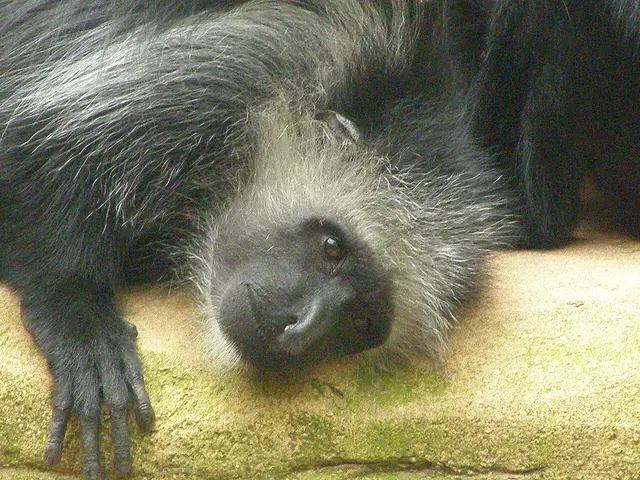
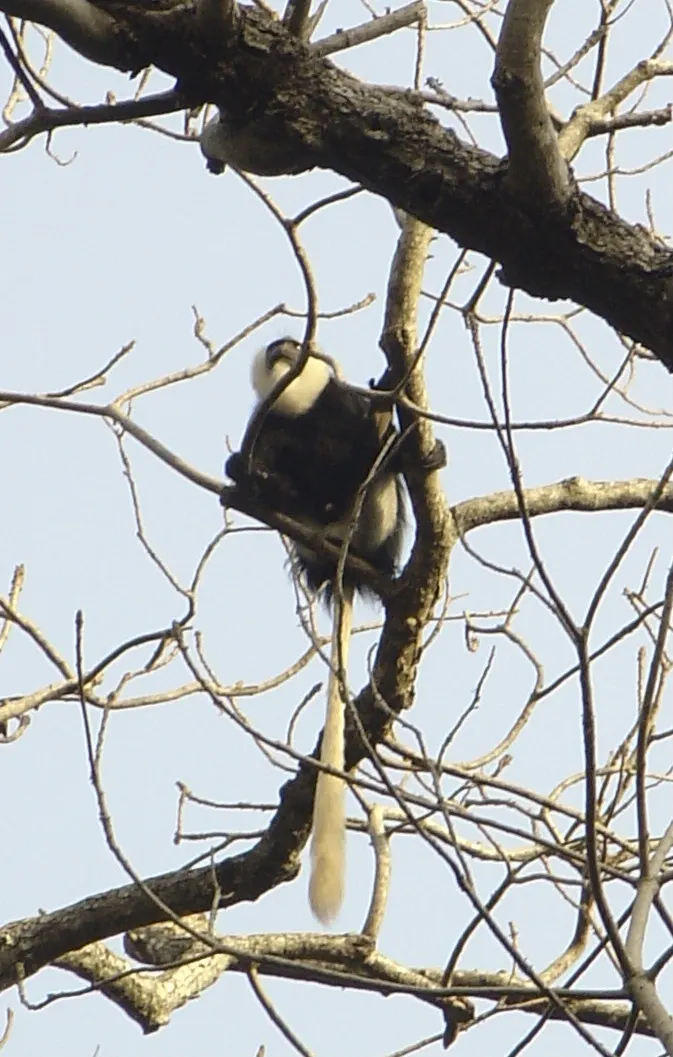
It is a slender monkey with mostly black fur, a bare black face ringed by a thick halo of white hair, and white patches on the thighs that vary in size from animal to animal. The tail is white and longer than the body. Unlike some other black-and-white colobus, it has no white mantle across the back.
Adult males weigh about 10 kg and females about 8.5 kg, with a body length of around 61 to 66 cm. Babies are born pure white and begin turning black at about three months old.
Where it lives
The species has been recorded from Ghana, Togo, Benin, Nigeria and Côte d'Ivoire. Burkina Faso is also listed, but the IUCN considers it probably extinct there. The assessment gives an elevation of 0 to 500 m. It lives in lowland moist forest, swamp forest and dry forest, including strips of gallery forest that push north into the forest-savanna zone.
Its range is badly fragmented. In Côte d'Ivoire it has gone from almost every protected area where it once lived, but several groups were seen in Comoé National Park in 2018 and 2019. Other protected areas that hold it include Fazao-Malfakassa in Togo and Mole National Park in Ghana, where patrol guards recorded a 69 percent fall in sightings between 2001 and 2006.
Pins are Wikidata “endemic to” fields. Orange dots, when present, are GBIF occurrence tiles — survey bias included.
How it lives
This is a tree-dwelling, daytime monkey that comes down mainly to feed. A typical group has several related females with their young and a single territorial male. Males leave the group they were born in when they mature, and they announce their territory with a low, repeated roar.
The diet is mostly young leaves and seeds, with some fruit, insects and termite clay. The assessment estimates a generation length of 9 years.
Why it is in trouble
The 2020 assessment inferred a decline of more than 80 percent over three generations, or 27 years. It cites an 87 percent drop in encounter rates at six sites in Ghana and the monkey's disappearance from about 80 percent of known sites in Côte d'Ivoire since 2004. The IUCN says the causes have not stopped, and puts the total at under 1,500 animals, with about 850 to 1,150 at known sites.
Hunting is the main threat, and forest loss comes second. Forest has been cleared for small-holder and industrial farms, plantations, grazing and mining, and the monkey is hunted for meat and skin.
In places its fortunes depend on local belief. Some communities treat the monkeys as sacred and protect them, though the IUCN warns that traditional beliefs are no longer as widely respected and that even sacred groves are not secure.
A rare local success
The Boabeng-Fiema Monkey Sanctuary in central Ghana is the best-known refuge. For decades it relied on traditional taboos against harming monkeys. The government stepped in to support management in the early 1970s, and the sanctuary has since combined the taboos with ordinary law enforcement.
A 2019 census counted 602 of these monkeys in 34 groups across six forest patches, up from about 365 in 2007, though the surveys used different methods and the comparison is only rough. Satellite imagery shows forest cover around the sanctuary also grew between 2010 and 2019.
That growth is local. Elsewhere in the range the trend remains down. A grant awarded through the Mohamed bin Zayed Species Conservation Fund in 2020 supports community forest restoration, a tree nursery and population monitoring at the sanctuary.
Sources
Written for this catalog in our own words from the sources below, checked against them on 12 November 2026. Population figures are estimates and carry the year they were made. Status and assessment year: IUCN. 2026. The IUCN Red List of Threatened Species. Version 2026-1. iucnredlist.org.