Endangered
Urosaurus auriculatus
Urosaurus auriculatus
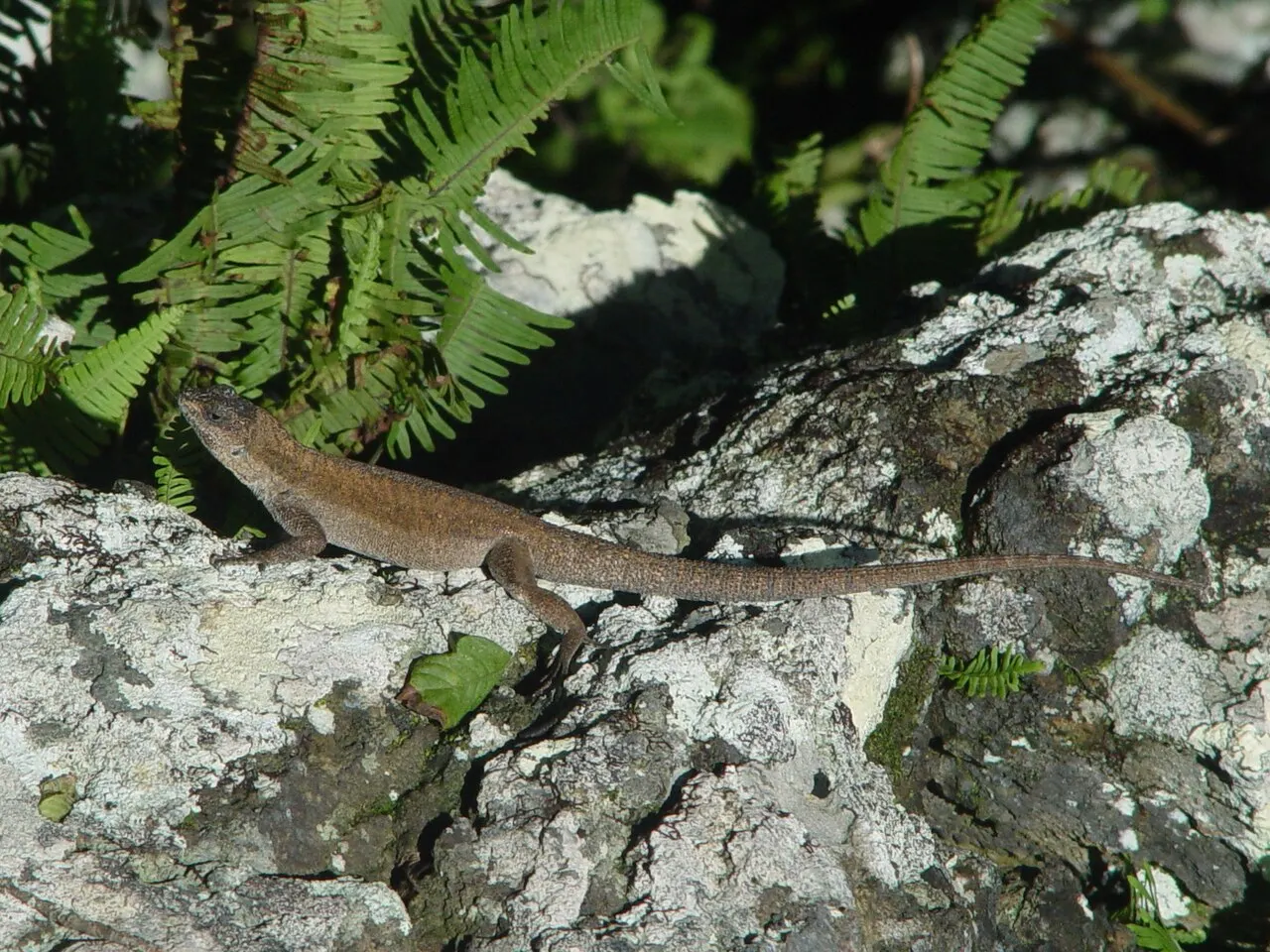
The Socorro Island tree lizard (Urosaurus auriculatus) lives nowhere else but Socorro, an island about 460 km off Mexico's Pacific coast. Males carry deep blue belly patches. The IUCN assessed it as Endangered in 2007, mainly because of introduced sheep and cats, which have since been targeted by removal campaigns.
How to recognise it
Its colour runs from grayish to bright blue, with six to eight short crossbars across the back, edged with pale blue on their rear borders. Males have broad deep blue patches on the belly, while females show a paler, uneven blue wash.
Seven adults measured in a museum study averaged about 65.5 mm from snout to vent, with a hind leg of 44 mm. It lays eggs. The species was described by the American naturalist Edward Drinker Cope in 1871, from specimens collected on Socorro.
Where it lives
Socorro is part of the Revillagigedo Archipelago. The island lies roughly 460 km south of Cabo San Lucas, covers about 132 km2 and rises to 1,050 m. The lizard is its only endemic reptile. The Red List places it in dry forest and dry shrubland, and records it in at least one protected area. The island is part of Revillagigedo National Park.
A 2017 paper in the journal Therya found the highest lizard densities in deciduous scrub, with fewer lizards in the higher forest.
Pins are Wikidata “endemic to” fields. Orange dots, when present, are GBIF occurrence tiles — survey bias included.
Why it is in trouble
Introduced mammals have degraded Socorro over roughly 140 years. Feral sheep contributed to the loss of about 30 percent of the island's habitat, through soil erosion and the loss of plant cover. Cats, introduced in the 1950s, were the second blow. Lizards are a major part of what they eat: half of the cat droppings examined in a 1993 study contained lizard remains.
The Red List assessment, published in 2007, lists the population as decreasing, with named introduced species as the threats.
What is being done
The Mexican group Grupo de Ecologia y Conservacion de Islas removed the island's feral sheep between 2009 and 2012, killing 1,762 animals. Vegetation recovered rapidly. The group also began controlling cats in 2011 and then turned it into an eradication campaign. By July 2015 it had killed 413 cats, and by December 2016 the total was 502.
Monitoring showed the lizards responding. The Therya paper reported rising lizard numbers as cats declined, with densities up to 43 per hectare on eroded ground where an earlier survey had recorded none. The team expected to finish the cat removal by the end of 2017 and then verify it; no confirmation of completion has been found. The Red List assessment dates from 2007, before any of this work.
Sources
Written for this catalog in our own words from the sources below, checked against them on 12 November 2026. Population figures are estimates and carry the year they were made. Status and assessment year: IUCN. 2026. The IUCN Red List of Threatened Species. Version 2026-1. iucnredlist.org.




