Critically Endangered
Vangunu giant rat
Uromys vika
The Vangunu giant rat or vika (Uromys vika) is a large tree-dwelling rodent known only from Vangunu Island in the Solomon Islands. The first specimen measured about 46 cm from nose to tail tip. The IUCN rated it Critically Endangered in 2020, with logging of its lowland forest the main threat.
How to recognise it
The vika is a giant among rats. The first specimen measured about 46 cm from nose to tail tip and weighed between 0.5 and 1 kg, roughly five times the weight of an ordinary street rat (around 200 g). Its fur is described as orange-brown.
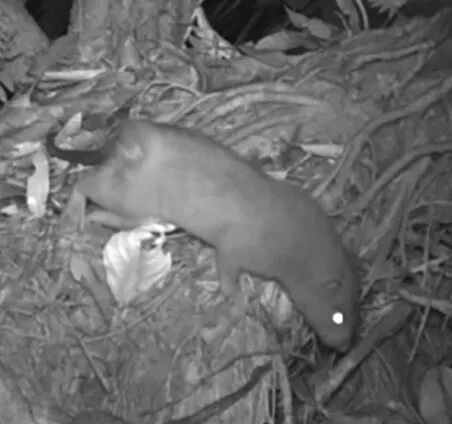
Camera images are identified by the large body, long tail and very short ears. The species was described in 2017 from partial remains of a single animal, compared with other rodents of northern Melanesia. It belongs to the genus Uromys.
Where it lives
Vangunu lies in the Western Province of the Solomon Islands. The type specimen came from lowland primary forest at about 145 m above sea level. The IUCN assessment gives an elevation range of 20 to 400 m, a single location and an extent of occurrence of about 77 km2. The rat appears to be absent from the island's heavily logged areas.
A 2023 study in Ecology and Evolution used nine camera traps in the Zaira Community Resource Management Area between September 2020 and August 2021. They took 95 images of the species, showing up to four individuals. Zaira holds what the paper calls the largest remaining tract of Vangunu's primary forest, about 36 km2.
Pins are Wikidata “endemic to” fields. Orange dots, when present, are GBIF occurrence tiles — survey bias included.
How it lives
Little is known. The vika is arboreal, nocturnal and presumed to live in the rainforest canopy. Specimen and dropping analysis points to a diet of fruit and nuts, and Canarium nuts are a preferred food. It gnaws round holes in nuts to reach the kernel. Local people say it opens coconuts with its teeth, though scientists had not watched that when the species was described.
Local communities knew the animal long before science did, and have songs and children's rhymes about these rats. Tyrone Lavery of the Field Museum first heard of it on a 2010 trip to the Solomon Islands. He searched with camera traps, tree traps, hollow-tree searches and spotlighting, and found only a single dropping. Then ranger Hikuna Judge captured a large rodent fleeing a felled Dillenia salomonensis tree, and local elders confirmed it was the vika. Lavery and Judge described it in the Journal of Mammalogy in 2017.
Why it is in trouble
The Red List criterion is B1ab(iii): a very small range, one location, and a continuing decline in habitat quality. The assessment lists logging as the threat, and the population trend is unknown. Most of the island's land is owned by Indigenous communities, and foreign timber companies offer large payments for logging rights.
The site where the type specimen was collected has since been logged, and loggers target Dillenia trees. In November 2022 the Solomon Islands Government granted development consent for commercial logging on Dokoso customary land. Zaira representatives lodged an appeal, and the 2023 paper reports no outcome.
Feral cats have been reported as the animal most often photographed on camera traps, and raptors such as the Solomon sea eagle are natural predators. How either affects the rat is unknown.
What is being done
The rat's best-known refuge is the Zaira Conservation Area, where the community has so far resisted logging companies. The rats themselves are not hunted, and hunting is allowed in only one of the area's three forest zones at a time on a rotating basis. The IUCN assessment records no species-specific conservation actions in place, so protection of the forest itself is currently the main safeguard.
Sources
Written for this catalog in our own words from the sources below, checked against them on 12 November 2026. Population figures are estimates and carry the year they were made. Status and assessment year: IUCN. 2026. The IUCN Red List of Threatened Species. Version 2026-1. iucnredlist.org.
- IUCN Red List assessment, Uromys vika (2020)
- Vangunu giant rat (Uromys vika) survives in the Zaira Community Resource Management Area (Ecology and Evolution, 2023)
- Field Museum, Tree-dwelling giant rat discovered in Solomon Islands (2017)
- Scientific American, Giant tree-dwelling, coconut-eating rat species discovered (2017)
- Mammal Diversity Database, Uromys vika
- Wikipedia, Vangunu giant rat




