Endangered
Mahony's toadlet
Uperoleia mahonyi
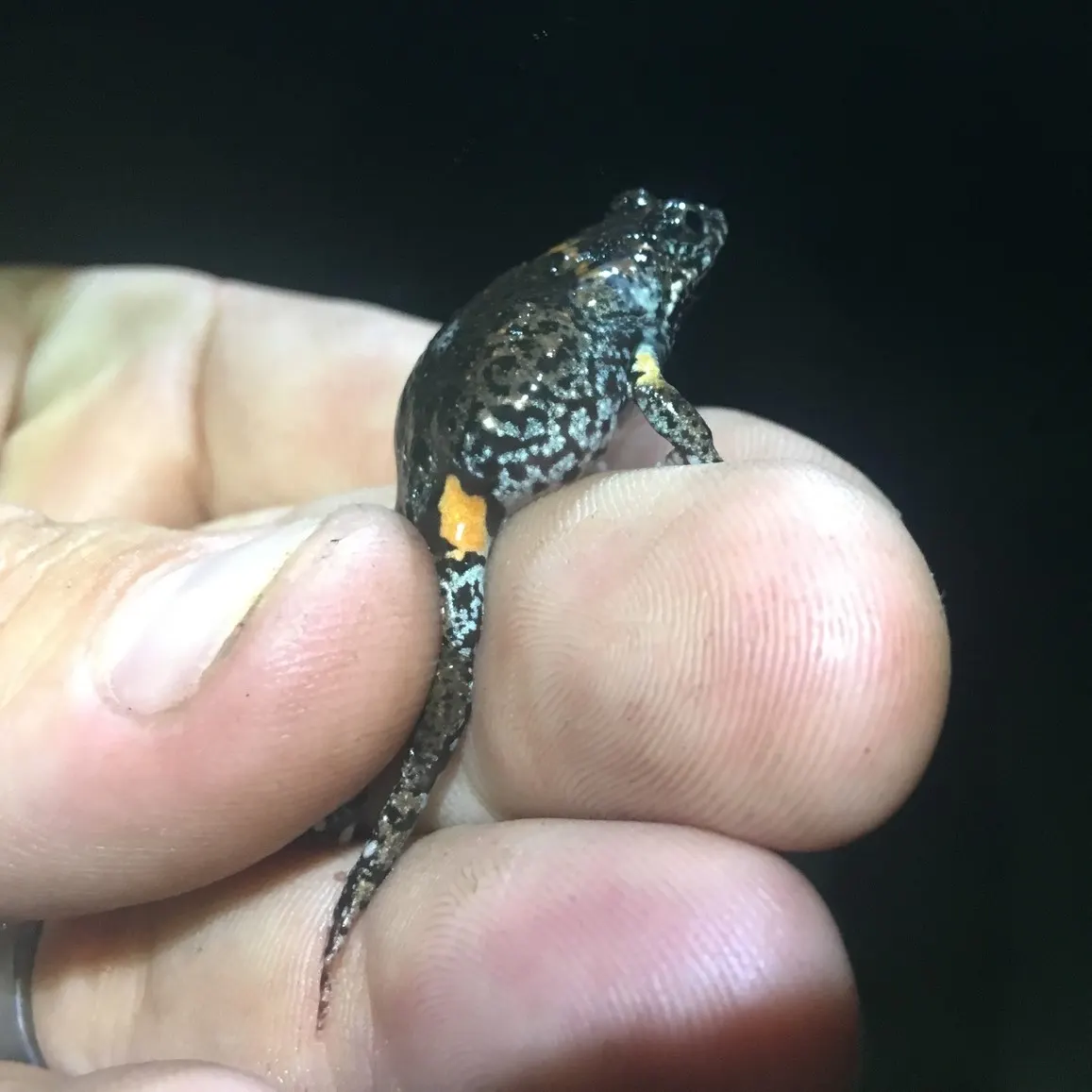
Mahony's toadlet (Uperoleia mahonyi) is a small brown frog with a bright orange groin that lives only on the sandy coastal lowlands of central New South Wales, Australia. It was described in 2016, and the IUCN Red List classed it as Endangered in 2022 because its range is tiny and its habitat keeps shrinking.
How to recognise it
This is a stocky little frog, about 30 to 35 mm long. The back is brown to dark brown, sometimes patched with grey, pale pink or orange-brown, and there is often a triangular brown mark on the head. The sides are bluish grey with black specks, and the tops of the arms can be yellow.
The best clues are underneath and out of sight. The belly is marbled black and bluish white, and the groin and backs of the thighs are bright orange. Its toes have no webbing. Several similar toadlets share the region, and the belly pattern is what separates this one. The call has been described as a squelch.
Where it lives
It is endemic to the mid-north coast of New South Wales, known between Kangy Angy and Seal Rocks. Records come from eight sites on coastal sand beds around Port Stephens, Myall Lakes and the northern Central Coast, including Wyrrabalong National Park, Tomago, Oyster Cove, Nelson Bay and Fingal Bay. A 2017 state listing put its extent of occurrence at about 1,905 square kilometres and the area it actually occupies at about 36 square kilometres.
It is tied to pale, nutrient-poor white sand. Most records are from acid paperbark (Melaleuca) swamps and wallum heath, with sedges and cumbungi around the breeding water. The IUCN lists four locations.
Pins are Wikidata “endemic to” fields. Orange dots, when present, are GBIF occurrence tiles — survey bias included.
How it lives
Breeding has been recorded in March and again in October and November, in shallow swamps and ponds. Eggs are probably attached to thin submerged plants or leaf litter, and the clutch size is unknown. Tadpoles are gold-brown to dark brown, grow to about 35 mm and take three to four months to become frogs.
Outside the breeding season the adults live on land. Some have been found as far as 400 m from standing water, in intact native vegetation. Lifespan hasn't been studied.
Why it is in trouble
The total population is unknown, though the 2017 listing estimated numbers at individual waterbodies in the hundreds. The IUCN records a decreasing trend and a continuing decline in habitat area. Housing, farming and commercial development have cleared much of the sandy country. Around Newcastle, the satellite towns, Tuggerah Lakes and Lake Macquarie, an estimated 31 to 44 percent of potential habitat has been lost.
Other pressures include water extraction, sand mine rehabilitation that alters breeding ponds, more frequent fire, runoff and chemicals, weeds, introduced foxes, cats and plague minnows, and sea level rise at low coastal sites. Whether it is vulnerable to chytrid fungus has not been established.
What is being done
It is listed as Endangered under both New South Wales law (2017) and Australia's national EPBC Act. It occurs in at least one protected area, and the IUCN names habitat restoration as an action in place. About 62 percent of suitable habitat in its known range is in reserves, but only three of the eight known sites are reserved.
Sources
Written for this catalog in our own words from the sources below, checked against them on 12 November 2026. Population figures are estimates and carry the year they were made. Status and assessment year: IUCN. 2026. The IUCN Red List of Threatened Species. Version 2026-1. iucnredlist.org.




