Endangered
Tulotoma magnifica
Tulotoma magnifica
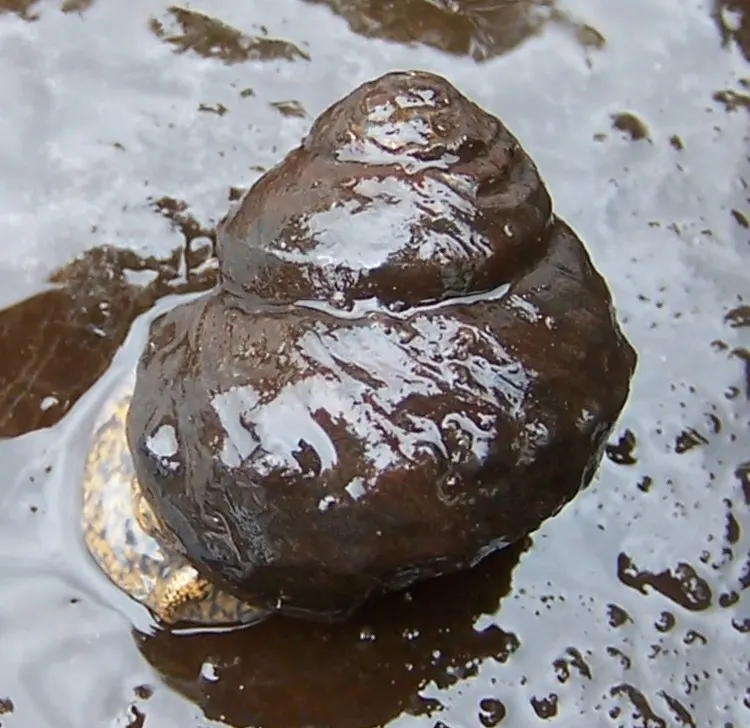
The tulotoma (Tulotoma magnifica), also called the Alabama live-bearing snail, is a large freshwater snail found only in the Coosa and Alabama river systems of Alabama. The IUCN Red List rates it Endangered (assessed 2000). In the United States it was moved from endangered to threatened in 2011.
How to recognise it
It is a gill-breathing snail with a round shell that can grow somewhat larger than a golf ball. The shell carries spiral rows of knobs, and the opening is closed by a horny lid, the operculum. Its size and ornament set it apart from other freshwater snails in the Coosa and Alabama rivers. It is the only species in its genus and belongs to the river snail family Viviparidae. Conrad described it from the Alabama River in 1834.
Where it lives
Tulotoma needs cool, clean, well-oxygenated water that keeps moving. It is found on shoals and shallower stretches with moderate to strong current, and has been collected at depths of more than 5 metres. Snails cling to the undersides of large rocks or sit in cracks in bedrock.
A 2016 side-scan sonar study (Garner and colleagues) found them only under boulders of dense, hard rock, never under brittle siltstone or in gaps that were empty or choked with silt. Some silt and sand still has to be present for the snails to settle.
The historic range ran about 563 kilometres (350 miles), from the Coosa River in St. Clair and Calhoun Counties to the Alabama River in Monroe County. By the time it was listed in 1991, it survived in less than 2 per cent of that range. Populations are now recorded in the Coosa River below Jordan Dam, in several Coosa tributary creeks (Choccolocco, Kelly, Yellowleaf, Weogufka, Hatchet and Weoka) and at colonies in the Alabama River below its lock and dams.
Pins are Wikidata “endemic to” fields. Orange dots, when present, are GBIF occurrence tiles — survey bias included.
How it lives
The young are born live. Births happen all year, with a peak from May to July, at a shell height of about 3 to 5 millimetres. The snails grow fast, reaching 11 to 14 millimetres in their first year. In a study below Jordan Dam, females produced an average of 16 young in their second year and 28 a year after that, though few snails in the lower Coosa River lived longer than two years.
Why it is in trouble
Dams were the main cause of the decline. By the time of listing, the remaining populations were cut off from one another by dams and impounded water, and hydropower releases below Jordan Dam had squeezed the snail into a stretch of river about 3 kilometres long, where flow was low and oxygen scarce.
Pollution and sediment still matter. The 2011 federal rule recorded that the Ohatchee Creek population had not been found for 15 years and was believed lost, probably to sediment and nutrient runoff. During the 2007 drought, reduced flows below Jordan Dam stranded an estimated 73,000 snails, a small share of a population the rule put at over 100 million.
What is being done
In 2011 the US Fish and Wildlife Service moved the tulotoma from endangered to threatened (final rule 76 FR 31866, effective 5 July 2011). It cited new populations found in Coosa tributaries and the Alabama River, and a large, improved population below Jordan Dam. An Alabama Power article called it the first downlisting of an endangered mollusc in North America.
The snail is not out of danger. Alabama Power, state and federal biologists and Auburn University researchers have surveyed populations in Lay Lake and below Jordan Dam. In 2013 they tested how the snails, and a second protected snail, respond to falling water levels in Lay Lake so that future drawdowns can be managed. The Service published a five-year review in 2025.
Sources
Written for this catalog in our own words from the sources below, checked against them on 12 November 2026. Population figures are estimates and carry the year they were made. Status and assessment year: IUCN. 2026. The IUCN Red List of Threatened Species. Version 2026-1. iucnredlist.org.




