Endangered
Tucuxi
Sotalia fluviatilis
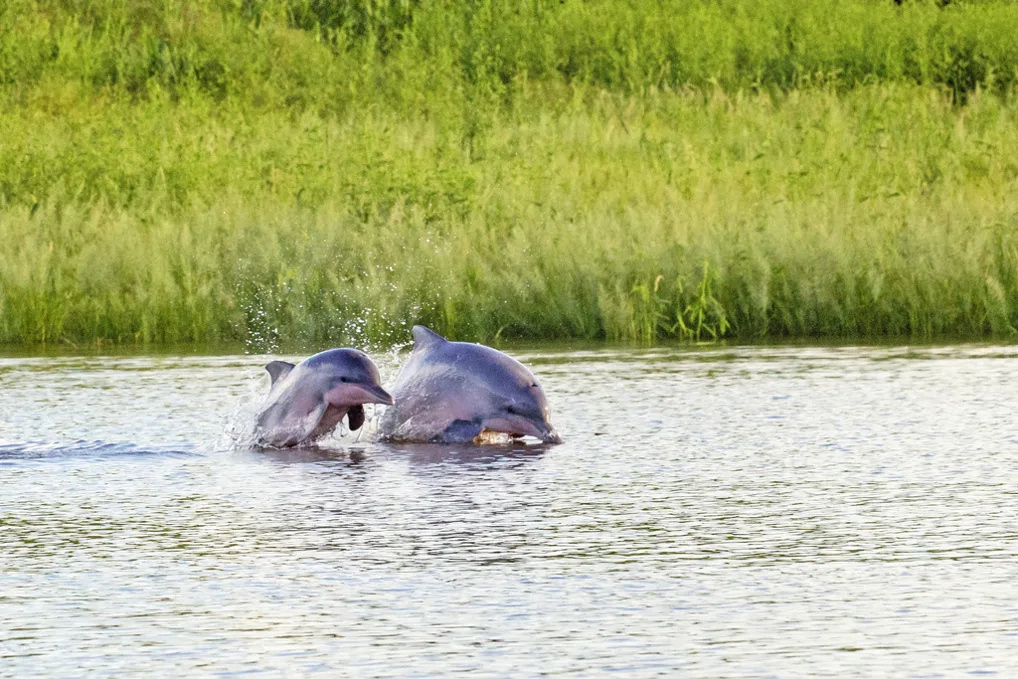
The tucuxi (Sotalia fluviatilis) is a small grey dolphin that lives in the rivers of the Amazon basin. It looks like a miniature bottlenose dolphin and belongs to the oceanic dolphin family, not the river dolphins. The IUCN Red List moved it from Data Deficient to Endangered in 2020, with a decreasing population.
How to recognise it
The tucuxi averages about 1.5 m long and 55 kg, within a recorded range of roughly 0.9 to 2 m. The back is light to bluish grey and the belly is paler, often pinkish. Males and females look alike. The beak is clear and of moderate length, the dorsal fin is slightly hooked, and many animals have a white-tipped snout.
People often mix it up with two other dolphins. The pink river dolphin, or boto, shares its waters but is a true river dolphin and not a close relative. The Guiana dolphin (Sotalia guianensis) was long lumped together with the tucuxi. Genetic work in 2005 and 2007 showed they are separate species. The Guiana dolphin lives in coastal and estuarine water and grows larger, to about 2.1 m.
Where it lives
The tucuxi lives in the Amazon basin, in the main river, its larger tributaries and lakes. The Red List records it in Brazil, Peru, Ecuador and Colombia. It does not occur in the Orinoco basin: Sotalia dolphins found far up the Orinoco belong to the Guiana dolphin. Waterfalls, rapids and shallow water mark the edges of its range in many rivers.
It prefers wide, deep channels and large lakes, and it favours the junctions where rivers meet and fish gather. It generally stays out of flooded forest. No one has produced a reliable count for the whole range, although surveys of smaller stretches have found it fairly common.
Pins are Wikidata “endemic to” fields. Orange dots, when present, are GBIF occurrence tiles — survey bias included.
How it lives
Tucuxis eat fish. The Red List cites at least 28 prey species from 11 families, mostly small schooling fish. Most groups number one to six animals, though larger gatherings occur at river confluences. Accounts describe them as active and acrobatic, breaching and splashing, but they rarely approach boats.
Mating is reported from August to October. A single calf is born after gestation of roughly 10 to 12 months, and both sexes mature at about six years. The oldest wild animals are thought to reach around 35 years. The Red List puts a generation at 15.6 years, which matters because a slow breeder takes a long time to recover from losses.
Why it is in trouble
The clearest evidence of decline comes from the Mamirauá Reserve in Brazil. Boat counts along a 30 km stretch, repeated from 1994 to 2017, showed tucuxi numbers falling by about 7.4 percent a year, a halving every nine years. A 2018 PLOS ONE study by da Silva and colleagues called these some of the steepest declines known for any whale or dolphin since early modern whaling. The reserve is a small part of the range, so the Red List treats it as a warning and not as a range-wide measurement.
Several things are at work. Tucuxis feed where fishers work, and gillnets and seine nets drown them by accident. Dolphins are also killed for use as bait in the piracatinga catfish fishery, a practice that began in Brazil around 2000 and continues despite a Brazilian ban on that fishery since 2015. Dams cut rivers into pieces. On the Madeira River the Santo Antonio and Jirau dams, running since 2012 and 2013, reportedly trapped 50 to 100 river dolphins between them, though that report concerns river dolphins in general rather than tucuxi alone.
Pollution is a further concern. Organochlorines and heavy metals have been found in botos from several Amazon rivers, and the Red List considers it likely that tucuxis carry similar loads.
What is being done
The tucuxi is on Appendix I of CITES, which bars international commercial trade. In Peru, national law protects small cetaceans and prohibits eating their meat. The Red List records that the species occurs in at least one protected area, that conservation sites have been identified across its range, and that river dolphin action plans exist in Brazil, Colombia and Ecuador. Harvest management is the conservation action it lists. The Mamirauá researchers call for much stricter enforcement of existing protections. Captivity has not helped: captive tucuxis reportedly did poorly, and the last known captive animal in Europe died in 2009.
Sources
Written for this catalog in our own words from the sources below, checked against them on 12 November 2026. Population figures are estimates and carry the year they were made. Status and assessment year: IUCN. 2026. The IUCN Red List of Threatened Species. Version 2026-1. iucnredlist.org.



