Endangered
Tuamotu Sandpiper
Prosobonia parvirostris
The Tuamotu sandpiper (Prosobonia parvirostris) is a small, short-billed shorebird that survives on a handful of low coral atolls in the Tuamotu Islands of French Polynesia. The IUCN Red List assessed it as Endangered in 2023, with an estimated 700 to 1,100 mature birds. Introduced rats and cats are the main threat.
How to recognise it
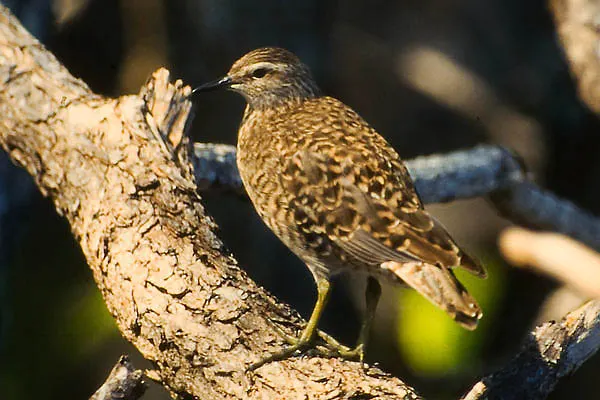
It's a plump, mottled brown bird about 16 cm long, with a bold pale stripe above the eye, barred underparts and a short, sharp black bill. The bill looks more like an insect-eater's than a typical wader's. There are pale and dark colour forms that grade into each other. The legs are dirty yellow to olive grey, the toes aren't webbed, and the sexes look alike, though females tend to be slightly larger and paler.
Its alarm call is a repeated series of medium-pitched notes, and the song is a longer, lower trill.
Where it lives
The species lives only in the Tuamotu Islands of French Polynesia, where birds have been recorded in modern times on many atolls, among them Rangiroa, Fakarava, Tahanea and Marutea Sud. Today it is reportedly confined to a few atolls without rats, such as Anuanuraro, Tenararo and Morane. The IUCN counts 3 to 7 locations and seven subpopulations, the largest holding 251 to 1,000 birds. Non-breeding birds are reported to visit nearby islands, especially in the Acteon group.
It lives from sea level to about 20 m, on rocky, sandy and shingle shores, in tidepools and in dry shrubland, and tends to avoid thick stands of pandanus. Unlike most sandpipers it doesn't migrate.
Pins are Wikidata “endemic to” fields. Orange dots, when present, are GBIF occurrence tiles — survey bias included.
Its place among the sandpipers
The US Exploring Expedition collected the first specimens in 1839, and Titian Peale described them in the late 1840s. A close relative, the Kiritimati sandpiper (Prosobonia cancellata), was recorded on Kiritimati (Christmas Island) during Captain Cook's third voyage in 1777 to 1778 and died out in the first half of the 19th century.
Whether the Tuamotu bird is a separate species is debated. Some researchers treat it as a subspecies of the Kiritimati sandpiper, but the Red List assesses it as its own species.
How it lives
It feeds in open ground such as beaches and scrub, taking insects like ants, leafhoppers and wasps from coral rubble and leaf litter. It also drinks nectar and uses trees more than most waders do. Its Tuamotuan names are kivi-kivi and titi, and in French it is the chevalier des Tuamotu.
Breeding timing varies from island to island, mostly April to June. The nest is reportedly a slight hollow in coral and shell debris along the lagoon shore, lined with grass stems, and the clutch is believed to be two eggs.
Why it is in trouble
The IUCN rates it Endangered under criterion B2ab(iii,v), which fits a small area of occupancy with habitat decline and a falling number of mature birds. The trend is decreasing. The assessment names Pacific rats, black rats and feral cats as ongoing threats, the yellow crazy ant as a possible future one, and coconut planting and small-scale farming as habitat pressures. Storms and flooding have caused rapid declines before and could again, and rising seas threaten low atolls in future.
Ground nests make the birds easy targets, and dogs and pigs also prey on them. The French biodiversity office (OFB) describes the bird as once very common and now gone from many atolls.
What is being done
The assessment records invasive species control as in place on some sites, and lists benign introduction, site management and awareness as further actions. It also records no recovery plan, no systematic monitoring and no protected area. Its recommendations include monitoring the recolonisation of nearby islands, improving biosecurity and planning a translocation to Temoe.
Researchers reported helping with rodent removal on a small islet and aiming to write a translocation plan for new populations on rat-free sites. The commune of Anaa funded a study by the marine biologist Matthieu Juncker, due to start in April 2024, in which he planned to spend eight months on an uninhabited atoll assessing the populations and identifying islets worth protecting.
Sources
Written for this catalog in our own words from the sources below, checked against them on 12 November 2026. Population figures are estimates and carry the year they were made. Status and assessment year: IUCN. 2026. The IUCN Red List of Threatened Species. Version 2026-1. iucnredlist.org.




