Critically Endangered
Tuamotu Kingfisher
Todiramphus gambieri
The Tuamotu kingfisher (Todiramphus gambieri) is a pale-headed, blue-backed kingfisher found only on Niau, a small atoll in French Polynesia. The IUCN Red List rated it Critically Endangered in 2024, with 100 to 150 mature birds. Surveys in 2003 and 2004 found as few as 39, and the population has since recovered.
How to recognise it
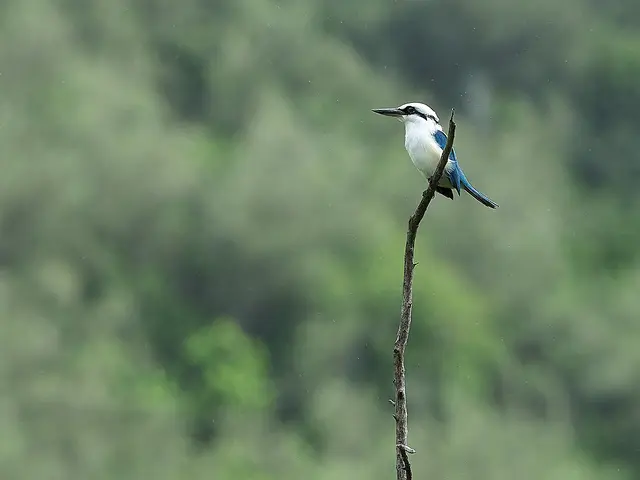
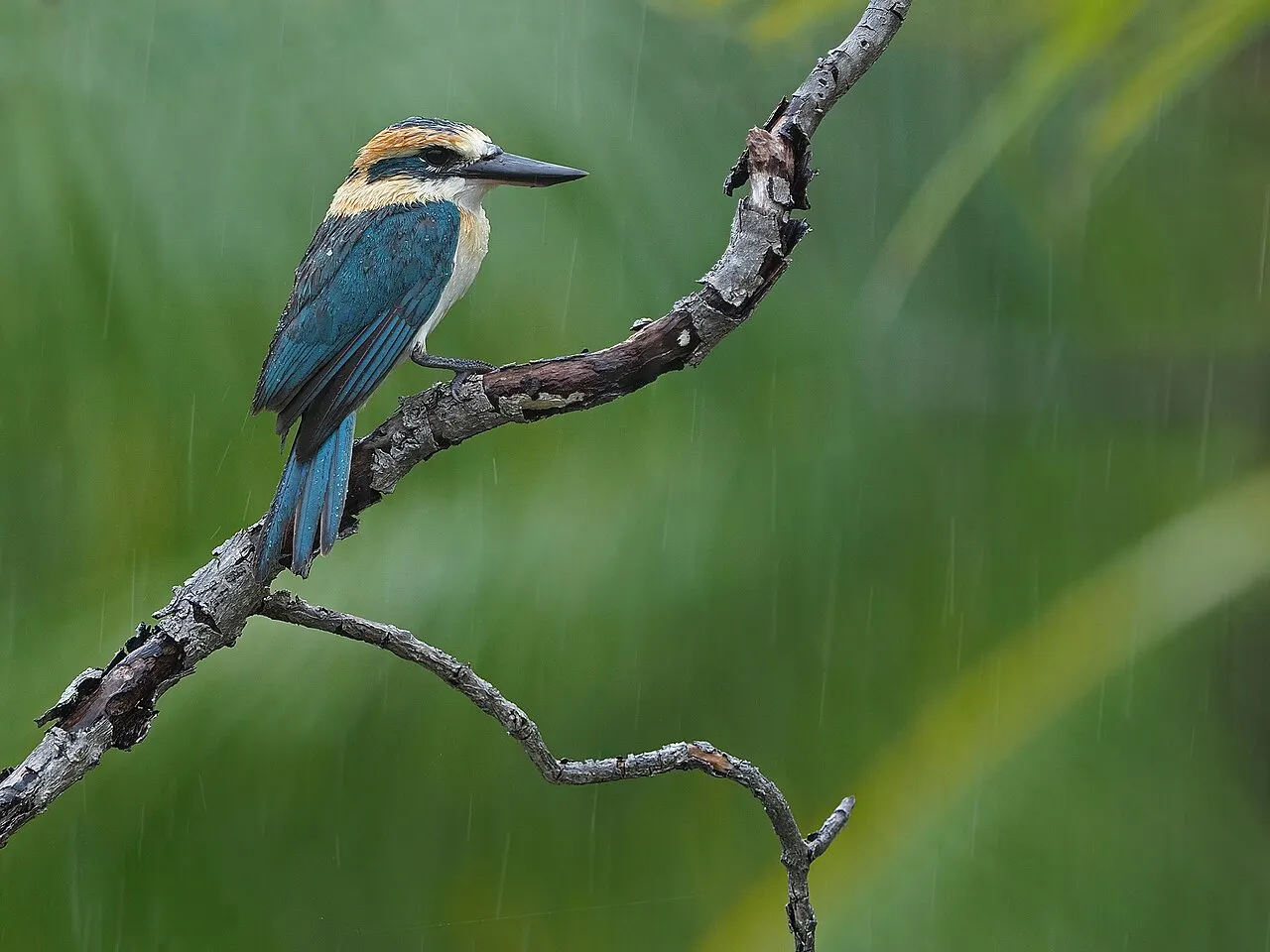
It has a buff-cream head and neck, a creamy forehead and a broad buffy collar, with dusky blue ear patches and a white chin and underparts. Many birds show a rufous band across the upper breast. The back, rump, wings and tail are blue, and the amount of blue on the crown varies from bird to bird.
Where it lives
Niau is part of the Tuamotu archipelago and covers about 20 km2 of land around a lagoon, with 226 residents in 2012. The kingfisher lives on no other island, so the Red List counts the whole species as a single location, at elevations from sea level to about 20 m.
Its main habitat is coconut plantation, with village gardens also used and native lowland forest a marginal fit. It is not a migrant.
Pins are Wikidata “endemic to” fields. Orange dots, when present, are GBIF occurrence tiles — survey bias included.
How it lives
It hunts insects and small lizards, often hunting from a perch. Lizards are the main food for chicks. Nests are cavities that the birds dig into dead or rotting coconut palms, mostly between September and January.
That dependence matters. Old and dead palms are the nest sites, so how growers manage their plantations shapes how many pairs can breed.
Why it is in trouble
Everything is packed on one small atoll, so a single storm or introduced predator can hit the whole species. Counts of 400 to 600 birds were reported in 1974. A hurricane in 1983 and the removal of nesting trees in 1984 cut the number of nest sites, and surveys in 2003 and 2004 estimated only 39 to 51 birds. Some 1990s numbers may have been inflated by double counting.
The Red List names feral cats, Pacific rats and black rats as predators or competitors, plus more frequent fires and past storms, all with low or unknown measured impact. Another concern is a shortage of old palms for nesting.
What is being done
Numbers have recovered since the early 2000s lows, to an apparently stable 135 birds by 2009, and the 2024 Red List assessment calls the trend stable. A 2010 grant of 15,000 US dollars paid for work on a species action plan, and the Red List records a recovery plan. Local palm growers agreed to leave dead palms standing for a few years as nest sites, and SOP Manu, BirdLife's partner in French Polynesia, ran a school workshop. A rat control programme was being developed with the community, while cat control was on hold because residents were not yet ready for it.
Proposals include nest boxes and a second population on Anaa atoll, which was judged the best release option. The Red List shows no reintroduction and no captive population yet, and Niau residents would have to agree to any introduction.
Sources
Written for this catalog in our own words from the sources below, checked against them on 12 November 2026. Population figures are estimates and carry the year they were made. Status and assessment year: IUCN. 2026. The IUCN Red List of Threatened Species. Version 2026-1. iucnredlist.org.