Endangered
Tropheus duboisi
Tropheus duboisi
Tropheus duboisi, the white spotted cichlid, is a small algae-grazing fish found only in Lake Tanganyika, in patches along the rocky shores of the northern lake. Young fish are black with white spots. The IUCN Red List assessed it as Endangered in 2025, as its shallow rocky habitat is silted, polluted and harvested.
How to recognise it
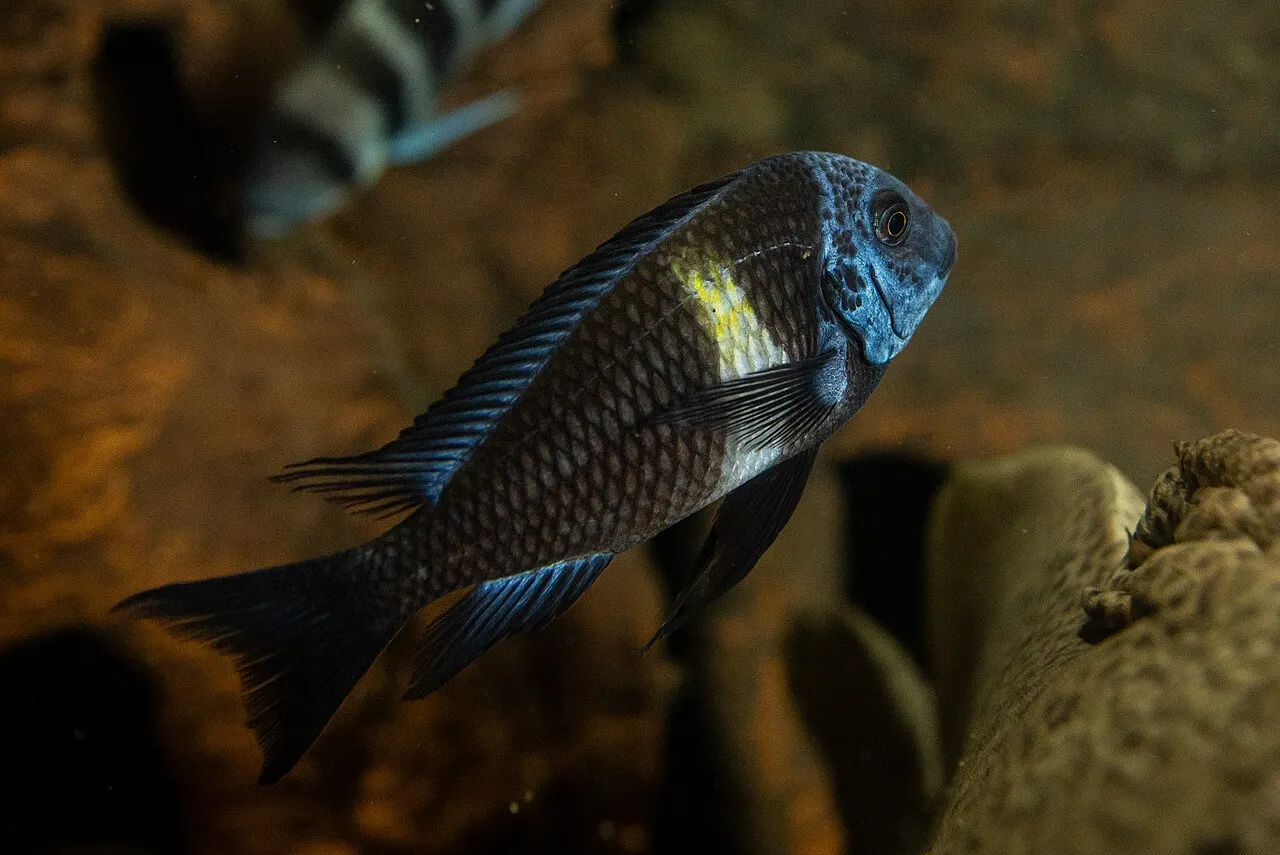
This is a stocky cichlid that reaches about 12 cm (4.7 in) in the wild. Juveniles are jet black with white or pale blue spots, which gives the species its common name. Adults change completely. The spots fade, leaving a blue-black body crossed by a white to yellow vertical bar.
The look varies by location. Fish from Bemba have a narrow, often incomplete bar, Muguruka fish can be entirely black, and Maswa fish have the widest bar, usually yellow above and white below. Fish from Kigoma and Gombe have a pure white bar. Hobbyists recognise five such local forms.
Where it lives
The species is endemic to Lake Tanganyika, and its distribution is patchy across the northern part of the lake. The IUCN lists it from Burundi, Tanzania, the Democratic Republic of the Congo and Zambia. Local forms are reported from Bemba, the type locality in DR Congo, from Muguruka in Burundi, and along the Tanzanian shore around Kigoma and Gombe.
It lives on rocky bottoms, on rubble and slabs, from the surface down to about 30 m (100 ft). One hobbyist site says it is most common between 6 and 10 m, and a keepers' guide says it lives deeper than other Tropheus. The IUCN estimates its occupied area at 92 square kilometres across five locations.
Pins are Wikidata “endemic to” fields. Orange dots, when present, are GBIF occurrence tiles — survey bias included.
How it lives
It grazes algae that grow on rocks. The genus name refers to specialised teeth for this kind of feeding. Adults are territorial, and in aquariums they are most aggressive toward their own kind. The female is a maternal mouthbrooder. She carries a small brood of 5 to 15 eggs. Keepers give a brooding time of about 24 to 26 days by one account and more than four weeks by another, and she guards the young for a few days after release.
One hobbyist site reports that females, unlike those of most lake cichlids, also hold feeding territories.
Why it is in trouble
The 2025 assessment lists silt washing into the lake, nutrient loads, sewage and large-scale harvest as ongoing threats, each affecting a majority of the range and linked to rapid declines. The area of habitat is still shrinking. It records a decreasing population trend.
This fish is popular in the aquarium trade. One hobbyist site reports that heavy collecting has badly reduced the Maswa form in the wild, though that is a keepers' account rather than a survey. An earlier IUCN assessment, from 2006, rated the species Vulnerable.
What is being done
The IUCN notes that the species occurs in at least one protected area, that conservation sites have been identified over part of its range, and that a harvest management plan exists. The actions it lists as needed are site management, awareness work, and policy and regulation.
Sources
Written for this catalog in our own words from the sources below, checked against them on 12 November 2026. Population figures are estimates and carry the year they were made. Status and assessment year: IUCN. 2026. The IUCN Red List of Threatened Species. Version 2026-1. iucnredlist.org.




