Critically Endangered
Triops emeritensis
Triops emeritensis
Triops emeritensis is a tadpole shrimp known only from two seasonal ponds near La Albuera in Extremadura, western Spain. It was described as a species in 2010. The IUCN Red List rated it Critically Endangered in 2020, because it occupies roughly 8 square kilometres and lives in one threatened location.
How to recognise it
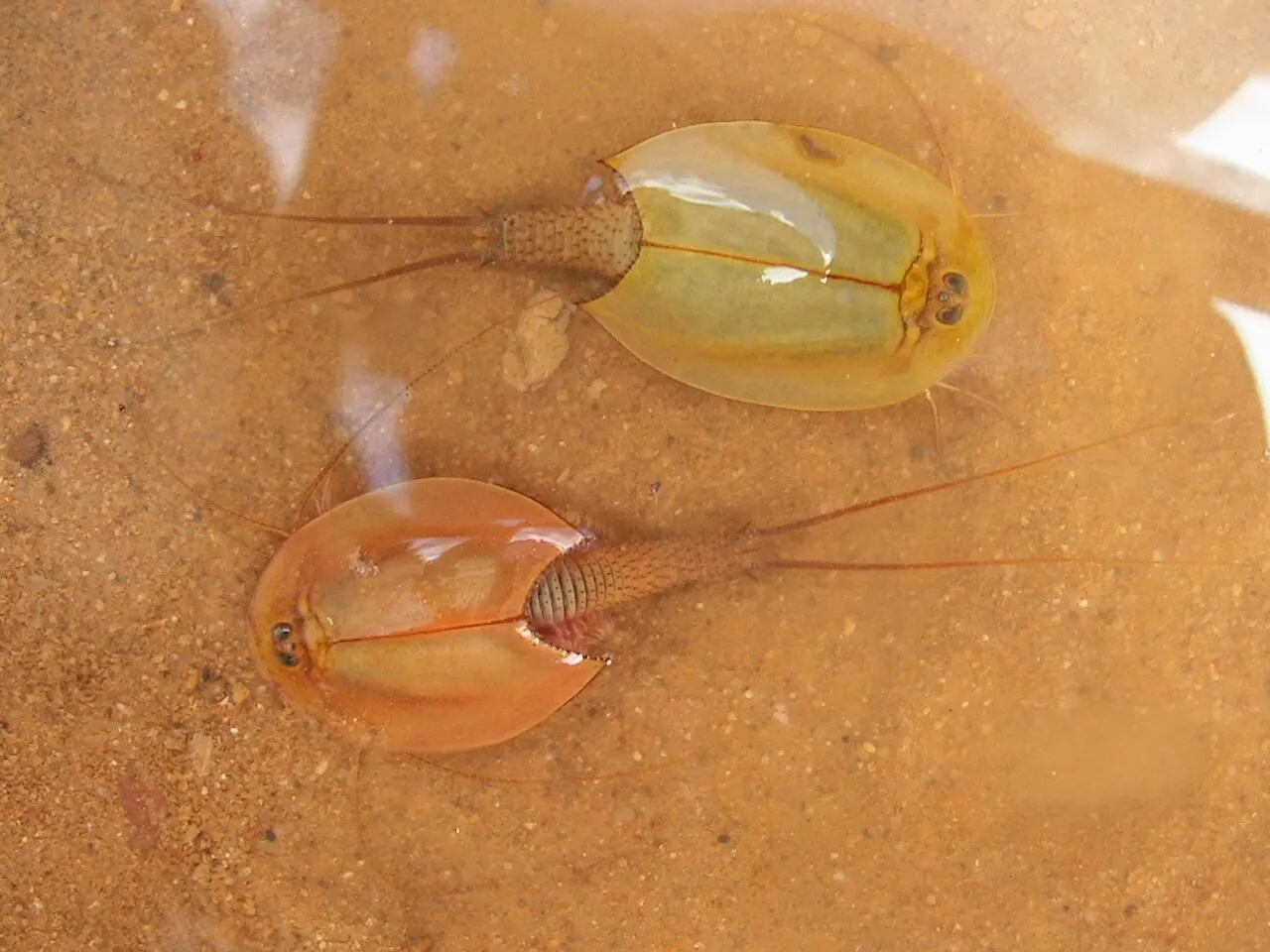
Like other tadpole shrimps (order Notostraca), it has a broad, flat shield over its head and front body, a long slender rear section, and a tail end flanked by two long, thin filaments. Tadpole shrimps in general reach roughly 2 to 5 cm. The adult male chosen as the type specimen had 55 pairs of trunk limbs and a shield 19.85 mm long.
Telling it from its Iberian relatives is a job for a specialist. The 2010 description separated it from nearby species using counts of tiny spines on the trunk limbs, the proportions of the second limb and the telson (tail plate), and the size of its resting eggs, which reach up to about 590 micrometres across. Its DNA also placed it in a lineage of its own.
Where it lives
The species is endemic to Spain and has only been recorded from two ponds near La Albuera, in the Guadiana valley of Badajoz province. The type specimens came from Laguna de la Gitanilla, which is part of the La Albuera lagoon complex. The IUCN gives its elevation as 240 m.
Its name points to Emerita Augusta, the Roman town that is now Mérida, which lies near the type locality. Its genetic lineage is known only from Extremadura, and the nearest recorded population of a related lineage is about 40 km away.
Pins are Wikidata “endemic to” fields. Orange dots, when present, are GBIF occurrence tiles — survey bias included.
How it lives
It lives in seasonal pools that fill with winter and spring rain. The La Albuera lagoons hold water through the wet season only in years of normal rainfall, and in a dry year they can stay empty for twelve months. Tadpole shrimps cope with this by laying resting eggs that wait in the mud. The type male was reared from eggs in pond sediment collected at the site.
The IUCN lists its habitat as seasonal saline, brackish or alkaline marshes and pools. How many animals live there in any given year is not known, and the Red List records its population trend as unknown.
Why it is in trouble
A species that exists in two ponds can be lost by a single bad event. The Red List assessment points to herbicides and pesticides from surrounding farmland, and to water being drawn from the surface for agriculture, both rated as low-impact but ongoing. It also describes the habitat as fragmented by roads and other infrastructure and by natural barriers, and expects the species' range and number of locations to keep shrinking.
The wider lagoon complex has had its own problems. An EU-funded project that ran from 2004 to 2008 aimed to slow silting of the lagoons, which human activity had sped up, and to reduce overgrazing on the shores and the farming of dry lagoon beds.
What is being done
The ponds sit inside the La Albuera lagoon complex, which is a Ramsar wetland, an EU Site of Community Importance and a Special Protection Area for birds. A regional management plan covers the area. The IUCN lists site protection, habitat protection and habitat restoration as the actions needed.
A 2017 follow-up visit to the EU project concluded that it had helped the lagoons recover, and that some would probably have been damaged beyond repair without it. The IUCN notes that no conservation effort is aimed at this species itself.
The Red List also flags a gap in knowledge. Sixteen older records were reported under this name in 2006, but their identification has been questioned. If they were confirmed, the species could end up in a lower threat category.
Sources
Written for this catalog in our own words from the sources below, checked against them on 12 November 2026. Population figures are estimates and carry the year they were made. Status and assessment year: IUCN. 2026. The IUCN Red List of Threatened Species. Version 2026-1. iucnredlist.org.
- IUCN Red List assessment, Triops emeritensis (2020), via IUCN API
- Korn et al. 2010, Organisms Diversity & Evolution 10: southern Iberian Triops mauritanicus lineages
- Wikipedia, Triops emeritensis
- Wikipedia, Notostraca
- Birding Places, Laguna de La Albuera
- EU LIFE project LIFE03 NAT/E/000052, Albuera Extremadura




