Critically Endangered
Trinidad Piping Guan
Pipile pipile
The Trinidad piping guan (Pipile pipile), known locally as the pawi, is a black and white, turkey-like bird of the forest canopy, found only on the island of Trinidad. The IUCN rated it Critically Endangered in 2020, with perhaps 150 to 330 mature birds left in the Northern Range.
How to recognise it
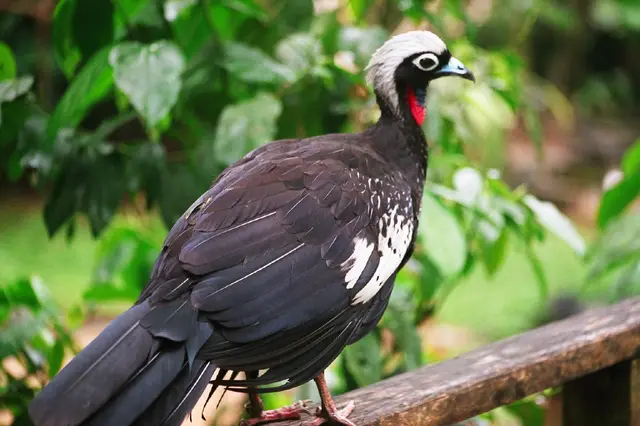
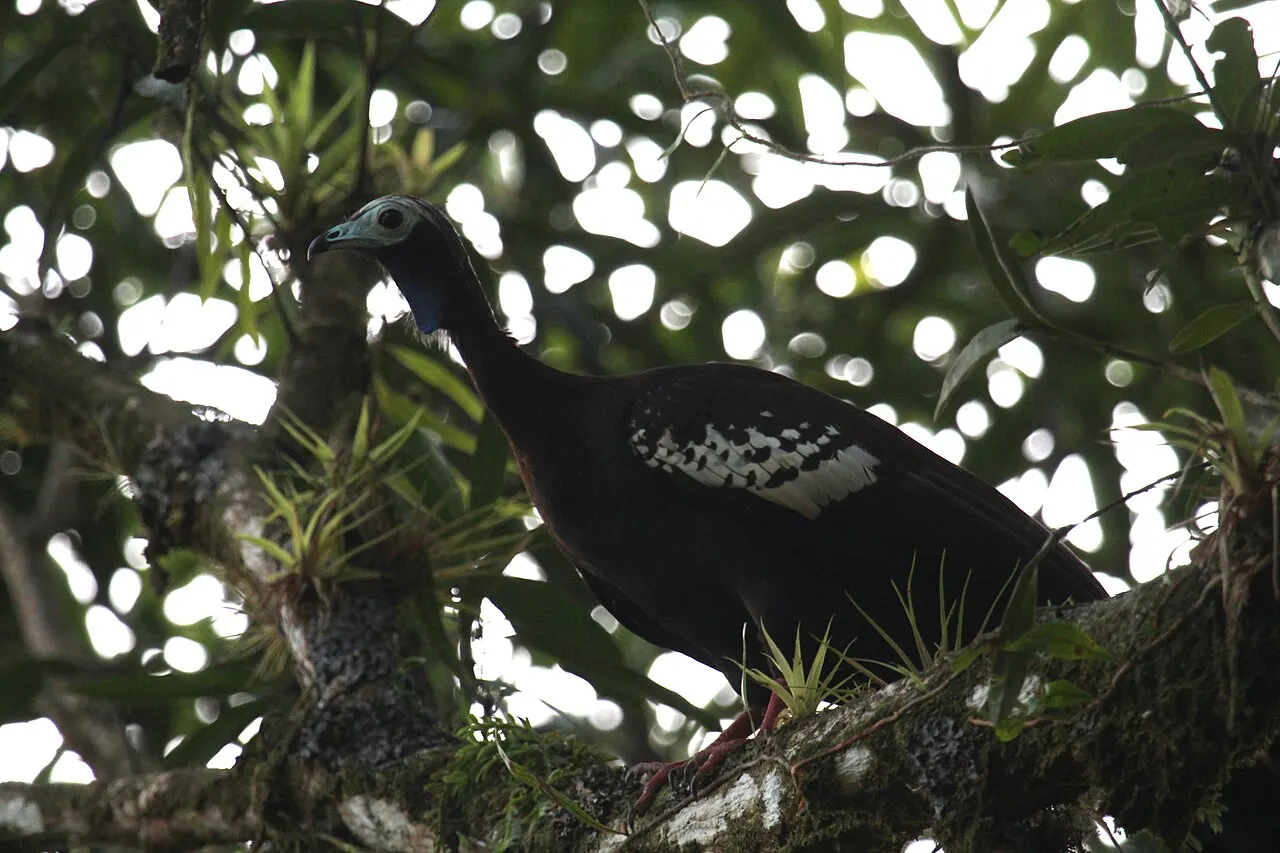
The pawi is a large cracid, roughly 60 to 70 cm long depending on the source, with a thin neck and small head. Its plumage is mostly blackish with a faint purple gloss, and it has a dark crest streaked or edged with white. Large white patches show on the wings. The bare face and wattle are blue and the legs are red.
Its call is a thin piping note, and its wings make an audible whirr in flight. It's the only member of its family on the island.
Where it lives
The pawi was once abundant across Trinidad's Northern Range and the southern Trinity Hills, and it also lived in lowland areas such as Nariva Swamp and the Aripo Savannas. It has vanished from the lowlands. Surveys have found no birds in the Trinity Hills since 1994, and it's almost certainly gone there.
What remains is in the eastern Northern Range, where the IUCN estimates 150 to 350 square kilometres of suitable habitat. The bird prefers remote, steep rainforest with streams, a closed canopy and plenty of lianas and epiphytes. Most records come from 400 to 900 m above sea level, though it occasionally occurs lower, and it also uses secondary growth and farmland close to primary forest. The IUCN counts 6 to 10 locations.
Pins are Wikidata “endemic to” fields. Orange dots, when present, are GBIF occurrence tiles — survey bias included.
How it lives
It spends most of its time in the canopy, eating mostly fruit and berries, including those of nutmeg and baboonwood trees, along with flowers and leaves. Breeding is poorly known. Two sources describe a tree nest with three large white eggs, incubated by the female alone, while the IUCN mentions two eggs and nests near the ground.
Why it is in trouble
Illegal hunting is the main threat, and habitat loss from timber extraction and conversion to plantation agriculture adds to it. Trinidad and Tobago has protected the bird in law since 1963, but the IUCN and a government species profile both say the laws protecting the species and its areas are generally not enforced. A 2010 project page also cites bush fires and quarrying.
Population estimates have shifted over time. A government profile gives 70 to 200 birds and decreasing. A 2010 project page says about 230. The 2020 IUCN assessment gives 150 to 330 mature individuals and an increasing trend, noting that the range is expanding and hunting pressure appears to be falling, though hunting around Grande Riviere still occurs.
What is being done
The pawi is on CITES Appendix I and was among the first three species listed as environmentally sensitive by Trinidad and Tobago's Environmental Management Authority. The University of the West Indies Pawi Study Group has studied it since 2004, and Project Pawi surveyed its distribution in 2005. Matura National Park, legislated in 2006, protects a large area of forest, though law enforcement there is limited.
The Pride in Pawi project, launched on 14 April 2010, is a community-based education and training effort that includes rural communities such as Grande Riviere. Ecotourism in Grande Riviere brings local income. The IUCN lists an action recovery plan and awareness programmes, but also records no systematic monitoring scheme.
Sources
Written for this catalog in our own words from the sources below, checked against them on 12 November 2026. Population figures are estimates and carry the year they were made. Status and assessment year: IUCN. 2026. The IUCN Red List of Threatened Species. Version 2026-1. iucnredlist.org.