Endangered
Tribolodon nakamurai
Tribolodon nakamurai
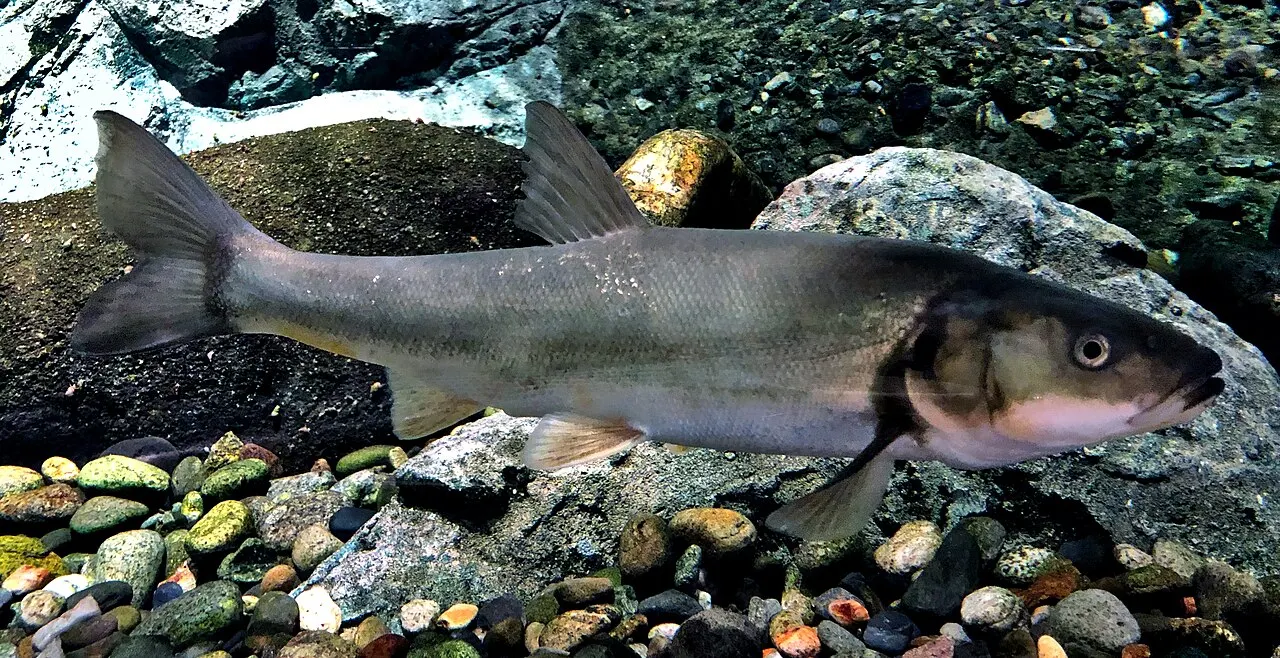
The Ukekuchi-ugui (Pseudaspius nakamurai, formerly Tribolodon nakamurai) is a large river minnow found only in big rivers of Honshu, Japan. Its lower jaw juts out in an underbite that gives it its name, and it was described as a species only in 2000. The IUCN rated it Endangered in 2019.
How to recognise it
This is the biggest of the Japanese daces in its genus. A typical adult is around 60 cm long, and fish up to 80 cm are reported, though FishBase gives a smaller maximum of 50 cm standard length, so the largest figures are not firmly pinned down.
The head is long and flat, and the lower jaw sticks out past the upper one, with a black tip. Ordinary Japanese dace have a mouth that points slightly downward, so the jaw is a quick way to tell them apart. Spawning males show a single red vertical band on the belly, and the lateral line has more than 85 scales.
Where it lives
It is endemic to Japan, in large rivers that drain into the Sea of Japan in Niigata, Yamagata, Akita and Nagano prefectures, including the Agano, Mogami and Shinano systems. The IUCN assessment lists rivers as its habitat, along with canals and drainage channels. It gives an extent of occurrence of about 24,500 square km but an area of occupancy of only about 384 square km.
Nagano's fisheries station says the fish was common in the Chikuma River until about 1950, then declined and was gradually forgotten. On 7 May 2007 an angler fishing for ordinary dace in Nagano City caught a 60 cm one, the first confirmed record in the prefecture in 16 years.
Pins are Wikidata “endemic to” fields. Orange dots, when present, are GBIF occurrence tiles — survey bias included.
How it lives
Its biology is poorly known. FishBase says it feeds on bottom-living invertebrates and small fish. Spawning is believed to take place around June in the upper to middle reaches of large rivers.
A late discovery
The ichthyologist Nakamura first found the fish in 1963 during a survey of the Tadami River system in Fukushima Prefecture. Its status stayed unclear for decades. Genetic differences from related dace, and the fact that it does not hybridise with them, supported Doi and Shinzawa in describing it as a new species in 2000.
Why it is in trouble
The 2019 assessment (criterion B2ab(iii,v)) records a decreasing population in only three locations. Listed threats include small dams, other ecosystem modifications, small-holder farming and small-scale harvest. It is sometimes caught without being told apart from other dace.
FishBase rates it as having very low resilience, with a minimum population doubling time of more than 14 years, so a depleted population recovers slowly. The assessment lists resource and habitat protection, site protection and awareness work as conservation actions. Japan's Ministry of the Environment also lists it as Endangered.
Sources
Written for this catalog in our own words from the sources below, checked against them on 12 November 2026. Population figures are estimates and carry the year they were made. Status and assessment year: IUCN. 2026. The IUCN Red List of Threatened Species. Version 2026-1. iucnredlist.org.




