Critically Endangered
Cozumel thrasher
Toxostoma guttatum
The Cozumel thrasher is a streaky brown songbird found only on Cozumel, an island off Mexico's Yucatan coast. Last assessed in 2020 as Critically Endangered, with 1 to 49 birds estimated, its last confirmed sighting was a single bird in June 2004.
How to recognise it
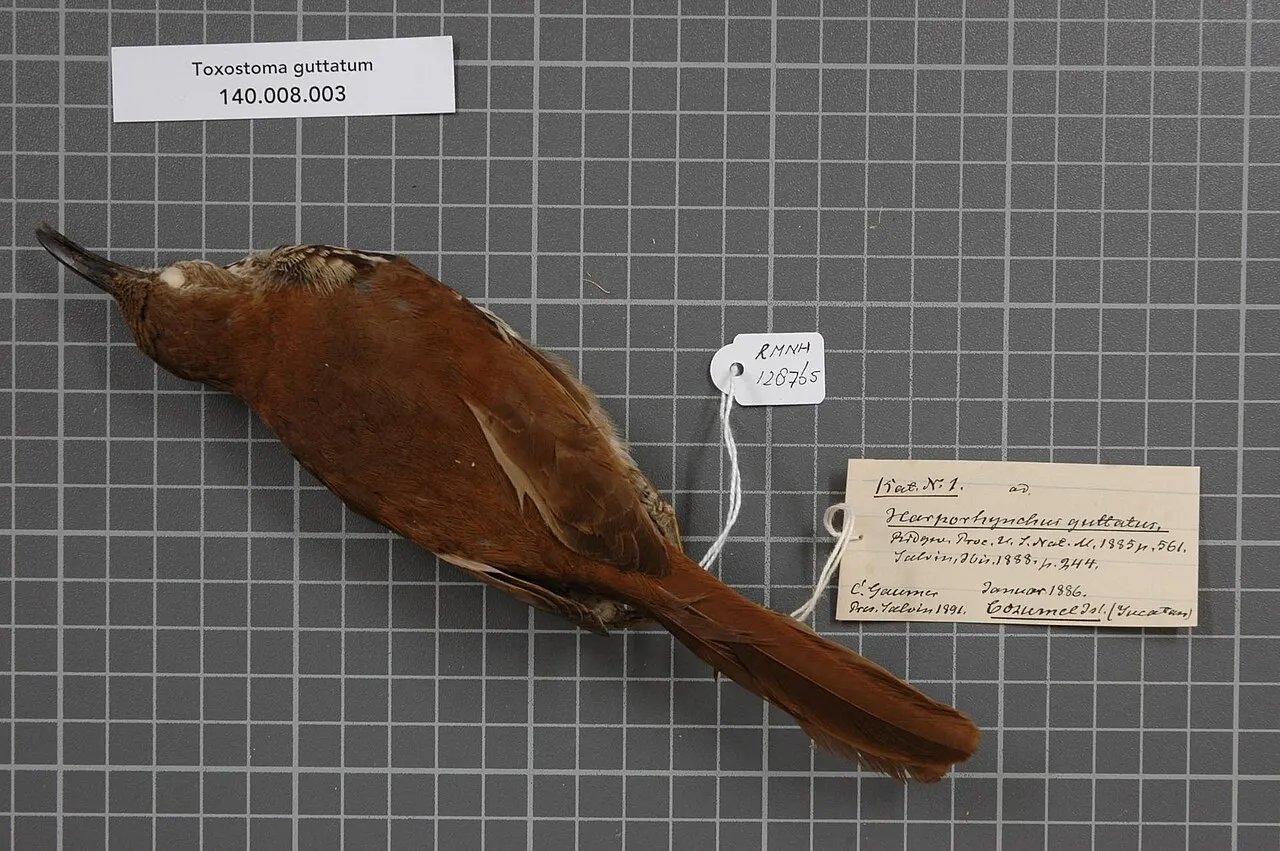
This is a mockingbird relative about 21 to 24 cm long, with a long, downcurved bill. It is brown above, rich chestnut in the IUCN description, with two white wing bars. The underparts are pale, marked with black teardrop-shaped spots, and the eye is yellow.
On Cozumel it has no thrasher neighbours. The related long-billed thrasher is larger, at 26.5 to 29 cm, while the Cozumel bird is smaller and darker with sharper markings. The song is a rich, scratchy warble.
Where it lives
The species is endemic to Cozumel, an island about 45 km long and 20 km wide. The IUCN treats the whole range as a single location, and records the bird as a non-migrant that stays on the island all year.
The Red List gives its habitats as dry forest, moist lowland forest and moist shrubland. It may once have been commonest at forest edges beside clearings.
Pins are Wikidata “endemic to” fields. Orange dots, when present, are GBIF occurrence tiles — survey bias included.
How it lives
Like other thrashers, it spends much of its time on the ground and tends to run rather than fly when startled. It has a reputation for being secretive and hard to see, which makes surveys difficult. Young birds in juvenile plumage have never been described.
Why it is in trouble
Scientists estimated in 2004 that up to 10,000 thrashers once lived on the island. Numbers dropped sharply after Hurricane Gilbert in September 1988, and the bird then went unrecorded after 1995, the year Hurricane Roxanne hit. It was widely assumed to be extinct until a field team sighted a single bird in June 2004.
Searches since have turned up little. An April 2006 survey produced one possible sighting, and none were found in a December 2006 survey. Reports from October and December 2007 could not be confirmed in January 2008. The 2020 Red List assessment puts the population at 1 to 49 birds and decreasing, and lists the species under criterion D, which covers very small populations.
Hurricanes are not thought to be the whole story, since the bird probably survived storms for thousands of years. Boa constrictors released on the island in 1971 are now abundant and may have preyed on the thrashers. The IUCN assessment lists storms as a high-impact ongoing threat, and boas and feral cats as medium-impact ones. Tourism development and future habitat change are also listed.
What is being done
The IUCN says the species occurs in at least one protected area, but it recommends formal protection for the island's interior lands and an awareness campaign aimed at visitors. Research on population size, life history and conservation actions is listed as needed.
Fieldwork has been carried out by Mexican and American groups, including Villanova University, with funding from Conservation International and the Philadelphia Zoo. The 2020 assessment records no recovery plan, no systematic monitoring and no captive population.
Sources
Written for this catalog in our own words from the sources below, checked against them on 12 November 2026. Population figures are estimates and carry the year they were made. Status and assessment year: IUCN. 2026. The IUCN Red List of Threatened Species. Version 2026-1. iucnredlist.org.




