Endangered
Tokyo bitterling
Tanakia tanago
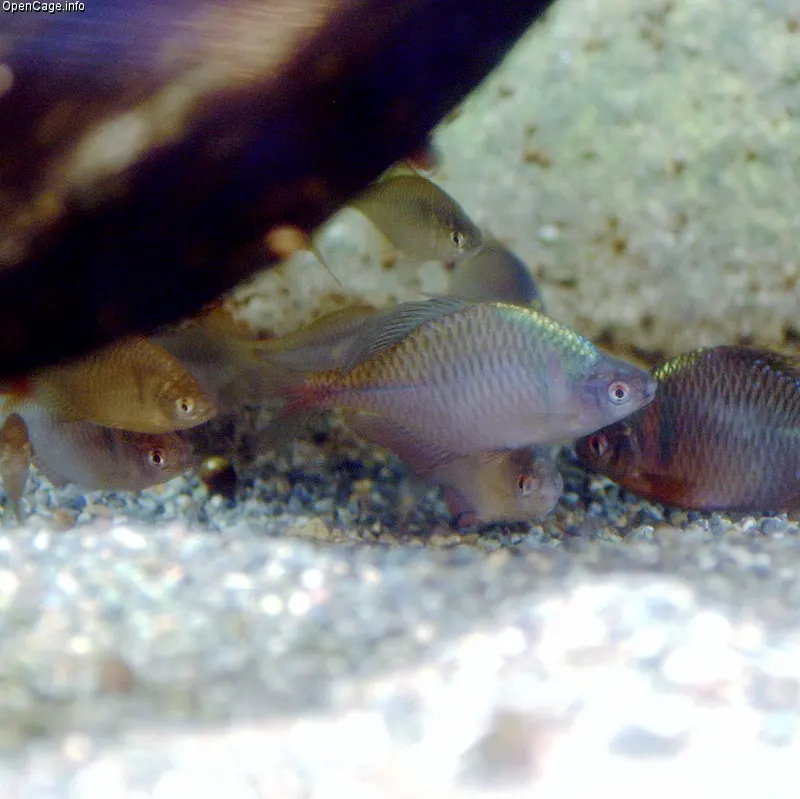
The Tokyo bitterling (Tanakia tanago, also placed in Pseudorhodeus) is a tiny freshwater fish found only on Honshu, Japan, around the Kanto Plain near Tokyo. The IUCN Red List rated it Endangered in 2019. It lays its eggs inside living freshwater mussels, so its survival is tied to theirs.
How to recognise it
It is a small member of the bitterling family, reaching at most about 5 cm in total length according to FishBase. It is a bottom-to-midwater fish of small streams.
The scientific name has shifted. Shigeho Tanaka described it in 1909 as Rhodeus tanago. Most sources still use Tanakia tanago, but a 2014 genetic study supported placing it in its own genus, Pseudorhodeus, and FishBase now lists it under that name.
Where it lives
In the wild it is found only on the Kanto Plain of Honshu, near Tokyo. The IUCN assessment lists permanent streams and also artificial canals and drainage ditches as habitat, and counts 12 locations. Estimated area of occupancy is just 48 square kilometres inside an extent of occurrence of about 2,200 square kilometres.
Pins are Wikidata “endemic to” fields. Orange dots, when present, are GBIF occurrence tiles — survey bias included.
How it lives
Bitterlings lay their eggs in freshwater mussels. The Tokyo bitterling is reported to use just one mussel species, Pronodularia japanensis. A 2010 study in Zoological Science, by Akiyama and Maruyama, looked at a small stream inside a protected area and found the mussels were less common on soft sediment and more common where the flow was faster. A change in the stream bed could therefore affect both mussel and fish.
Young fish need cover too. A study of a canal in southeastern Tochigi found juveniles were more likely where there was underwater cover and where eggs had been laid in nearby mussels, and less likely in faster current.
Why it is in trouble
Small streams on the Kanto Plain, once home to many of these fish, have been overrun by development and pollution. The assessment lists herbicides and pesticides, small-holder farming, small dams, named species and some small-scale harvest as pressures, and it records a decreasing and severely fragmented population in 12 subpopulations. It gives a population-size figure of 2,533 fish.
The related rosy bitterling competes with it and is reportedly the more aggressive of the two.
What is being done
Japan has declared the fish a natural monument, which gives it legal protection. The assessment records invasive species control and captive (ex situ) conservation as actions in place, and lists habitat restoration, species recovery and reintroduction among the actions needed.
In the Tochigi canal, workers dug out the bottom, drove in stakes and added mussels. Juveniles were more numerous at restored spots (99, about 71 percent of all juveniles counted) than at untouched ones (41, about 29 percent).
Sources
Written for this catalog in our own words from the sources below, checked against them on 12 November 2026. Population figures are estimates and carry the year they were made. Status and assessment year: IUCN. 2026. The IUCN Red List of Threatened Species. Version 2026-1. iucnredlist.org.




