Endangered
Togian babirusa
Babyrousa togeanensis
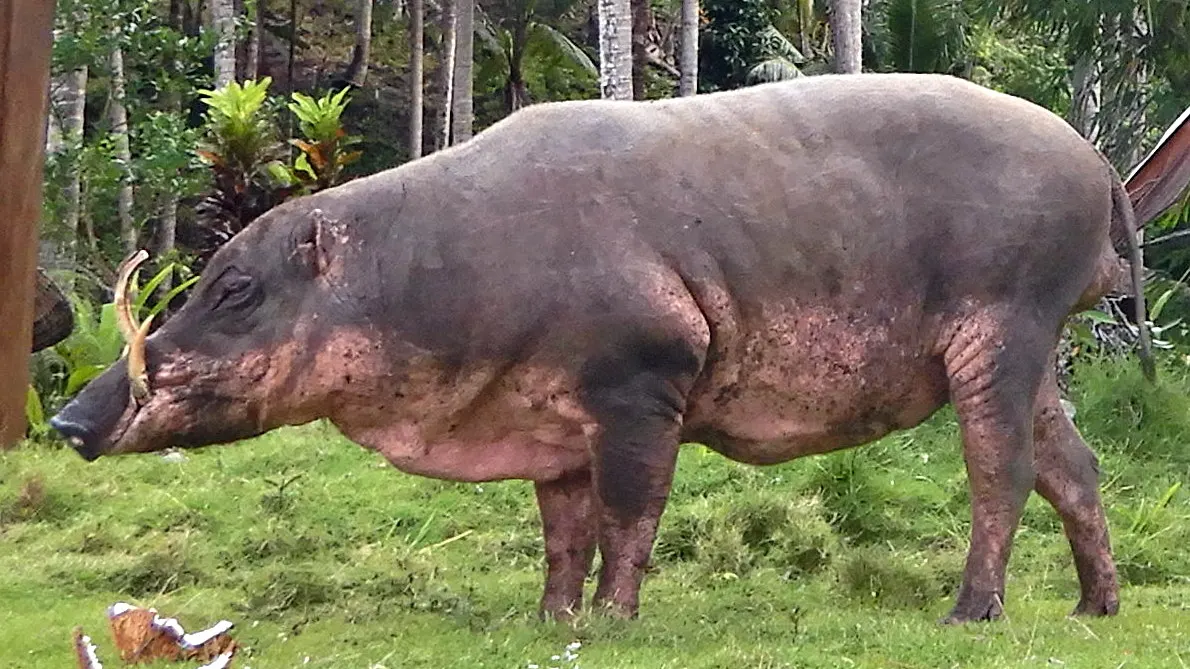
The Togian babirusa is a wild pig found only on a few islands in the Togian archipelago off Sulawesi, Indonesia. It is the largest of the babirusas, and males carry long, odd tusks. The IUCN Red List classed it as Endangered in 2016, with about 1,000 animals or fewer thought to remain.
How to recognise it
Three measured specimens had a head and body length of roughly 88 to 106 cm, with a tail of 27 to 32 cm. No weights have been recorded, but adult males are estimated at 100 kg or more. The sparse hair runs from pale fawn to black, so individual animals can look almost golden or almost black, with a whitish belly and inner legs.
The tail ends in a well-developed tuft. Males grow long tusks from their canine teeth. The upper canines are short and slender and converge at the tips.
Where it lives
It is found on four islands, Batudaka, Togean, Talatakoh and Malenge. Tracks have also been reported from little Kadidiri Island. Until 2002 it was treated as a subspecies of the north Sulawesi babirusa.
Its natural home is wet forest, but it also turns up in gardens, regrowing scrub on old farm clearings, village edges, freshwater swamps and beaches. On Malenge and Kadidiri it is most often seen moving through coconut plantations. The IUCN gives its extent of occurrence as about 980 square kilometres.
Pins are Wikidata “endemic to” fields. Orange dots, when present, are GBIF occurrence tiles — survey bias included.
How it lives
Babirusas are omnivores. This one eats rhizomes, tubers and fallen fruit, including wild mango and breadfruit relatives, plus worms and beetle larvae. Unlike most pigs it doesn't plough the ground with its snout. It paws at the soil to loosen plants. It also wallows in mud and has been reported swimming between islands.
Interviews with local people disagree on its social life. Some describe lone animals (37 percent of respondents), others a pair with young, others groups of more than five with one male and several females. Up to eleven have been recorded at a single wallow. Farmers report two or three young per litter, while another account suggests one or two.
Why it is in trouble
The numbers are small and scattered. The IUCN estimated about 1,000 individuals in 2016, with no group larger than about 250, and records the population as fragmented and still declining. An older estimate for 1978 put it at 500 to 1,000, and some more recent estimates give an upper limit near 500. None of these come from a full census.
Forest clearing for farming, forest fires, dogs and killing by farmers who see it as a crop pest all weigh on it. About two thirds of Malenge's forest was damaged by fire in 1998, although babirusas were seen in several burned areas afterward. Hunting for meat is reported only in a few non-Muslim villages.
What is being done
The whole genus has had full protection under Indonesian law since 1931, and the Togian babirusa has been on CITES Appendix I since 2017. It occurs in at least one protected area. The IUCN lists site protection, harvest management and awareness work among the actions in place or needed.
Sources
Written for this catalog in our own words from the sources below, checked against them on 12 November 2026. Population figures are estimates and carry the year they were made. Status and assessment year: IUCN. 2026. The IUCN Red List of Threatened Species. Version 2026-1. iucnredlist.org.




