Endangered
Timor Yellow Tiger
Parantica timorica
The Timor yellow tiger (Parantica timorica) is a large, slender butterfly, a tiger butterfly named for its yellow markings, found only on the island of Timor. The IUCN Red List rates it Endangered, but that assessment dates from 1996. Very little has been published about how it lives.
What it is
It belongs to the tiger butterflies, the genus Parantica, which has about 40 species ranging from southeastern Asia through Indonesia to Papua New Guinea and the Philippines. Most are large, slender and dark, with white or pale blue markings. This species is named for yellow ones.
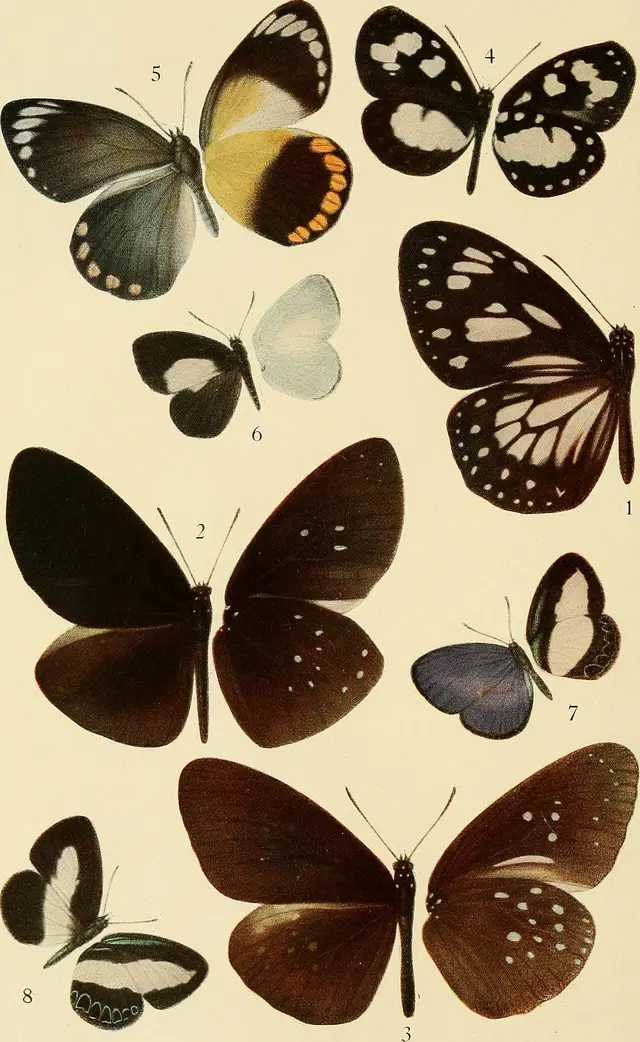
Grose-Smith named it in 1887 in a different genus, Mangalisa, and it is now placed in Parantica. An 1892 hand-coloured plate by Grose-Smith and Kirby, where it is labelled Asthipa timorica, shows dark wings crossed by yellow bands with small white spots at the edges.
Where it lives
The species is endemic to Timor, an island shared between Indonesia and Timor-Leste. The Red List assessment names only Indonesia, but the global biodiversity database GBIF also holds records from Timor-Leste, so the butterfly is not confined to the Indonesian half.
The public record is small. GBIF lists just six occurrences. Four are preserved museum specimens labelled with places in central Timor, including a river called Daisouli and a locality written as Boeloe Boeloe. The other two are research-grade iNaturalist photographs from Aileu district in Timor-Leste, one from July 2025 and one from February 2026.
Pins are Wikidata “endemic to” fields. Orange dots, when present, are GBIF occurrence tiles — survey bias included.
Why it is in trouble
The IUCN assessed the species as Endangered in 1996 under its range-size criteria (B1+2c). That is the only assessment on file, so the rating rests on information almost 30 years old. The entry gives no population trend, no habitat description and no list of threats.
Many other Parantica species are island endemics that the Red List treats as threatened, and a butterfly with a single-island range has little room for error if its habitat shrinks.
What is being done
No conservation actions or research are recorded for the species on the Red List. The 2025 and 2026 photographs show that it was still flying in Timor-Leste recently, which is the most current sign of it that can be found.
Sources
Written for this catalog in our own words from the sources below, checked against them on 12 November 2026. Population figures are estimates and carry the year they were made. Status and assessment year: IUCN. 2026. The IUCN Red List of Threatened Species. Version 2026-1. iucnredlist.org.