Endangered
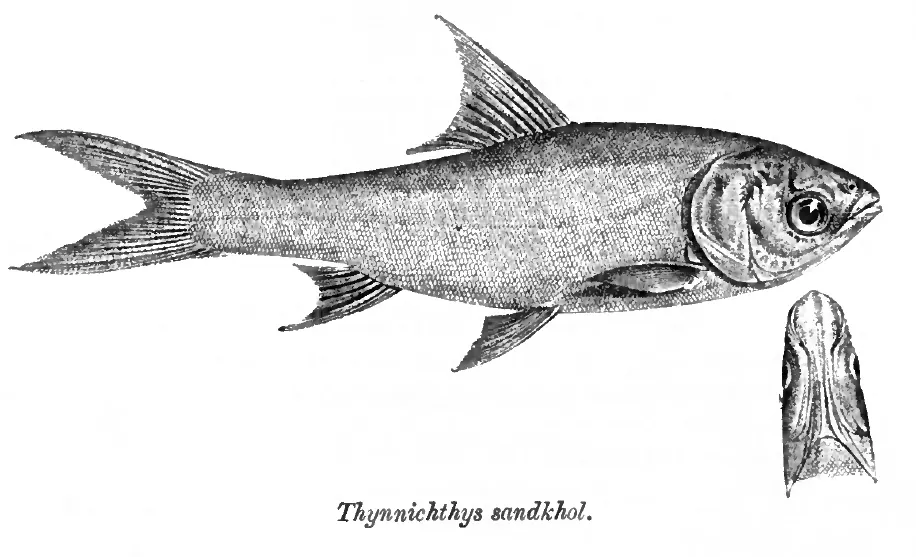
Thynnichthys sandkhol
Thynnichthys sandkhol
The sandkhol carp (Thynnichthys sandkhol) is a freshwater fish of peninsular India, found in the Krishna and Godavari river systems. The IUCN Red List rated it Endangered in 2011 and describes its population as decreasing. It grows to about 46 cm and is farmed in ponds as well as fished.
Where it lives
The sandkhol carp is a member of the carp family (Cyprinidae) and is endemic to India. The IUCN lists it from Maharashtra, Andhra Pradesh and Karnataka, in the Krishna and Godavari basins. FishBase also records it from the Mahanadi system.
It's a river fish, living in both permanent and seasonal rivers and streams. The assessment also rates large artificial water-storage areas as suitable habitat, which suggests it copes with reservoirs. William Henry Sykes described it in 1839 under the name Leuciscus sandkhol.
Pins are Wikidata “endemic to” fields. Orange dots, when present, are GBIF occurrence tiles — survey bias included.
How it lives
Adults reach about 46 cm in total length. They feed on algae, protozoans, rotifers and small crustaceans. FishBase describes the species as potamodromous, meaning it migrates within fresh water rather than out to sea, and the IUCN classes it as a full migrant.
It doesn't breed in ponds. In South India it is nonetheless cultured in ponds, with fry collected from the wild to stock them. FishBase classes it as commercially important in both fisheries and aquaculture, and rates its vulnerability to fishing as moderate.
Why it is in trouble
The 2011 assessment (criteria A2, A3 and A4) estimates a population reduction of 50 to 60 percent, counted across past, ongoing and projected future change. It records a continuing decline in the area the fish occupies, estimated at about 400 square kilometres, across three to five locations.
The threats it lists are mostly water quality and habitat damage. Agricultural run-off and sewage each affect the majority of the population, and mining and quarrying add to the damage. Competition from other carp-family fish is rated as the highest-impact threat, with effects across the whole population.
What is being done
Little has been done directly. At the time of assessment there was no recovery plan, no systematic monitoring and no harvest management plan, and the species was not under any trade controls. Conservation sites had been identified over part of the range. The actions the IUCN calls for are habitat and resource protection, harvest management and captive breeding.
Sources
Written for this catalog in our own words from the sources below, checked against them on 12 November 2026. Population figures are estimates and carry the year they were made. Status and assessment year: IUCN. 2026. The IUCN Red List of Threatened Species. Version 2026-1. iucnredlist.org.




