Critically Endangered
Thomasset's Seychelles Frog
Sooglossus thomasseti
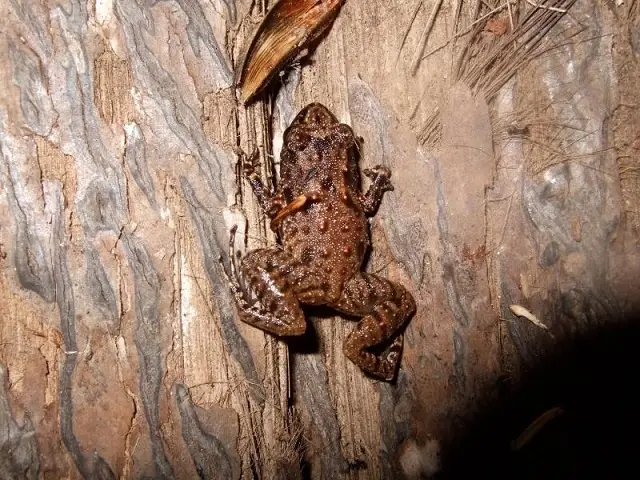
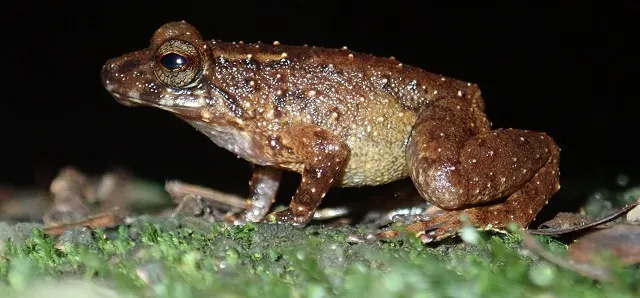
Thomasset's Seychelles frog (Sooglossus thomasseti) is a rock-dwelling frog found only on two islands in the Seychelles, Mahé and Silhouette. The IUCN Red List rated it Critically Endangered in 2025. It is the largest native frog in the archipelago and is considered the rarest.
How to recognise it
It belongs to the Sooglossidae, a small family of frogs found only in the Seychelles, and it's the biggest native frog there. Edge of Existence gives its length as about 55 mm, while Nature Seychelles puts adults at 35 to 45 mm, so published sizes vary.
It climbs well and is usually seen at night on rocks and large boulders. Its call is longer than those of its relatives, opening with a guttural note repeated three or four times.
Where it lives
There are two known populations, one on Silhouette Island and one on Mahé. On Mahé it occurs inside Morne Seychellois National Park. The IUCN lists a single location and an area of occupancy of 44 km2, with records between roughly 210 and 905 m above sea level.
The frog favours wet, relatively undisturbed rocky ground beside streams and dry streambeds, in misty, cloudy forest. The IUCN gives lowland moist forest as its key habitat, along with permanent and seasonal streams. Edge of Existence estimates its true range at under 20 km2.
Pins are Wikidata “endemic to” fields. Orange dots, when present, are GBIF occurrence tiles — survey bias included.
How it lives
Eggs are laid among rocks, and the young hatch as tiny froglets with no tadpole stage. Related frogs guard their nests, so females probably do too, but that hasn't been observed in this species.
A 2019 genetic study of Seychelles sooglossid frogs by Groombridge and colleagues, in the Biological Journal of the Linnean Society, found that populations on different islands are genetically distinct. It advised managing each island population as its own evolutionarily significant unit and proposed the island lineages as candidate species.
Why it is in trouble
The IUCN lists habitat shifting and alteration, invasive species, drought, storms and flooding, and the taking of surface water for homes and farms as threats. Edge of Existence names fire and invasive species as the main causes of habitat damage, and also points to climate change.
A tiny, fragmented range makes the frog easy to hurt, since one fire or storm could hit much of it. Conservation planners also want to keep chytrid fungus, a disease that has devastated amphibians elsewhere, from reaching the islands. The IUCN records the population trend as unknown, though it notes the area the frog occupies is still shrinking.
What is being done
The frog occurs in at least one protected area, Morne Seychellois National Park on Mahé, and part of the Silhouette population lies within a conservation project run by the Nature Protection Trust of the Seychelles. The IUCN lists some animals as held in ex situ conservation and invasive species control as a conservation action. Nature Seychelles, with the RSPB and the Herpetological Conservation Trust, ran a scoping study to design long-term monitoring on Mahé.
A survival blueprint for the frog family, published by Edge of Existence, ranks long-term monitoring in protected areas on all three frog islands, a review of the action plan and laws to limit the arrival of chytrid disease among its critical priorities.
Sources
Written for this catalog in our own words from the sources below, checked against them on 12 November 2026. Population figures are estimates and carry the year they were made. Status and assessment year: IUCN. 2026. The IUCN Red List of Threatened Species. Version 2026-1. iucnredlist.org.