Endangered
Thaumatoperla alpina
Thaumatoperla alpina
Thaumatoperla alpina is a large stonefly found only in the mountain streams of the Bogong High Plains in Victoria, Australia, and is often called the largest Australian stonefly. The IUCN's 2021 assessment lists it as Endangered, with a very small range and a population trend that is unknown.
How to recognise it
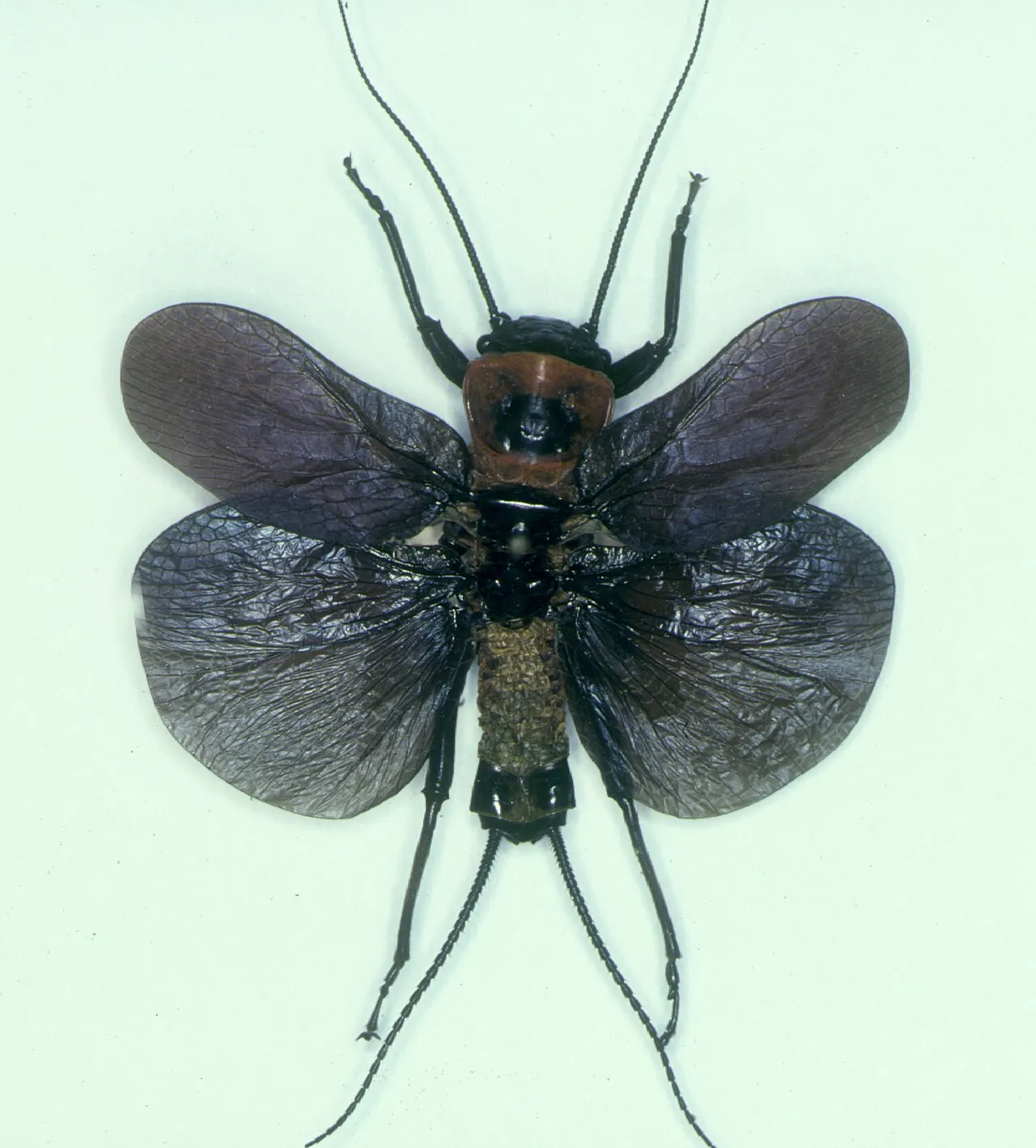
It's big for a stonefly. When A. N. Burns and A. Neboiss described the species in 1957, they measured fresh females at 36 to 44 mm long, with a wingspan of 42 to 51 mm. Males are reportedly smaller. The head, legs and long antennae are black. The oval, rusty orange prothorax (the first body segment behind the head) carries a shiny black mark in the middle, and the pale yellowish-grey abdomen has black markings.
Both pairs of wings are black, and the hindwings show a dark blue iridescence. Despite the wings, adults are reportedly incapable of flight. The nymphs reportedly spend about three years in the water before they emerge.
Where it lives
The species is endemic to the Bogong High Plains, in the alpine country of Victoria. The IUCN gives its elevation range as 750 to 1,986 m, an extent of occurrence of about 109 km2 and an area of occupancy of about 56 km2, and counts one to three locations. Genetic work reportedly points to three sub-populations separated by the West Kiewa, East Kiewa and Mitta Mitta catchments.
The IUCN lists permanent rivers, streams and creeks as its habitat, and the species is described as living in alpine heathland streams. The nymphs reportedly live in the saturated gravel beside and beneath the water, and adults emerge between January and April. The holotype, a female collected on 18 April 1954 at Mount Fainter, was resting on a stump about 50 yards from the nearest running water.
Pins are Wikidata “endemic to” fields. Orange dots, when present, are GBIF occurrence tiles — survey bias included.
How it lives
Where introduced rainbow trout are absent, the nymphs are reportedly the top predators in their streams. The IUCN gives a generation length of 3 to 4 years.
The first specimen brought alive to the National Museum in Melbourne was a female carrying a mass of 1,029 eggs, each about 1 mm long, held against the underside of the end of her abdomen. Once placed in water the eggs separated, and each became enclosed in a clear gelatinous capsule.
Why it is in trouble
The Red List assessment qualifies it as Endangered on its tiny range, one to three locations and a continuing decline in the area it occupies. The listed threats are drought, an increase in fire frequency and intensity, temperature extremes, large dams, and tourism and recreation areas and activities. The population trend is recorded as unknown, and no population estimate exists.
The Atlas of Living Australia records it as Endangered under both national and Victorian listings.
What is being done
The 2021 assessment records no conservation actions in place. No species-specific recovery programme appears in it.
Sources
Written for this catalog in our own words from the sources below, checked against them on 12 November 2026. Population figures are estimates and carry the year they were made. Status and assessment year: IUCN. 2026. The IUCN Red List of Threatened Species. Version 2026-1. iucnredlist.org.




