Endangered
Thaumatodon hystricelloides
Thaumatodon hystricelloides
Thaumatodon hystricelloides is a small air-breathing land snail in the family Endodontidae, found only in Samoa. The IUCN Red List rated it Endangered in 1996, and that assessment has not been updated since. Very little has been published about it beyond old museum specimens.
How to recognise it
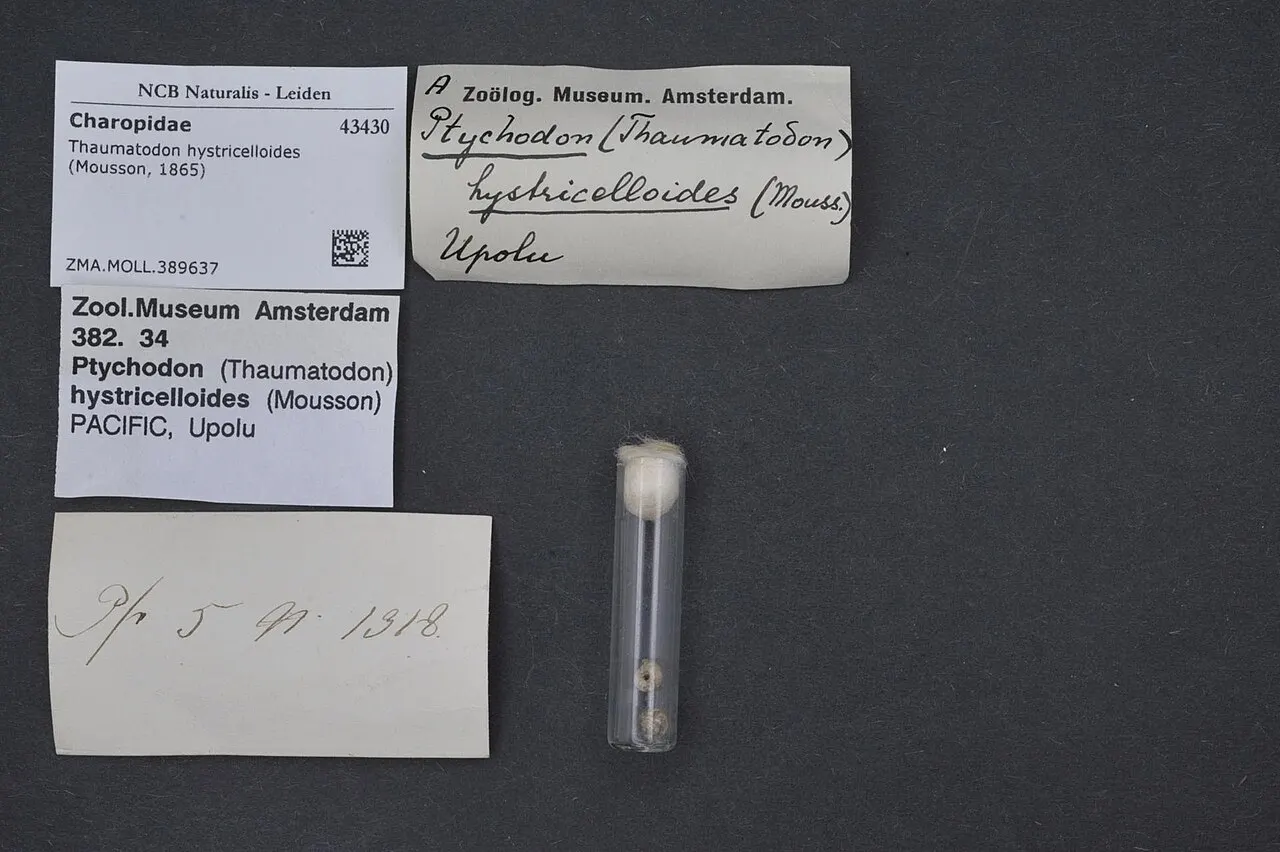
This is a small terrestrial snail, an air-breathing pulmonate. It belongs to the Endodontidae, a family of small land snails. Albert Mousson described it in 1865 under the name Patula hystricelloides, and it was later moved to the genus Thaumatodon.
Detailed descriptions of its shell are hard to find, and most of what is on record comes from preserved museum specimens.
Where it lives
The IUCN lists Samoa as the only country, and marks the species as endemic there. Records in the Global Biodiversity Information Facility, 38 in all and almost all preserved museum specimens, point mainly to Upolu. Collection sites include the rim of Lake Lanuto'o crater and a slope of Mount Siga'ele, both on Upolu. The dated records run from 1868 to 1965, with one undated human observation.
The IUCN assessment records the species as living on land, but it lists no habitat type, elevation, population size or population trend.
Pins are Wikidata “endemic to” fields. Orange dots, when present, are GBIF occurrence tiles — survey bias included.
Why it is in trouble
The 1996 assessment used the older version 2.3 of the Red List system and gave criteria A2ce. It lists no threats in its structured data. The wider picture for Samoan land snails is better documented. The New Guinea flatworm (Platydemus manokwari), a snail-eating predator, was brought to Samoa in the 1990s to control the giant African snail. Studies recorded introductions on Savai'i in 1996 to 1998 and in 2001, and the flatworm was already on Upolu by the late 1990s. Researchers caution that not every loss of native snails can be pinned on the flatworm, since some populations were falling earlier and habitat change may also have played a part.
Nothing links this particular snail to the flatworm or to any single cause, and no recent survey is on record. Its true status today is uncertain.
Sources
Written for this catalog in our own words from the sources below, checked against them on 12 November 2026. Population figures are estimates and carry the year they were made. Status and assessment year: IUCN. 2026. The IUCN Red List of Threatened Species. Version 2026-1. iucnredlist.org.




