Critically Endangered
Sardinian Green Bush-cricket
Tettigonia longispina
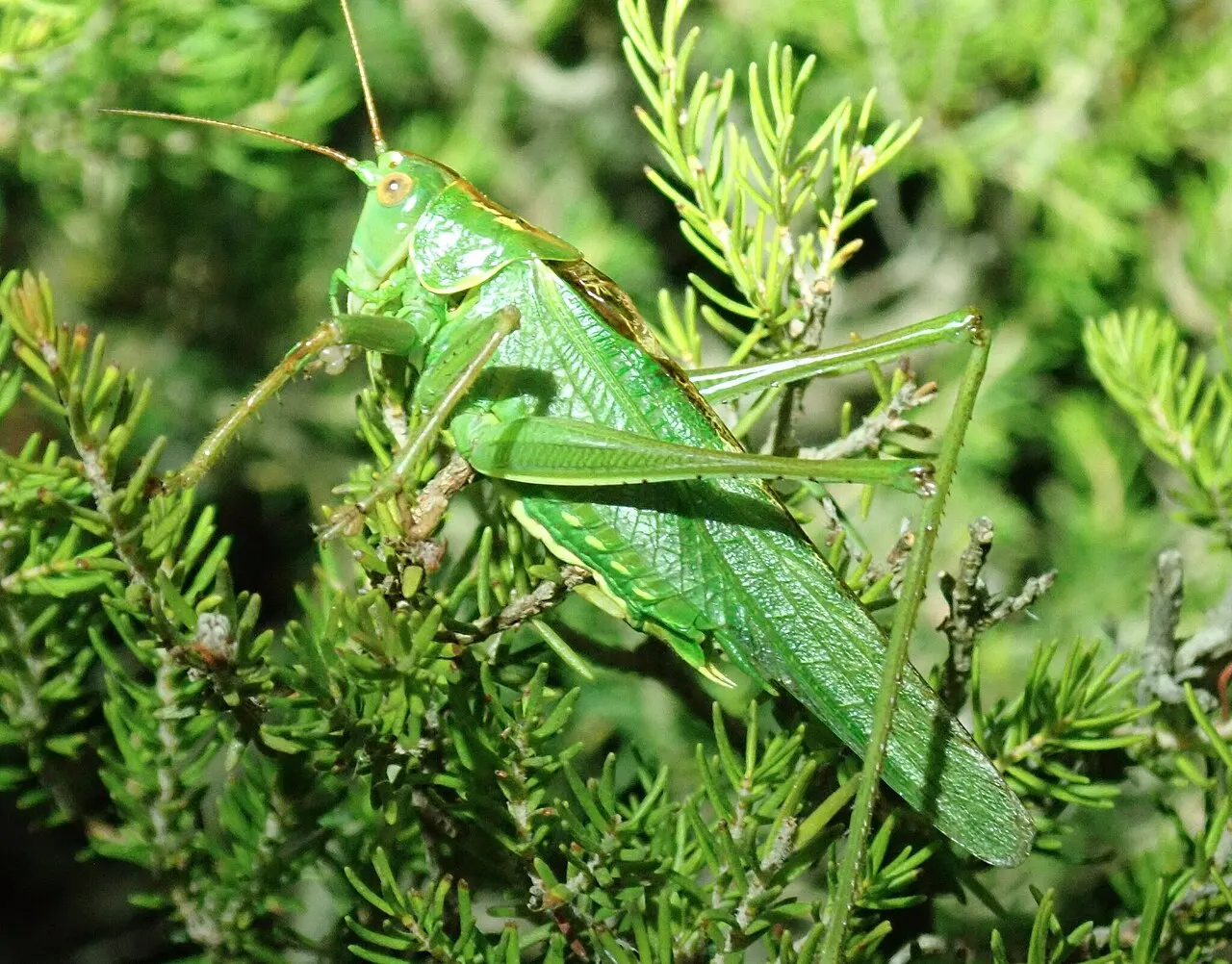
The Sardinian green bush-cricket (Tettigonia longispina) is a green katydid found only in the Gennargentu mountains of Sardinia, Italy. The IUCN's 2016 assessment lists it as Critically Endangered, with a decreasing population across six locations, threatened by tourism, recreation and grazing.
How to recognise it
Sigfrid Ingrisch described Tettigonia longispina in 1983, in the journal Nachrichtenblatt der Bayerischen Entomologen. It resembles the great green bush-cricket, Tettigonia viridissima. The two are easily told apart by the males, which have a much larger tooth on the cerci, the paired appendages at the tip of the abdomen.
Adults are on the wing in summer and autumn. The male's song usually draws attention to a site.
Where it lives
This cricket is endemic to Sardinia, and within the island it is known only from the Gennargentu mountains. It lives above roughly 1,400 m in mountain pasture, in patches of bracken and bramble, among shrubs, and in stands of tree heath. The IUCN lists its habitats as temperate forest and temperate shrubland, and records it as resident and not migratory. The assessment lists no country other than Italy, and no part of Italy other than Sardinia.
Pins are Wikidata “endemic to” fields. Orange dots, when present, are GBIF occurrence tiles — survey bias included.
Why it is in trouble
The assessment rates it Critically Endangered under criteria B1ab(iii,v)+2ab(iii,v), which reflect a tiny range, a limited number of sites and ongoing declines. It counts six locations.
Three threats are listed, each affecting the whole population and causing slow, significant decline: tourism and recreation areas, recreational activities, and small-holder grazing and farming. The pressures on the animals are habitat conversion, habitat degradation and disturbance.
What is being done
The species occurs in at least one protected area. The assessment lists site and area management and habitat restoration as conservation actions, but records no species recovery plan and no systematic monitoring scheme. Research on its life history and on population size, distribution and trends is also listed as needed. The assessment gives no count of individuals, so how many remain is not known.
Sources
Written for this catalog in our own words from the sources below, checked against them on 12 November 2026. Population figures are estimates and carry the year they were made. Status and assessment year: IUCN. 2026. The IUCN Red List of Threatened Species. Version 2026-1. iucnredlist.org.




