Endangered
Teratoscincus rustamowi
Teratoscincus rustamowi
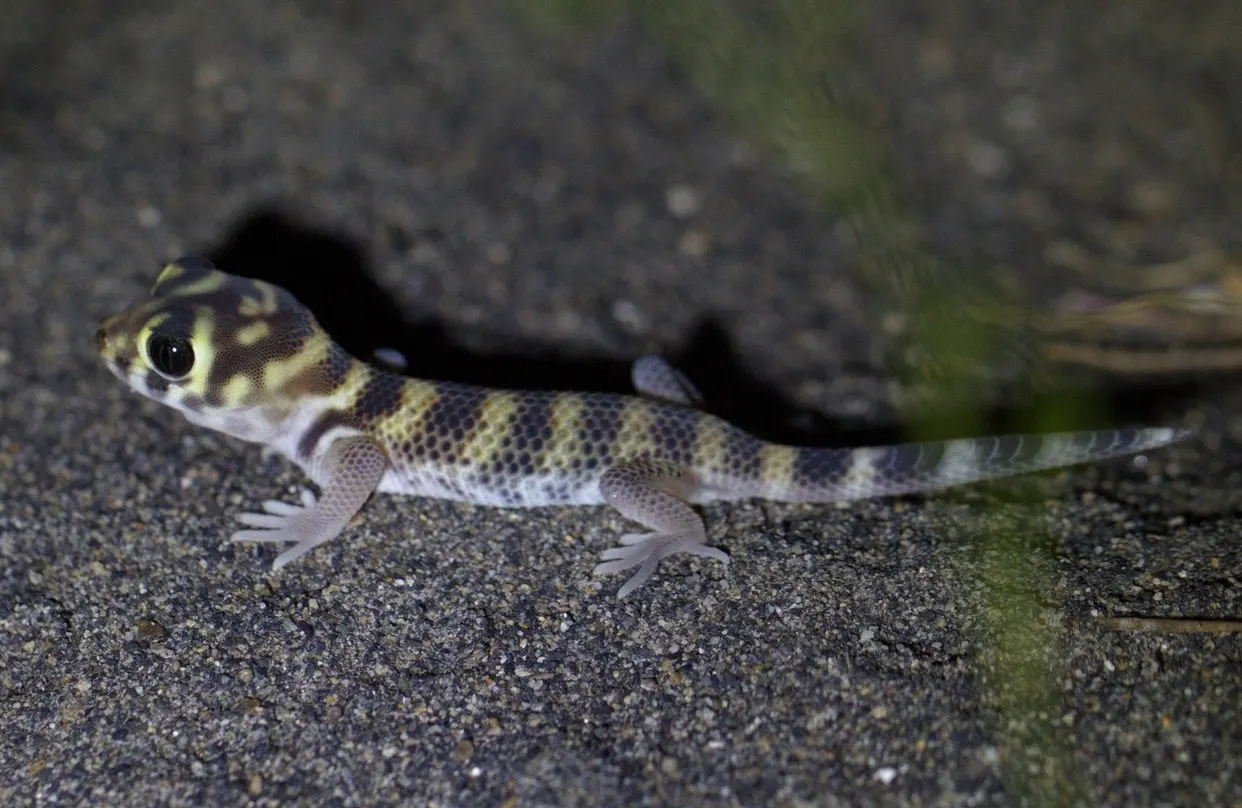
Teratoscincus rustamowi is a small, egg-laying desert gecko from the sandy country of the Fergana Valley in Uzbekistan. It was once treated as a form of the common wonder gecko and was recognised as its own species in the 2010s. The IUCN Red List rated it Endangered in 2021.
How to recognise it
It's a member of the wonder geckos, family Sphaerodactylidae. Adults grow to a snout-to-vent length of up to about 81 mm (3.2 inches), a little smaller than the 90 mm reported for the common wonder gecko, Teratoscincus scincus.
The back is covered in enlarged, overlapping scales, arranged in 26 to 36 lengthwise rows and 32 to 41 crosswise rows. The tail is round in cross-section and carries 11 to 18 enlarged, nail-shaped scales on top. Males and females didn't differ significantly in the characters measured in a 2017 study. The species lays eggs.
Where it lives
The type locality is the sand dunes of central Fergana, between Quqand and Djumashuyi, where the holotype was collected on 8 June 1976. The Reptile Database gives the range as Uzbekistan, in the Fergana Valley, and the IUCN assessment lists the species in Uzbekistan and in Tajikistan. Several other references describe it as endemic to Uzbekistan, so the extent of its range is not settled. The IUCN lists temperate desert and temperate shrubland as its habitat.
The scientific name honours the zoologist A. K. Rustamov.
Pins are Wikidata “endemic to” fields. Orange dots, when present, are GBIF occurrence tiles — survey bias included.
A species with a changing history
Nikolai Szczerbak described it in 1979 as a subspecies of the common wonder gecko. Later authors followed that treatment, until De Lisle and colleagues raised it to species level in 2013. A 2017 study by Nazarov and colleagues also treated it as a species and found no significant size or scale differences between males and females, unlike in the common wonder gecko. In 2020 Bondarenko returned it to subspecies rank, so its status is still debated.
Why it is in trouble
The 2021 assessment judged the population to be shrinking and severely fragmented, with its range continuing to contract. The Endangered rating uses criterion B2ab(ii,iii,v), which applies to a small area of occupancy that is declining.
Three pressures are recorded, each across the whole range: small-holder farming, housing and urban growth, and industrial aquaculture, which is tied to very rapid declines. The assessment states the species doesn't occur in any protected area, and site protection is the only conservation measure it lists. No population estimate is given.
Sources
Written for this catalog in our own words from the sources below, checked against them on 12 November 2026. Population figures are estimates and carry the year they were made. Status and assessment year: IUCN. 2026. The IUCN Red List of Threatened Species. Version 2026-1. iucnredlist.org.




