Critically Endangered
Telegraphic Hedyleptan Moth
Omiodes telegrapha
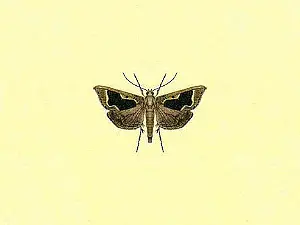
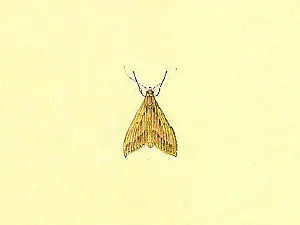
The telegraphic hedyleptan moth, Omiodes telegrapha, is a small Hawaiian moth known from a single specimen collected in or before 1899 on the island of Hawaii. The Red List rated it Critically Endangered (Possibly Extinct) in 2022, inferring no more than 49 mature individuals if it survives at all.
What is known about it
Omiodes telegrapha belongs to the moth family Crambidae. The English entomologist Edward Meyrick described it in 1899 in Fauna Hawaiiensis, the multi-volume survey of Hawaiian wildlife. It has also appeared in the literature under the older names Hedylepta telegrapha and Phostria telegrapha.
Very little else has been written about it. Nothing is recorded about its habitat or ecology, and its host plant is unknown, though grasses are presumed from the habits of similar moths. The one known specimen dates from 1899 or earlier, and no later collection has been reported.
Where it lived
The moth is endemic to the island of Hawaii, the Big Island. The Red List says the single specimen was collected at Keaau, then known as Olaa. The island's whole area is about 12,010 square kilometres, and the species' true extent is certainly smaller, but nobody knows how much. The Red List lists its habitat as unknown.
Pins are Wikidata “endemic to” fields. Orange dots, when present, are GBIF occurrence tiles — survey bias included.
Why it may be gone
Nobody has documented the cause. The Red List assessment notes that threats which hit other Omiodes moths have probably affected this one too. Non-native parasitoid insects, released in Hawaii between 1895 and 1960 to control pest moths on coconut palm and sugarcane, were implicated in the declines of several other native Omiodes. Native Hawaiian plants have also been shrinking under pressure from invasive plants and feral hoofed animals.
A related example shows how fast native Hawaiian moths can vanish. Omiodes continuatalis was one of the most common native moths in Hawaii in the early 1900s, and a PLOS ONE study from the University of Hawaii, reported in 2013, found it extinct on Oahu and Kauai.
Status and what is being done
Different bodies classify the moth differently. The Red List says Critically Endangered (Possibly Extinct) under criterion D, which is used for very small populations, with the assessment dated 2022. An older UNEP-WCMC listing from 1992 called it extinct, and NatureServe lists it as missing.
The assessment records no recovery plan, no monitoring scheme and no identified conservation site, and it is unknown whether any protected area holds the species. It says attempts to collect specimens around the type locality could show whether the moth is still there.
Sources
Written for this catalog in our own words from the sources below, checked against them on 12 November 2026. Population figures are estimates and carry the year they were made. Status and assessment year: IUCN. 2026. The IUCN Red List of Threatened Species. Version 2026-1. iucnredlist.org.