Endangered
Teardrop White-eye
Rukia ruki
The teardrop white-eye (Rukia ruki) is a dark, warbler-like bird with a white teardrop mark below each eye. It lives only on a few small islands in the Faichuk group of Chuuk, Micronesia. The IUCN Red List lists it as Endangered (assessed 2023), with an uncertain 300 to 400 mature birds.
How to recognise it
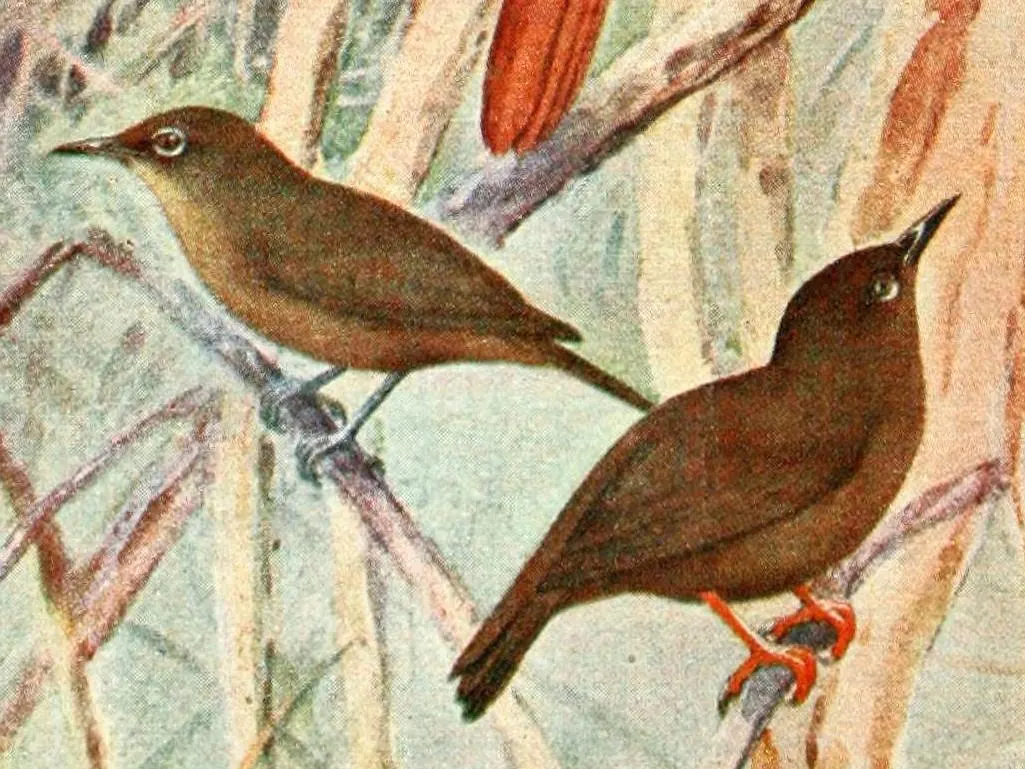
It's a medium-sized, all-dark bird of about 14 cm. The plumage is uniform dark brown, the bill black and the legs orange. The conspicuous white teardrop under the eye is the giveaway. The song is a lively, lilting warble, very like that of the golden white-eye of the Mariana Islands.
Males and females look alike. It is also called the Faichuk white-eye, Truk white-eye or great Truk white-eye. Ornithologist Ernst Hartert described it in 1897, and some authorities argue it is the only true member of its genus.
Where it lives
The bird is confined to the Faichuk group, within Chuuk (formerly Truk) lagoon. Surveys in 1984 found it on Tol South, Onei, Paata and Polle, counting about 530 birds in total, which the Red List treats as roughly 350 mature birds. Since 2010 almost all records have come from Mount Winipot on Tol. Many other sites have not been searched in recent years.
A 1988 paper put its total known range at only about 1 square kilometre. The 2023 Red List gives an extent of 72 square kilometres. It has been recorded in old and secondary native forest, particularly the rich forest of Mount Winipot, and also in native trees mixed with plantations, where it is much less dense. Figs, native palms and the endemic Chuuk poisontree dominate that forest.
Pins are Wikidata “endemic to” fields. Orange dots, when present, are GBIF occurrence tiles — survey bias included.
How it lives
Almost everything known about its breeding comes from a single nest found in April 1984, 20 m up in a poisontree at 350 m. It was a thin, finely woven cup of bark strips, moss and dry fibres, holding one nestling. Over 12 hours the chick was fed 54 times, mostly by one parent, which also did nearly all the brooding. The adults brought moths and other soft insects.
The adults foraged along inner branches and vine tangles rather than the outer foliage, where honeyeaters and other white-eyes were common. The Red List suggests the poisontree may play an important role in the bird's survival, since the only recorded nest was in one.
Why it is in trouble
The only population estimate, 300 to 400 mature birds, rests on the 1984 surveys and is probably optimistic, according to a Red List reviewer. A birder's tally posted during the 2023 review shows at most ten birds on any of six visits to Mount Winipot since 2010, against an average of 22 per transect in 1984. Survey methods differed, but the Red List infers a decline and describes the population as decreasing.
The Red List names habitat loss to small-scale farming and housing, harvest, invasive species, and storms. Large-scale farming cleared forest in the past. Forest on the Tol plateau is relatively undisturbed, and only small-scale timber cutting is reported there, but human pressure is growing across Chuuk. Local disdain for the poisontree is also said to threaten the bird's main habitat.
What is being done
Conservation sites have been identified across its whole range, but the species isn't in a formal protected area, has no recovery plan, and isn't under a monitoring scheme. Site protection (especially of the Mount Winipot forest), education and control of invasive species are the actions listed as needed. The Red List notes that recent on-ground access to the population has not been possible, so basic counts are still missing.
Sources
Written for this catalog in our own words from the sources below, checked against them on 12 November 2026. Population figures are estimates and carry the year they were made. Status and assessment year: IUCN. 2026. The IUCN Red List of Threatened Species. Version 2026-1. iucnredlist.org.




