Endangered
Tate's Triok
Dactylopsila tatei
Tate's triok (Dactylopsila tatei), also called the Fergusson Island striped possum, is a rare tree-living marsupial known only from Fergusson Island, off the eastern tip of Papua New Guinea. It has been listed as Endangered since 1994, and the current assessment dates from 2016.
How to recognise it
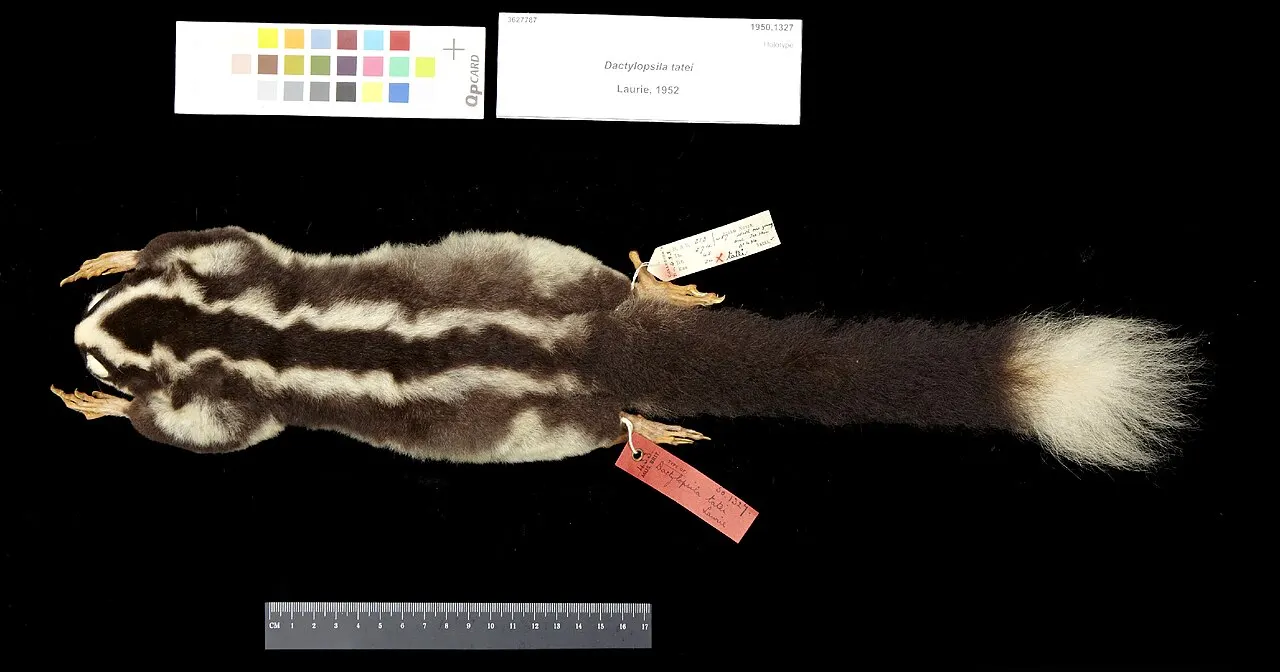
Tate's triok belongs to the striped possums, a small group of marsupials with black fur marked by white stripes down the back. One reference gives its weight as 420 to 470 g.
Striped possums are built for hunting insect larvae inside wood. They have a very long fourth finger for probing and a wrist structure used to tap on bark, and scent glands that give off a strong smell.
Where it lives
The species is found only on Fergusson Island in the D'Entrecasteaux Islands of Milne Bay Province. The first specimen, described by Eleanor Laurie in 1952, came from the mountains above Taibutu village in the Faralulu district of West Fergusson Island, at about 2,000 to 3,000 feet.
The IUCN gives an elevation of 600 to 1,000 m and treats the whole range as a single location. Its habitats are lowland and montane moist forest.
Pins are Wikidata “endemic to” fields. Orange dots, when present, are GBIF occurrence tiles — survey bias included.
How it lives
Very little has been recorded about this particular species. It is thought to be nocturnal and to live in trees, sleeping through the day in dry leaf nests inside tree hollows, as striped possums generally do. The diet is mainly insects, with some fruit and leaves.
Why it is in trouble
The IUCN names shifting agriculture and small-holder farming as the threats, both converting and degrading the forest it needs. It records an ongoing decline in the area of habitat, but the population trend is listed as unknown, and no population estimate exists.
Its small range on one island is a key weakness, and the species is rarely recorded.
What is being done
The IUCN says conservation sites have been identified across its entire range, but that the animal does not occur in any protected area. No recovery plan or monitoring is listed.
Sources
Written for this catalog in our own words from the sources below, checked against them on 12 November 2026. Population figures are estimates and carry the year they were made. Status and assessment year: IUCN. 2026. The IUCN Red List of Threatened Species. Version 2026-1. iucnredlist.org.




