Endangered
Giant wall gecko
Tarentola gigas
The giant wall gecko (Tarentola gigas) is one of the largest geckos in the world, and it lives on two small, uninhabited islets in Cape Verde, Raso and Branco. The IUCN Red List rated it Endangered in 2013, mainly because its range is so tiny. Its numbers are expected to swing with drought.
How to recognise it
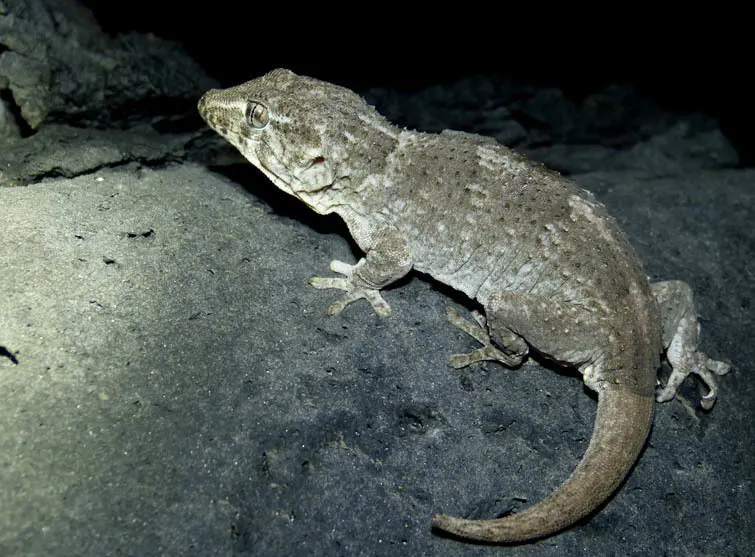
It's a big, grey-backed, nocturnal gecko, reaching about 15.5 cm (6 inches) from snout to vent, which is not counting the tail. Two subspecies are recognised, Tarentola gigas gigas and Tarentola gigas brancoensis.
Where it lives
Raso and Branco are small islets in the Cape Verde (Cabo Verde) archipelago off West Africa. Both are Integral Nature Reserves and are uninhabited. A 2013 review of Cape Verde's reptiles in the journal Oryx found that both subspecies live on small islets and have extremely restricted ranges, among the smallest of the archipelago's endemic reptiles. The IUCN counts two locations for the species and an extent of occurrence of about 10 square kilometres.
The IUCN lists its habitat as sea cliffs and rocky offshore islands. Some accounts also place it on São Nicolau, but the CIBIO research programme that has studied it describes it as an endemic of Raso and Branco.
Pins are Wikidata “endemic to” fields. Orange dots, when present, are GBIF occurrence tiles — survey bias included.
How it lives
It's reportedly a generalist feeder, taking plants, small vertebrates and invertebrates such as beetles and flies. The 2013 Oryx review says both subspecies have feeding relationships with birds, and that cyclic droughts are a likely cause of swings in their numbers. Beyond that, little is documented about its diet and behaviour, and its population size is unknown.
Why it is in trouble
The main issue is that the whole species sits on two tiny pieces of rock. The IUCN records drought as an ongoing threat and lists cats, black rats and house mice as future threats if they reach the islets. It also lists accidental killing and intentional use of the species among the threats, the latter affecting a minority of the population.
Its range has also shrunk, and it reportedly once lived on São Vicente and Santa Luzia before people settled the islands. The IUCN currently records the population trend as stable.
What is being done
Both islets are reserves. The IUCN lists site management, national and international action, awareness work, invasive species control and harvest and trade management among its conservation actions. A 2016 CIBIO-InBIO project funded by Fondation Ensemble aimed to map the gecko's range, estimate numbers, study its prey and train local researchers.
The Oryx review called for better annual estimates of the number of mature individuals, and for research, policy action and control of invasive and competing species. A 2002 Cape Verdean law already lists both subspecies as Endangered.
Sources
Written for this catalog in our own words from the sources below, checked against them on 12 November 2026. Population figures are estimates and carry the year they were made. Status and assessment year: IUCN. 2026. The IUCN Red List of Threatened Species. Version 2026-1. iucnredlist.org.




