Endangered
Tarbagan marmot
Marmota sibirica
The tarbagan marmot (Marmota sibirica) is a big, colonial burrowing rodent of the Central Asian steppe, found in Mongolia, southern Siberia and northeastern China. The IUCN Red List has it as Endangered (assessed 2016) after a steep fall in numbers driven mostly by hunting for fur, meat and body parts.
How to recognise it
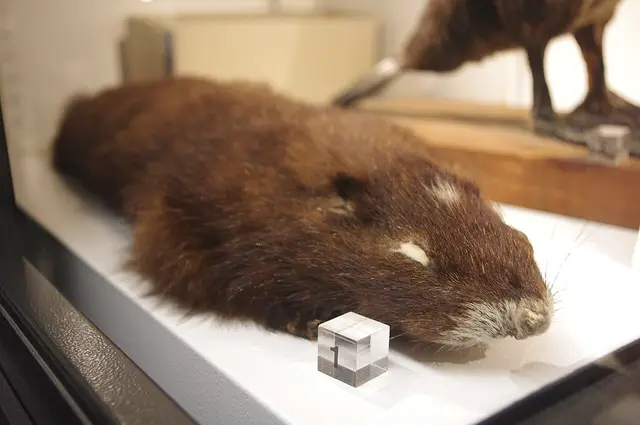
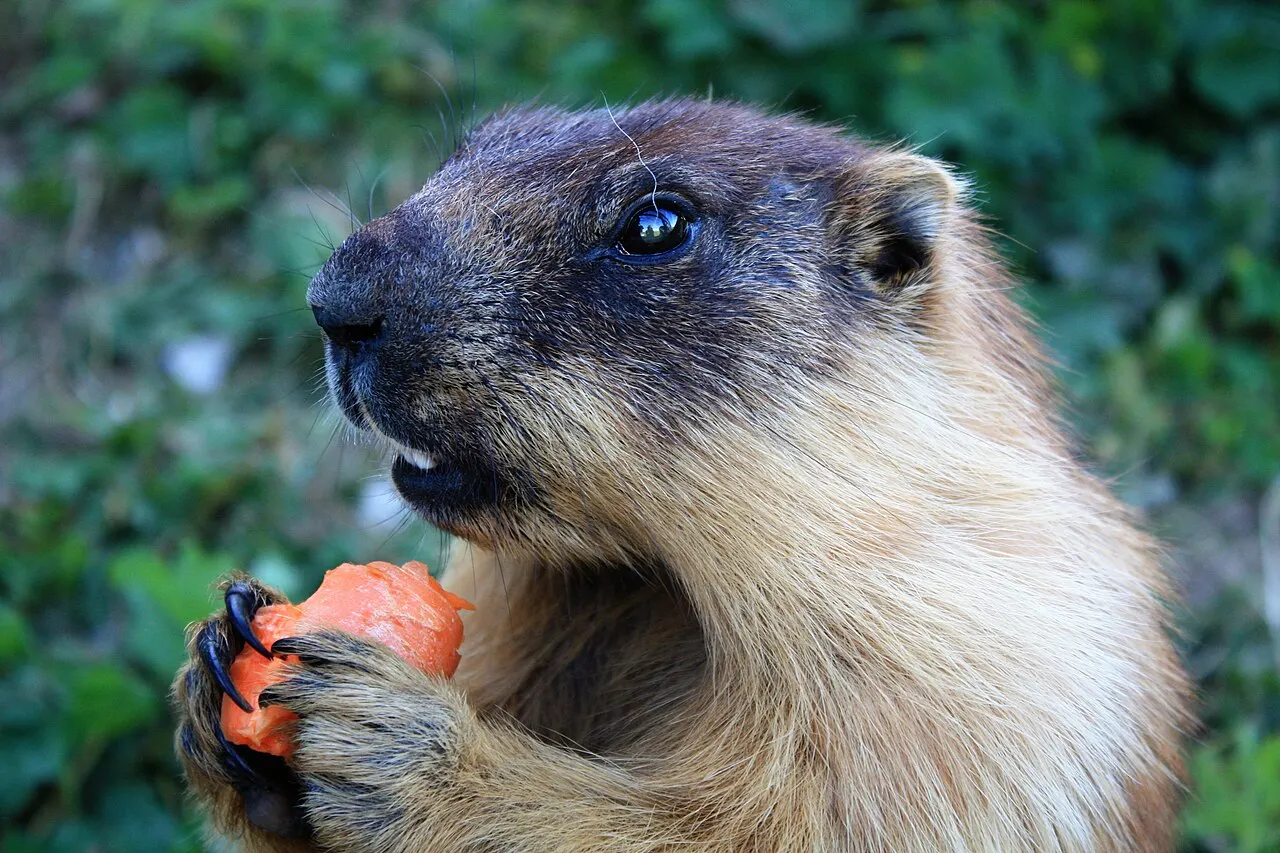
It's a stocky, medium-sized marmot. Adults of both sexes average roughly 6 to 8 kg, with males tending to be a little larger and heavier than females. The cheeks are yellow, and the fur grows from about 11 to 20 mm in summer to as much as 30 mm in winter.
Animals are reportedly heaviest in autumn, just before hibernation, which is also when hunters go after them.
Where it lives
The range runs through most of Mongolia, into Russia (southwestern Siberia, Tuva and Transbaikalia) and into Inner Mongolia and Heilongjiang in China. It reaches south to the Dzungarian Basin and the Gobi. The Red List records it from sea level up to 3,800 m, in temperate grassland and shrubland.
It is one of only two marmot species that live in lowland country. The groundhog is the other.
Pins are Wikidata “endemic to” fields. Orange dots, when present, are GBIF occurrence tiles — survey bias included.
How it lives
Tarbagans are social, colonial rodents that eat steppe grasses. Families keep summer burrows and separate hibernation burrows, and each family group hibernates together. In a 2021 monitoring report from Mongolia's Zavkhan province, five reintroduced families that went into hibernation held 4 to 6 animals each.
The burrows matter to other wildlife. In a radio-tracking study at Ikh Nart Nature Reserve in 2006, published in Oryx in 2009, ten collared corsac foxes rested in marmot burrows on 53 percent of their daytime fixes, more often than in other burrows. Gray wolves and golden eagles also rely on marmots as food.
Why it is in trouble
Marmots are hunted in Mongolia for food, fur and body parts. The Red List lists deliberate hunting as an ongoing threat and estimates a reduction of about 50 percent over the period it assessed, based on direct observation and levels of exploitation. The population is also fragmented. A 2009 Oryx paper gave national numbers of about 40 million in 1940 and about 5 million in 2001, a fall of more than 85 percent. Mongolian researchers say the decline sped up after the country moved to a market economy in the 1990s.
Plague complicates things. Outbreaks in Mongolian marmot populations have led to quarantines and marmot eradication programmes, and people can catch the disease from fleas or by eating infected meat.
What is being done
Mongolia has banned commercial and recreational hunting since the 2000s, but a 2021 report by a park ranger specialist and an Institute of Biology researcher judged these bans ineffective so far. The species occurs in at least one protected area, though the Red List records no recovery plan or systematic monitoring.
Reintroduction is under way. In 2020 and 2021, 50 marmots were moved in two stages from Arkhangai and Zavkhan provinces to sites in Tarvagatai National Park's area, where local colonies had dwindled or vanished. In the first stage, 25 animals were captured as whole families. That group grew by 13.6 percent in a year, with pup mortality of 25 percent. It's a small trial, but an encouraging one.
Sources
Written for this catalog in our own words from the sources below, checked against them on 12 November 2026. Population figures are estimates and carry the year they were made. Status and assessment year: IUCN. 2026. The IUCN Red List of Threatened Species. Version 2026-1. iucnredlist.org.