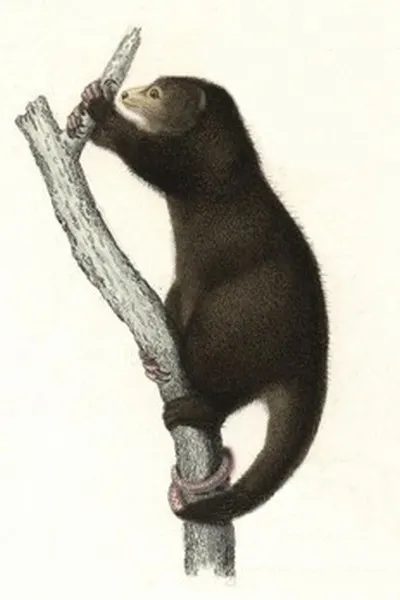
Critically Endangered
Talaud Bear Cuscus
Ailurops melanotis
The Talaud bear cuscus (Ailurops melanotis) is a shy, tree-living marsupial found on a handful of small islands in North Sulawesi, Indonesia, mainly Salibabu in the Talaud group. The IUCN rated it Critically Endangered in 2016, with hunting for meat and forest loss driving a continuing decline.
How to recognise it
It is a bear cuscus, a tree-living marsupial of the possum family that spends its life in the canopy. It reportedly grips branches with a prehensile tail, and its species name, melanotis, refers to black ears. When alarmed it reportedly gives off a strong musk.
Published accounts give no size or colour description. Its only relative in the genus is the Sulawesi bear cuscus.
Where it lives
The type locality is Lirung, on Salibabu in the Talaud Islands. A 2020 survey led by Terri Repi found it on Salibabu, Nusa and Bukide, all in North Sulawesi and each under 750 square kilometres. The survey authors think it probably also occurs on Sahandaruman mountain on Sangihe, which they did not survey. The Red List assessment treats the range as a single location and lists lowland moist forest as its main habitat, with degraded forest and gardens used only marginally.
Pins are Wikidata “endemic to” fields. Orange dots, when present, are GBIF occurrence tiles — survey bias included.
How it lives
It eats leaves. A three-month study on Salibabu in 2016 found it feeding on 22 plant species, 20 trees and 2 lianas, with young leaves making up 57 percent of what it ate, then leaf stalks, mature leaves and buds. It spent about 78 percent of its time resting and 15 percent moving. Repi describes it as quiet, shy and lazy. When people appear it slowly covers itself with leaves, so it has to be spotted first, and hunting has made it warier.
Why it is in trouble
Hunting for meat is the main threat. On Salibabu, cuscus meat has traditionally been spiced and eaten while drinking, a custom called tola-tola. Hunting it is illegal because the species is protected in Indonesia. Forest is also being converted, and the Red List records housing and settlement as an ongoing pressure. All three island populations are very small. Repi's 2020 survey estimated about 29 animals on Salibabu, 19 on Nusa and 10 on Bukide, with density estimates of 3.7, 12.3 and 7.2 animals per square kilometre.
A follow-up survey by Progres Sulawesi in early 2022 found the species at only one transect on Salibabu, where the 2020 work had recorded it across six. The group's leader said this could signal serious decline, but rainy weather and the animal's secretive habits might also explain it. More surveys were planned.
What is being done
Progres Sulawesi runs a community programme on Salibabu with young people, traditional and religious leaders, village officials and schools. It prefers local agreement to criminal penalties, and formalises agreements as village regulation. The villages of Musi and Alude have declared protection for the cuscus, and Sereh and Kalongan recently agreed to ban hunting, as a step toward an island-wide ban. Reports include the cuscus becoming easier to find near Alude. The Red List notes that conservation sites have been identified over its whole range.
Sources
Written for this catalog in our own words from the sources below, checked against them on 12 November 2026. Population figures are estimates and carry the year they were made. Status and assessment year: IUCN. 2026. The IUCN Red List of Threatened Species. Version 2026-1. iucnredlist.org.
- IUCN Red List assessment, Ailurops melanotis (2016)
- Repi et al. 2020, Biodiversitas 21(12), population density and distribution
- Repi et al. 2019, Biodiversitas 20(9), Salibabu study
- Mongabay, 22 June 2022, Talaud bear cuscus
- Eco-Business, Talaud bear cuscus championed by island conservationists
- Mammal Diversity Database, Ailurops melanotis
- Wikipedia, Talaud bear cuscus




