Endangered
Takydromus dorsalis
Takydromus dorsalis
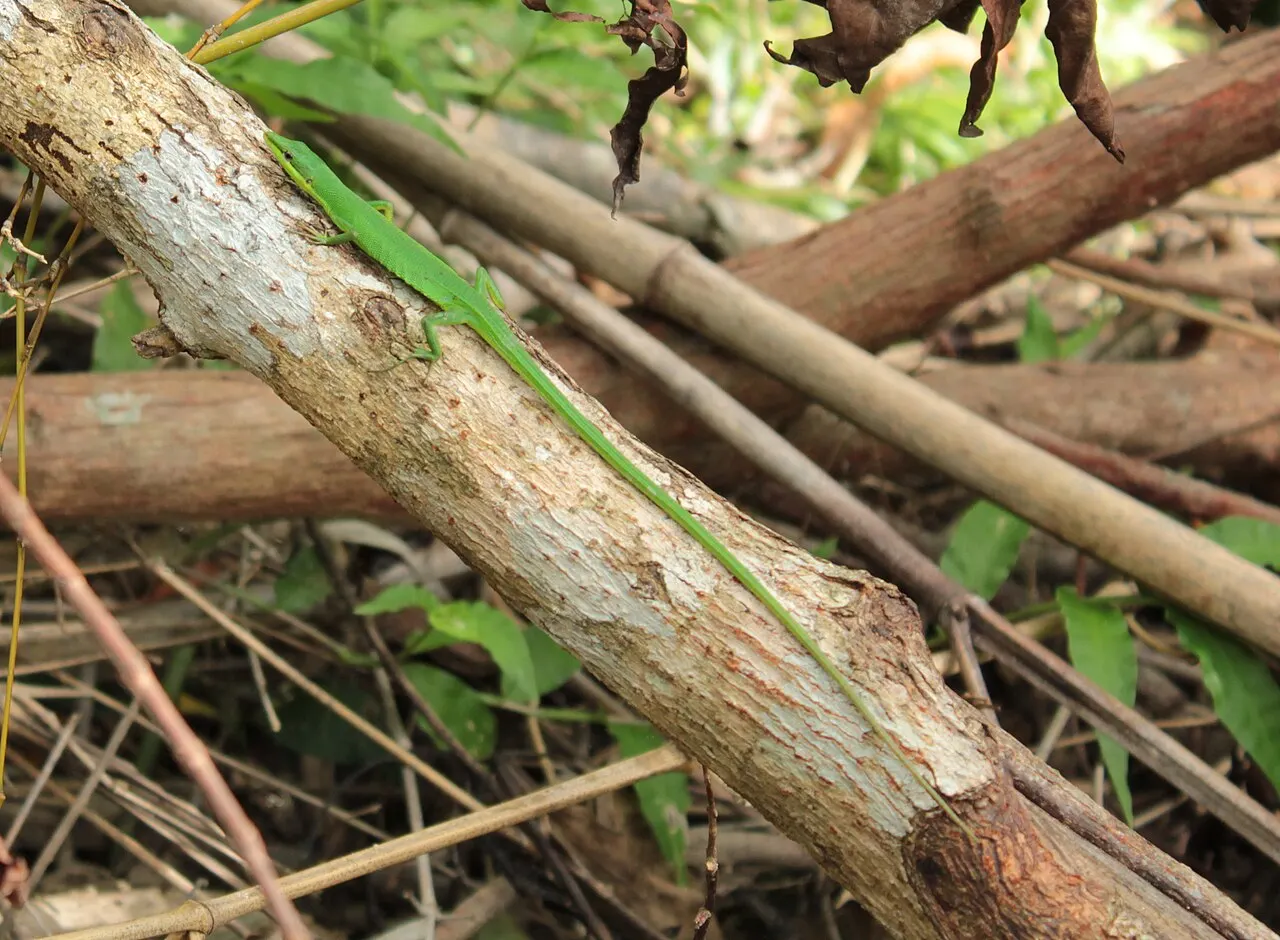
The Sakishima grass lizard (Takydromus dorsalis) is a slender, long-tailed lacertid found only on a few islands of the Yaeyama group in southern Japan. The IUCN rated it Endangered in 2017, with a decreasing population. Its dry forest and grassland homes are being altered, and invasive peafowl share them.
How to recognise it
Like other grass lizards, this one is built for running through low vegetation. Its tail is very long, at least three times the length of the head and body together. The scales along its back are small and not lined up in neat lengthwise rows, which is reportedly what its Latin name, dorsalis, refers to.
The original 1904 description by Stejneger adds a few more details. A light stripe runs from the nostril to the ear, but there is no stripe on the body, and the large belly scales form six rows.
Where it lives
The species is endemic to the Yaeyama Islands in the southern Ryukyu chain of Japan. The IUCN lists Ishigaki, Iriomote, Kohama and Kuroshima. The Reptile Database names Ishigaki as the type locality and mentions only that island, so accounts differ slightly on the exact range.
The IUCN gives its habitat as dry tropical and subtropical forest and dry grassland. It counts five subpopulations across four locations (each island is treated as one), with an area of occupancy of about 529 square kilometres and an extent of occurrence of about 1,598 square kilometres. It occurs in at least one protected area.
Pins are Wikidata “endemic to” fields. Orange dots, when present, are GBIF occurrence tiles — survey bias included.
How it lives
This lizard is active by day. Females lay eggs in clutches of one or two, in spring and summer.
A 2014 study by Takenaka, cited in the IUCN assessment, found that young lizards favour grassland and shrubs, while adults spend more time in trees, on leaves and branches. A stable population probably needs a mix of habitats: humid ground for laying eggs, grassland for juveniles and patches of forest for adults. Published detail on diet and lifespan is thin.
Why it is in trouble
The assessment lists several ongoing pressures without ranking most of them. Small-holder farming and grazing affect part of the range, and roads, tourism and recreation areas add to it. Invasive peafowl are named as a threat affecting a minority of the range.
On Iriomote, farmland improvement and road building have removed some of the forest and grassland mosaic the lizard needs. Most of Kuroshima is pasture, and more intensive grazing there may have stripped out shade-giving vegetation.
The IUCN records a continuing population decline and a continuing decline in habitat area, though not in the number of locations. Resource and habitat protection is the conservation action it lists.
Sources
Written for this catalog in our own words from the sources below, checked against them on 12 November 2026. Population figures are estimates and carry the year they were made. Status and assessment year: IUCN. 2026. The IUCN Red List of Threatened Species. Version 2026-1. iucnredlist.org.




