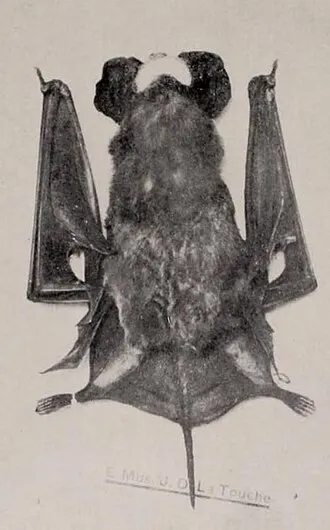
Endangered
La Touche's free-tailed bat
Tadarida latouchei
La Touche's free-tailed bat (Tadarida latouchei) is a cave-roosting bat with scattered populations in northeast China, Laos and Thailand, plus a few stray records in Japan. The IUCN Red List rated it Endangered in its 2020 assessment, which gives a population figure of about 200 and a continuing decline.
How to recognise it
Measurements in the Handbook of the Mammals of the World give a head and body length of 67 to 72 mm, a tail of 41 to 49 mm, ears of 22 to 27 mm and a forearm of 53 to 57 mm.
The fur is short, soft and velvety, dark brown or grayish brown above and paler below. The upper lip is wrinkled, and the large ears are joined by a narrow flap of skin across the forehead. A 2000 study in Mammal Study, based on a specimen from Japan, found it significantly smaller than the related Tadarida teniotis and Tadarida insignis, with thinner, rounder ears and shorter dorsal hairs.
Where it lives
The type specimen came from Chin-wang-tao, in what is now Hebei, China, and the bat was described in 1920 by Oldfield Thomas. The Handbook places it in northeast China (Liaoning, Inner Mongolia, Hebei, Beijing and Shandong), northern and central Laos, and Loei Province in northeast Thailand. The IUCN and the Mammal Diversity Database also list Viet Nam, which the Handbook does not.
Japan has three records, from Amami-Oshima, Kuchinoerabu-jima and Yoronjima, and the IUCN classes Japan as vagrant. The Kuchinoerabu-jima bat, reported in 2000, was only the second Japanese record. In Thailand the bat has been found in dry evergreen hill forest at about 1,500 m, and the IUCN lists temperate forest, tropical dry forest and caves as suitable habitat.
Pins are Wikidata “endemic to” fields. Orange dots, when present, are GBIF occurrence tiles — survey bias included.
How it lives
It roosts in caves, and a large colony has been recorded in Laos. The IUCN gives a generation length of about 3.9 years, and lists life history and ecology among its research needs.
Why it is in trouble
The IUCN assessment gives a population figure of 200 and a continuing decline. It puts a past reduction at 40%, with the basis given as levels of exploitation and the causes not understood. Use as human food is a recorded subsistence use of the species.
The listed threats are mining and quarrying, recreational activities, work and other activities, and intentional use of the species, each scored low impact. The Handbook, published in 2019, names hunting for food and roost disturbance as the main risks.
What is being done
The IUCN lists site protection, site management, resource and habitat protection, habitat restoration, species recovery and awareness work as actions needed, and records that conservation sites have been identified over the entire range. Research needs include population size and trends, habitat trends, threats and a species recovery plan.
Sources
Written for this catalog in our own words from the sources below, checked against them on 12 November 2026. Population figures are estimates and carry the year they were made. Status and assessment year: IUCN. 2026. The IUCN Red List of Threatened Species. Version 2026-1. iucnredlist.org.




