Endangered
Synophis bicolor
Synophis bicolor
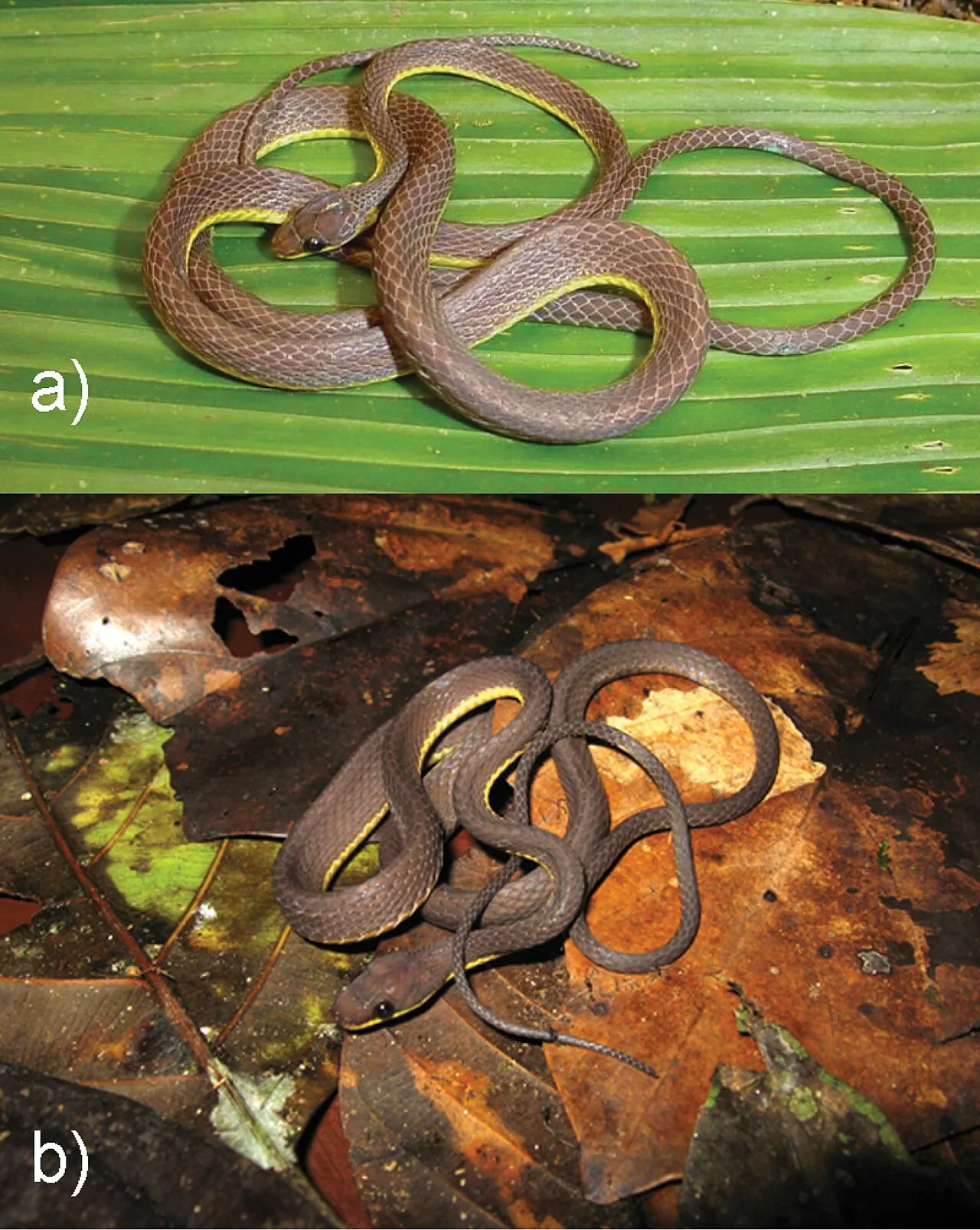
The bicolored shadow snake (Synophis bicolor) is a small, brown, little-known snake of lowland rainforest in Ecuador, with possible records from neighbouring Colombia. The IUCN Red List rates it Endangered (assessed 2020), with a decreasing population. Researchers are still sorting out which populations truly belong to this species.
How to recognise it
This is a slim colubrid snake, brown on the back and paler on the sides, with a yellowish white belly and upper lip. Its back scales are keeled (ridged) and arranged in 19 rows at midbody. It is often called the two-colored fishing snake, but there is no evidence that it eats fish.
The Reptile Database lists its diet as lizards of the family Gymnophthalmidae, small ground-dwelling lizards. It is described as nocturnal, living on the ground and in low bushes, and it lays eggs. Because the name has covered several species, some of these descriptions may blend more than one animal.
A species that is hard to pin down
Mario Peracca described the species in 1896 from a single specimen with a vague origin, recorded only as South America. That made later identifications difficult, since no one can go back to the type locality to collect comparison animals.
In 1964 Charles Bogert found that Ecuadorian snakes differed from the original specimen in scale counts and tooth numbers, and suggested they might not be the same species. A 2015 study in ZooKeys concluded that all earlier records from eastern Ecuador belong to a different species, Synophis bogerti, found at 1,000 to 1,750 m on the Amazonian slopes. Another 2015 ZooKeys paper, by Pyron and colleagues, concluded that numerous hidden species are likely present within S. bicolor. The range and numbers of the true species are therefore uncertain.
Where it lives
The Red List gives Ecuador as the country where the species is present, and Colombia as a place where it is possibly present. The assessment places it in moist lowland forest at roughly 200 to 300 m, estimates its extent of occurrence at 3,959 square kilometres and describes the population as severely fragmented. Some other sources also mention Andean cloud forest, but the IUCN assessment lists only lowland forest.
Pins are Wikidata “endemic to” fields. Orange dots, when present, are GBIF occurrence tiles — survey bias included.
Why it is in trouble
The assessment lists ecosystem conversion linked to agriculture (scale unrecorded) as an ongoing threat affecting most of the population, with very rapid declines. The area the species occupies is still shrinking, and the trend is decreasing.
What is being done
The species is not known to occur in any protected area, according to the 2020 assessment, which lists site and area protection as the action needed. Sorting out the taxonomy would help show which populations most need that protection.
Sources
Written for this catalog in our own words from the sources below, checked against them on 12 November 2026. Population figures are estimates and carry the year they were made. Status and assessment year: IUCN. 2026. The IUCN Red List of Threatened Species. Version 2026-1. iucnredlist.org.




