Endangered
Sutilizona pterodon
Sutilizona pterodon
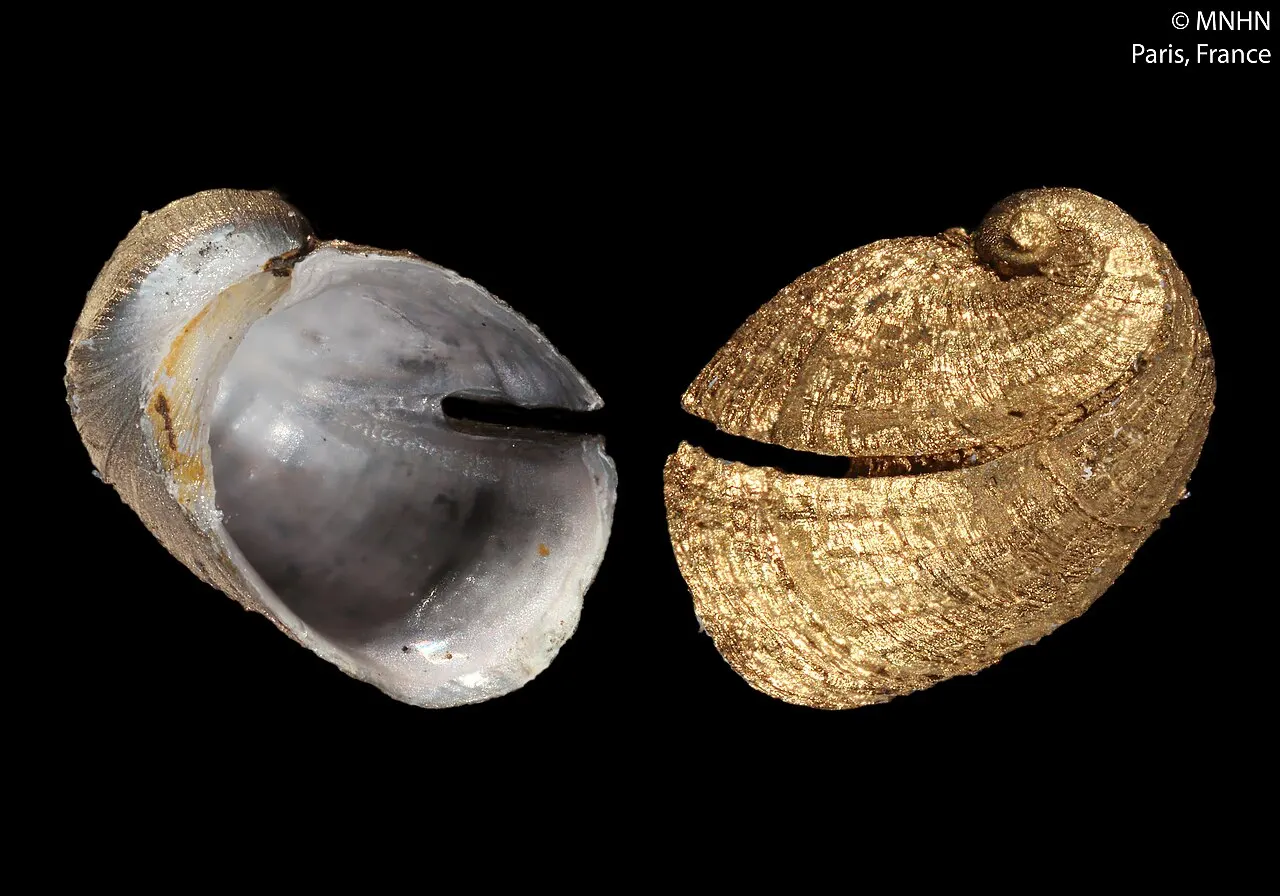
Sutilizona pterodon is a sea snail about 2 millimetres long that lives at hydrothermal vents on the deep Mid-Atlantic Ridge, at depths of 3,470 metres or more. The IUCN Red List assessed it as Endangered in 2020 because it occupies only a few square kilometres in two locations, in an area targeted for seabed mining exploration.
What it is
This is a tiny marine gastropod in the family Sutilizonidae, within the subclass Vetigastropoda. Warén and Bouchet described it in 2001.
The shell reaches about 2 millimetres. It has no widely used common name, only its scientific one.
Where it lives
The species is known from the Mid-Atlantic Ridge, the underwater mountain chain that runs down the middle of the Atlantic. The Red List counts just two locations, both in international waters, and gives its depth range as 3,470 to 4,080 metres. It estimates the area the snail actually occupies at only 8 square kilometres, within an overall extent of about 2,310 square kilometres.
The two locations are the Snake Pit vent field, near 23 degrees north, and the Ashadze-1 vent field, near 13 degrees north. A specimen record from Snake Pit lies at about 3,490 metres, and records from Ashadze, dated 2007, fall at about 4,090 metres. The snail lives at active black smokers and at sites of gentler, diffuse venting, and it is present over very small areas within each field. It is not a migrant.
Vents are patches of seafloor where hot, mineral-rich fluid rises through the rock. The populations have only been sampled by remotely operated vehicles, so the species is hard to study.
Pins are Wikidata “endemic to” fields. Orange dots, when present, are GBIF occurrence tiles — survey bias included.
Why it is in trouble
The one threat listed in the 2020 assessment is mining. Sulfide mineral deposits form at active vents, and the International Seabed Authority has granted 15-year exploration contracts (2015 to 2030) covering the region that includes both vent fields, to a French research institute (IFREMER) and the Russian government. Exploration licences allow some extraction and testing of mining technology, so disturbance may already be happening.
The assessment judges that mining could affect the majority of the species' range, between 50 and 90 percent. Sediment plumes from mining could spread 60 to 70 kilometres and smother nearby seabed communities. With only two locations, one disturbed field could hit a large share of the population.
The assessors found the threat level uncertain, somewhere between Vulnerable and Endangered, and took the cautious option of Endangered. No one knows whether numbers are going up or down. The population trend is listed as unknown, and no population count exists.
What is being done
Very little so far. The assessment records no conservation actions at either vent field, no recovery plan, no monitoring scheme, no protected area covering any of the population, and no captive population.
The IUCN lists international-level policy and protection of the species' resources and habitat as the actions needed. It recommends research into the effects of mining disturbance and into whether the snail lives at other vents along the ridge, and it says a reassessment would be merited if mining licence arrangements change substantially.
Sources
Written for this catalog in our own words from the sources below, checked against them on 12 November 2026. Population figures are estimates and carry the year they were made. Status and assessment year: IUCN. 2026. The IUCN Red List of Threatened Species. Version 2026-1. iucnredlist.org.




