Endangered
Sunset Lorikeet
Trichoglossus forsteni
The sunset lorikeet (Trichoglossus forsteni), called the scarlet-breasted lorikeet by the IUCN, is a nectar-feeding parrot of a few Indonesian islands in the Lesser Sundas. It was moved to Endangered in 2020, with an estimated 500 to 1,500 mature birds, and trapping for the cage-bird trade is the main threat.
How to recognise it
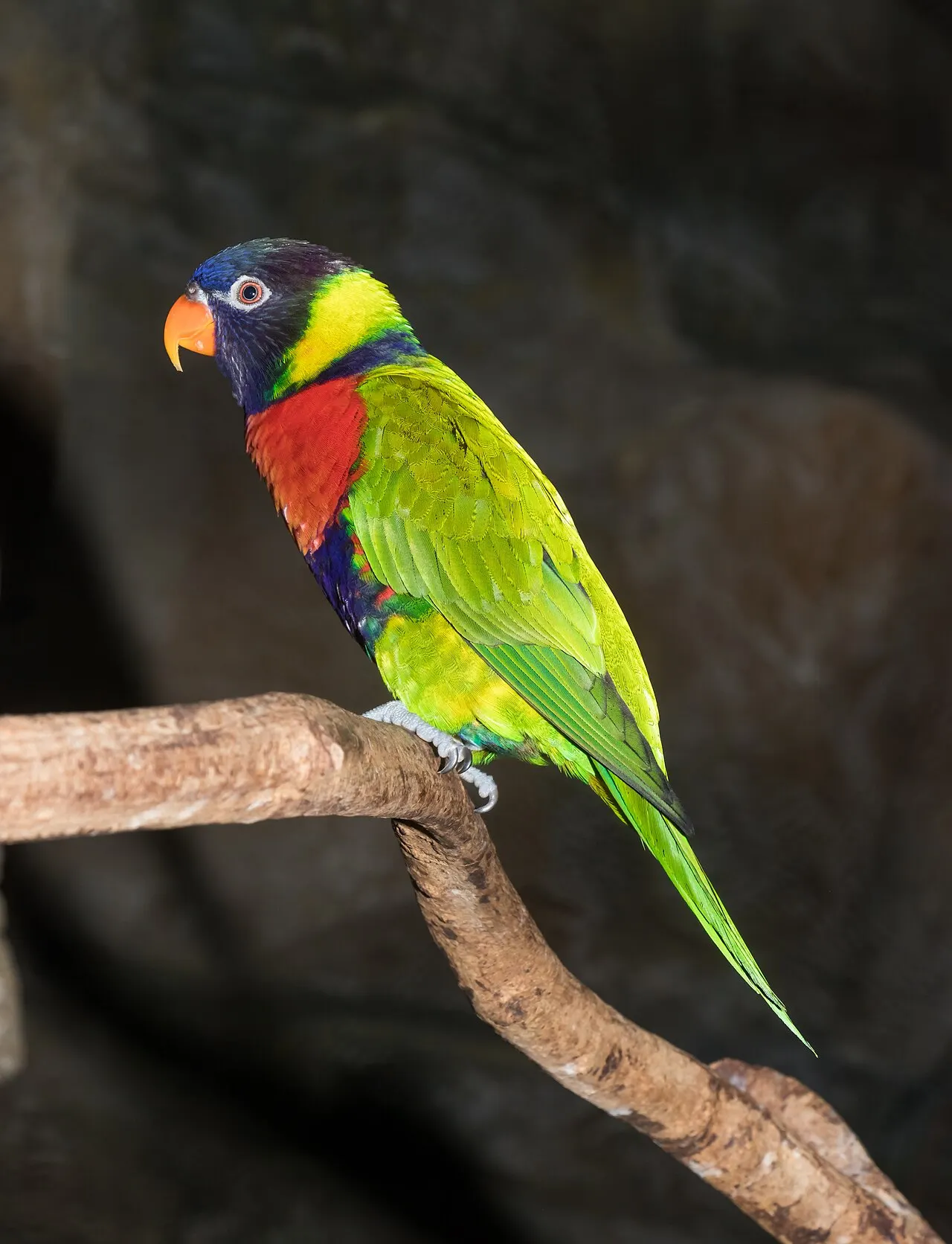
It is a medium-sized lorikeet, about 26 cm (10 in) long and 100 to 157 g. The head is dark bluish with a pale green nape or collar, the breast is red and the belly dark bluish, and the rest of the plumage is bright green. In flight it shows a yellow wing flash and deep red underwing. It is darker and more strongly marked than its relatives in the rainbow lorikeet group, and was long treated as a subspecies of the rainbow lorikeet until a 1997 review.
The IUCN counts the Bali and Lombok bird (Mitchell's lorikeet, mitchellii) and the forms from Tanah Jampea (djampeanus) and Kalaotoa (stresemanni) as part of this one species, alongside the nominate form from Sumbawa. Mitchell's lorikeet is smaller, with a blackish-brown head and a red-brown wash at the back of it. The Kalaotoa form has a paler orange-red breast.
Where it lives
Historically it occurred on Sumbawa, Lombok, Bali, Tanah Jampea and Kalaotoa, all in Indonesia. Recent records suggest it is now limited to parts of Bali (reaching the Banyuwangi area of Java), northern Lombok and parts of West Nusa Tenggara on Sumbawa, including around Mount Tambora. It is likely extinct on Tanah Jampea, Kalaotoa and Kalao, with no records there in the past 15 years, and birds released on Nusa Penida may not have persisted.
It uses lowland and lower montane forest, forest edges, secondary growth and plantations, tending to stay near disturbed vegetation rather than deep closed forest. On Sumbawa it ranges from sea level to 500 or 700 m and up to about 1,200 m, and on Lombok to about 2,150 m. The Red List also lists shrubland, marsh, swamp and mangrove forest, and even urban areas, among habitats it uses.
Pins are Wikidata “endemic to” fields. Orange dots, when present, are GBIF occurrence tiles — survey bias included.
How it lives
Mostly it feeds on nectar, with figs and insects as extras, and it visits man-made feeding stations. It travels in small, noisy groups, often alongside other parrots, and wanders to follow flowering trees. The IUCN classes it as nomadic. Birds roost together in groups that can number in the hundreds, and the usual flight call is a harsh, repeated screech.
It nests in a deep hole in a large tree and lays two or three eggs. Young fledge at about eight to nine weeks. Birds in breeding condition have been recorded in May on Sumbawa.
Why it is in trouble
Trapping for the pet trade is the primary threat. The IUCN suspects a decline of 50 to 79 percent over three generations (15 years), and counts 10 to 19 locations. It was rated Near Threatened in 2014, Vulnerable in 2016 and Endangered in 2020, so each assessment has been worse than the last. Bird markets in Bali and Java still sell lorikeets.
Sumbawa was once seen as the stronghold, but the assessors now think only a small, unstable population remains there. At Tatar Sepang a count of about 200 birds in 1997 fell to about 50 in 2003 and 6 in 2016. Forest clearing for maize has removed mature trees on Sumbawa, and burning for cashew plantations on the Flores Sea islands has probably contributed to local losses.
Mitchell's lorikeet is in the worst position. The World Parrot Trust puts it at fewer than 50 birds. On Bali, 6 or 7 were seen recently, although the IUCN says some of those could be escaped cage birds.
What is being done
The species is on CITES Appendix II and CMS Appendix II, and it is protected in Bali. The IUCN's recommended actions are to estimate the population and the scale of trapping, to survey for important sites so they can be protected, to study feeding ecology and forest fragmentation, and to run awareness campaigns that win local support against illegal trade. It records no recovery plan or monitoring scheme.
Since 2023 the World Parrot Trust has run a project with Taman Safari Bali, Paradise Park UK and West Bali National Park rangers on the Bali and Lombok birds. It uses workshops and educational material for all ages to reduce trapping.
Sources
Written for this catalog in our own words from the sources below, checked against them on 12 November 2026. Population figures are estimates and carry the year they were made. Status and assessment year: IUCN. 2026. The IUCN Red List of Threatened Species. Version 2026-1. iucnredlist.org.




