Endangered
Sumba eclectus
Eclectus cornelia
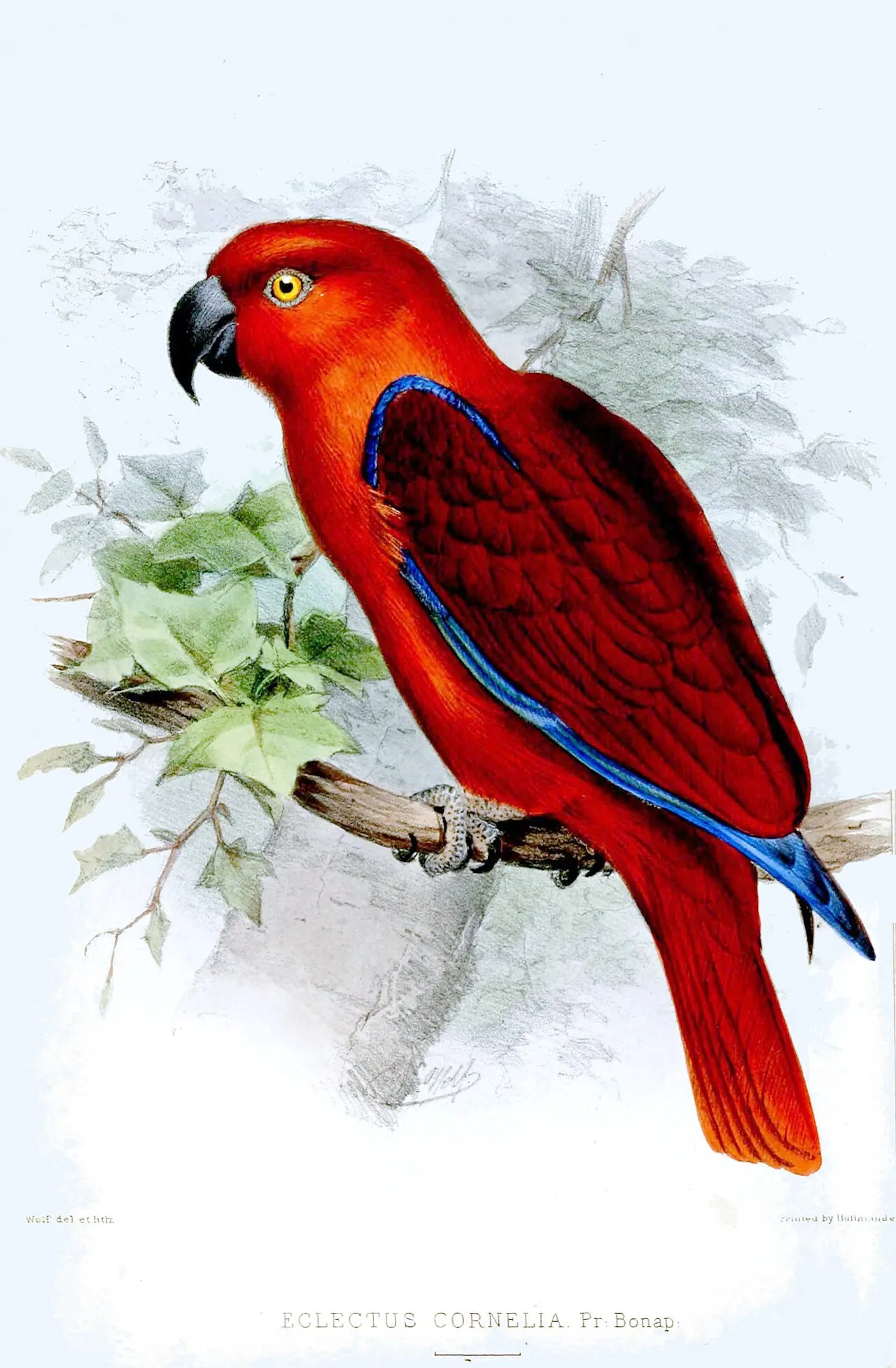
The Sumba eclectus (Eclectus cornelia) is a large parrot found only on the Indonesian island of Sumba. Males are green and females red. The IUCN rated it Endangered in 2019, with an estimated 1,000 to 2,499 mature birds and a declining trend. Trapping and the loss of big nest trees are the main pressures.
How to recognise it
It's about 35 cm long and weighs 450 to 600 g, and it's larger than other eclectus parrots. The sexes look so different that people once took them for separate species. Males are green with a paler head and neck and a tail washed with blue. Females are red over the whole body, with blue to lilac underwing coverts.
Young birds look like duller versions of their parents, with a greyer bill. The Sumba bird was long treated as a subspecies of the eclectus parrot and was split as its own species in 2019.
Where it lives
It occurs only on Sumba, in Indonesia's Lesser Sunda Islands, from sea level to about 1,000 m. Its habitats include lowland moist forest, dry forest, scrub, plantations and rural gardens. The IUCN counts six to ten locations and an extent of occurrence of about 13,500 square kilometres, with all birds treated as one population.
Pins are Wikidata “endemic to” fields. Orange dots, when present, are GBIF occurrence tiles — survey bias included.
How it lives
It eats fruit, seeds, nuts, buds and blossoms. Birds are usually seen alone, in pairs or in small groups, mainly at dawn and dusk, and a loud harsh screech often gives them away in flight. Breeding runs from about April to September, and a clutch is probably two eggs.
It nests only in natural cavities high in very large trees, mostly the deciduous Tetrameles nudiflora, which are hard for predators to climb. Females compete for these holes.
Why it is in trouble
Trapping for the local and international bird trade is the main pressure, and it favours females for their colour. Selective logging removes the big hollow trees the birds need, and the Red List also lists small-holder farming. It rates deliberate capture and unintentional take as affecting most of the population.
Counts are old. A survey of Sumba in 1989 and 1992, reported in a 1995 paper in Bird Conservation International, put the number at about 1,900 birds. The 2019 assessment gives 1,000 to 2,499 mature birds and notes that no systematic monitoring is in place.
What is being done
The species is in CITES Appendix II, and it occurs in at least one protected area. The IUCN lists trade management, habitat protection and captive breeding as needed actions, and records no recovery plan. Sources disagree on captive birds: one reports the species in zoos and bird parks in Spain and Germany, another says it is not kept outside Indonesia.
Sources
Written for this catalog in our own words from the sources below, checked against them on 12 November 2026. Population figures are estimates and carry the year they were made. Status and assessment year: IUCN. 2026. The IUCN Red List of Threatened Species. Version 2026-1. iucnredlist.org.




