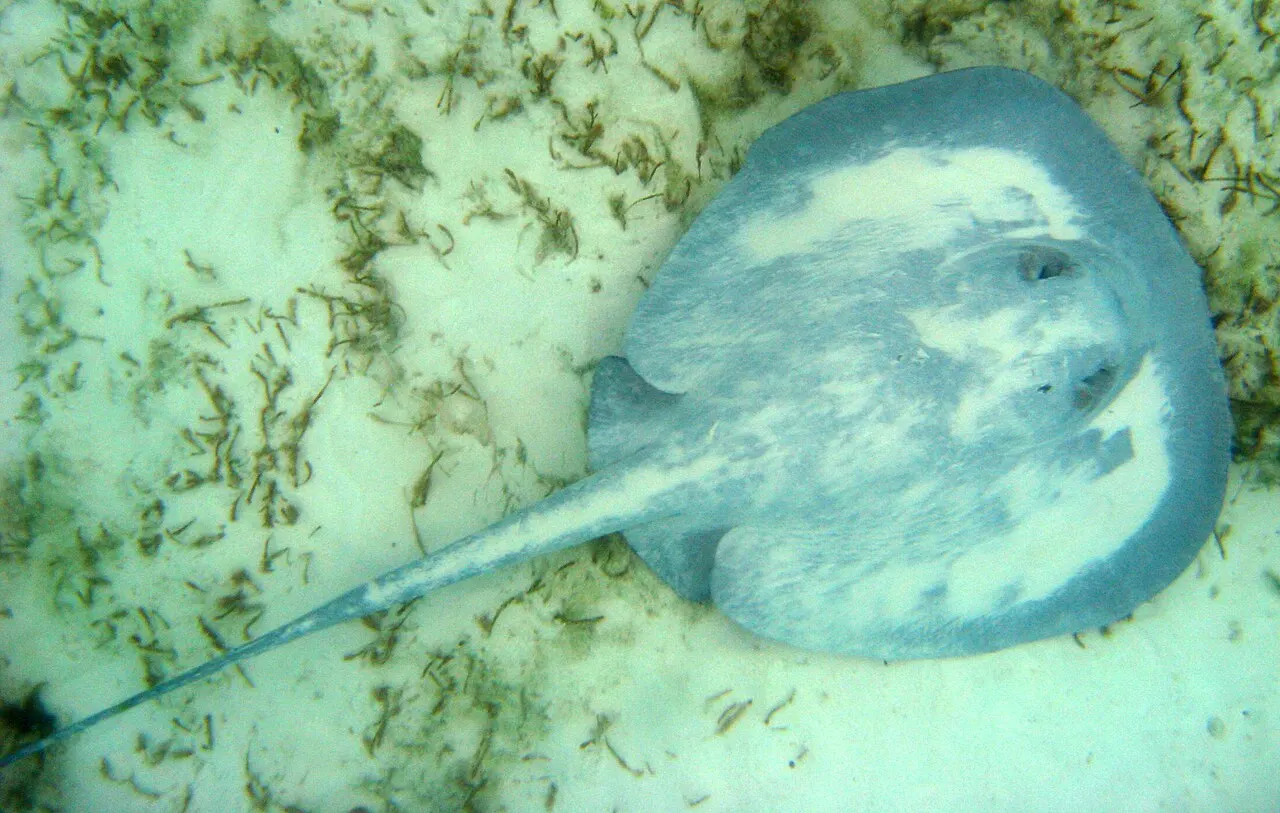
Endangered
Chupare stingray
Styracura schmardae
The chupare stingray, also called the Atlantic chupare, is a large grey-brown ray of sandy shallows, lagoons and mangroves in the western Atlantic, from Mexico and the Caribbean to northern Brazil. The IUCN Red List assessed it as Endangered in 2021, with numbers falling, mainly because of fishing.
How to recognise it
Styracura schmardae is a big, broad-bodied stingray. Its disc is oval to nearly round, and its slender tail carries a serrated spine in the latter half. The back is dark brown, grey or olive, with no markings, and the underside is yellowish white. Large, flattened denticles cover the disc, and the shoulders carry enlarged pearl-like thorns.
Maximum disc width is given as 1.8 m (6 ft) by one field profile and 2 m (6.6 ft) by FishBase, a Mexican fish guide and an encyclopedia article. It can be confused with the southern stingray (Hypanus americanus), which is uniformly grey with rows of thorns along the back and shoulders. Its Pacific relative, the Pacific chupare (Styracura pacifica), is reportedly much smaller, with a more pointed snout and a single shoulder thorn.
Where it lives
It is a western Atlantic species. The IUCN lists it from Mexico, Central America and the Caribbean islands, and from Colombia, Venezuela, the Guianas and Brazil, in about 40 countries and territories in all. It lives from the surface down to about 50 m (165 ft), over sand, mud and seagrass, among mangrove roots, in estuaries and around coral reefs.
Snorkellers report seeing it fairly often in mangrove-fringed lagoons. One observer has recorded it in Oyster Bed Lagoon on Utila, Honduras, and in Nichupte Lagoon near Cancun, Mexico.
Pins are Wikidata “endemic to” fields. Orange dots, when present, are GBIF occurrence tiles — survey bias included.
How it lives
Life history is poorly known. It spends the day half buried in sand, and it has been watched foraging in shallow mangrove lagoons for animals that stay in one place. One fish guide lists crustaceans, molluscs, worms and small bony fish as prey, but diet has not been properly studied. Like other stingrays it gives birth to live young. Embryos reportedly live on a yolk sac for roughly the first sixty days, then on a nutrient-rich fluid from the mother, and pups are born as miniature adults. Litter size and size at birth are unrecorded.
The IUCN uses a generation length of 25 years for the species.
Why it is in trouble
The assessment records a decreasing trend and a past reduction of 50 to 79%, based on actual or potential levels of exploitation. Fishing is the main threat. The ray is caught in nets and on hooks, both by accident and on purpose, by small-scale and commercial boats. Its meat is sold salted, and it is also used for gelatin and oil.
Habitat loss from housing, tourism, industry and aquaculture on the coast adds to the pressure. One conservation profile says the species was common in Colombia, Venezuela and northern Brazil in the 1970s but is now rarely seen there, and that Caribbean populations appear steadier where fishing pressure is low.
What is being done
Not much has been done specifically for this ray. The IUCN notes that it occurs in at least one protected area, but records no recovery plan, no monitoring scheme and no harvest management plan, and says it is not subject to international trade controls. The assessment calls for harvest and trade management, species recovery work and site protection. A Mexican fish guide reports no management of its catch, and landing data for rays in the region are thin.
Sources
Written for this catalog in our own words from the sources below, checked against them on 12 November 2026. Population figures are estimates and carry the year they were made. Status and assessment year: IUCN. 2026. The IUCN Red List of Threatened Species. Version 2026-1. iucnredlist.org.




