Endangered
Streptocephalus woottoni
Streptocephalus woottoni
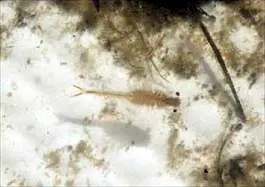
The Riverside fairy shrimp (Streptocephalus woottoni) is a small freshwater crustacean of seasonal rain pools in Southern California and northern Baja California. The IUCN Red List assessed it as Endangered in 1996. It spends most of each year as dormant eggs in dry soil and appears only after winter rains fill its pools.
How to recognise it
Adults measure about half an inch to an inch (roughly 12 to 25 mm). Males can be told from other fairy shrimp mainly by their second pair of antennae, and females carry their eggs in an oval or elongated brood sac on the underside of the body.
The species was described in 1990 by Eng, Belk and Eriksen, from a site at Murrieta in Riverside County.
Where it lives
It lives in vernal pools and other bare, short-lived pools. Reportedly it needs pools at least about 30 cm deep.
In the United States it has been recorded in Ventura, Riverside, Orange and San Diego counties, and historically also in Los Angeles County and north-western Baja California, Mexico. One encyclopedia account counts five sites in Riverside and San Diego counties plus two in northern Baja California, but that count is dated. Several populations have vanished, including the one at the original collecting site in Murrieta, one in the Peninsular Ranges foothills and one at Costa Mesa.
Pins are Wikidata “endemic to” fields. Orange dots, when present, are GBIF occurrence tiles — survey bias included.
How it lives
Rain sets the schedule. Eggs lie in the dried pool bed until water returns, then hatch. The shrimp mature and reproduce within about 7 to 8 weeks, depending on water temperature. They are usually seen between January and March.
They feed on algae, bacteria, protozoa, rotifers and scraps of detritus. The eggs are cysts that tolerate drying. Some drop to the pool bottom, while others stay in the brood sac until the female dies. All of them wait in the soil for the next wet season.
Why it is in trouble
Habitat loss is the main problem. The U.S. Fish and Wildlife Service lists habitat loss, the indirect effects of development, fragmentation, non-native plants, climate change and fire as threats. A pool can be filled in or paved, but it can also be damaged by changes to the surrounding land that alter how and when water collects.
The IUCN assessed the species as Endangered in 1996, under criterion A2c, and that assessment gives no population estimate or trend. Several known populations have already been lost.
What is being done
The species was listed as endangered under the U.S. Endangered Species Act in 1993. In December 2012 the Fish and Wildlife Service announced 1,724 acres of critical habitat in parts of Ventura, Orange and San Diego counties. That was down from about 2,984 acres proposed in 2011, because some land was excluded or already covered by military management plans.
Sources
Written for this catalog in our own words from the sources below, checked against them on 12 November 2026. Population figures are estimates and carry the year they were made. Status and assessment year: IUCN. 2026. The IUCN Red List of Threatened Species. Version 2026-1. iucnredlist.org.




